Analysis
Druze in Syria: resistance and survival under the new jihadist regime
Since the new Syrian government, led by jihadist Ahmed al-Sharaa, took power, this ethno-religious minority has experienced increasing sectarian violence, culminating in the recent bloody clashes. Israel, where this community lives in freedom and security, decided to intervene in their defense.

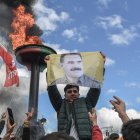
A young Druze hangs the image of Hikmat al-Hijri, spiritual leader of his community in Syria.

The Druze community in Syria—a religious and ethnic minority making up about 3% to 4% of the population (roughly 700,000 people, primarily in the As-Suwayda province)—has faced significant challenges both under dictator Bashar al-Assad’s regime and the new government led by jihadist Ahmed al-Sharaa (formerly known as Abu Mohammed al-Golani), who took power following Assad’s ouster in December 2024.
Clashes recently erupted between Druze forces and Bedouin tribesmen in the southern city of As-Suwayda, resulting in hundreds of deaths and injuries. In response, regime forces decided to intervene. Additionally, jihadist fighters allied with the government also joined the fighting, heightening concerns among the Druze community.
Historical context: the Druze under the Assad regime
The Druze, an Arabic-speaking ethno-religious group whose monotheistic faith combines elements of Islam, Gnosticism, and other traditions, have maintained a complex relationship with the Assad regime. They primarily live in Syria, Lebanon and Israel, with a total population of about one million.
During the Syrian governments of Hafez al-Assad (1971–2000) and later his son Bashar, the Druze enjoyed limited cultural and religious autonomy but remained politically marginalized.
During the Syrian civil war (2011–2024), the Druze in As-Suwayda largely remained neutral, avoiding full alignment with either the regime or the rebels. However, some Druze opposed Assad through protests—particularly in 2023—due to economic decline and the growing influence of Iran and Hezbollah in the region. At the same time, they faced threats from extremist groups like the Islamic State, which carried out a massacre in As-Suwayda in 2018, killing 258 Druze.
The transition to the Al-Sharaa regime
Following the fall of Bashar al-Assad on December 8, 2024, Ahmed al-Sharaa, leader of the jihadist group Hayat Tahrir al-Sham (HTS), emerged as the central figure in the transitional government, formally assuming the presidency on January 29, 2025. Al-Sharaa, who previously led the al-Nusra Front (affiliated with al-Qaeda), has sought to project an image of moderation, advocating for pluralism and the inclusion of minorities such as the Druze, Alawites, Christians, and Kurds. However, his jihadist background and the actions of HTS-affiliated militias have generated skepticism among the Druze, who fear forced Islamization and the loss of their autonomy.
In his first statements after the seizure of Damascus, Al-Sharaa promised to integrate all communities and dissolve the armed factions into a unified army. However, the Druze have resisted these efforts, insisting on maintaining their local militias to protect their region. This resistance has sparked tensions and episodes of violence, especially in As-Suwayda, where the Druze make up the majority.
Sectarian violence and tensions in As-Suwayda
Since Assad’s fall, the Druze have faced escalating sectarian violence. Recently, clashes broke out between Druze militias and government-allied Bedouin tribes in As-Suwayda, leaving at least 248 dead—including government soldiers and several Druze civilians.
The violence erupted following the kidnapping of a Druze trader, which heightened intercommunal tensions. Additionally, a forged recording insulting the Prophet Muhammad—attributed to a Druze leader—was used by extremist groups to incite attacks against the community, including summary executions and acts of humiliation, such as forcibly shaving Druze men’s beards.
The Druze spiritual leader, Hikmat al-Hijri, condemned what he called a “total war of extermination” against his community and appealed for international protection.
Israel's response and regional dynamics
Israel has actively intervened in support of the Druze, launching airstrikes against Syrian government forces advancing toward As-Suwayda. The Israeli government, led by Prime Minister Benjamin Netanyahu and Defense Minister Israel Katz, has declared it will not tolerate attacks against the Druze, citing historical ties with the Druze community in Israel. These strikes, which continued despite U.S. efforts to normalize relations between Jerusalem and the new Syrian government, highlight Israel’s concern about instability along its northern border and the potential resurgence of hostile militias.
On the other hand, Turkey—a key ally of HTS—has supported Al-Sharaa but has also sought to neutralize Kurdish forces in northeastern Syria, adding complexity to the regional dynamics. Caught between these external powers and Islamist militias, the Druze face an uncertain future.
Prospects and challenges
The Druze community in Syria stands at a crossroads. While the new Al-Sharaa regime promises inclusiveness, its jihadist origins and the Druze’s limited representation in government have fostered deep distrust. At the same time, the Druze resistance to disarmament and their pursuit of autonomy have sparked clashes with government forces and allied militias.
Human rights organizations and international observers have warned of the risk of a new wave of sectarian violence in Syria, particularly targeting minorities such as the Druze, Alawites, and Christians.

The Druze in Israel: stability and integration
Unlike the Druze in Syria, the approximately 150,000 Druze in Israel—about 2% of the population—enjoy full citizenship and voting rights. They are active in politics, with representatives in the Knesset (Israeli Parliament) and holding government positions.
In addition, the Druze have an educational system that respects their cultural and religious identity, with schools teaching in Arabic and promoting Druze heritage. This contrasts sharply with fears of Islamization in the Syrian education system under Al-Sharaa.
The Druze are regarded as a community loyal to the state, with a high level of political integration.
A distinctive aspect of the Druze in Israel is their mandatory military service, unlike other Arab minorities. Since 1956, Druze have served in the Israel Defense Forces (IDF), holding prominent positions in elite units and achieving high ranks, including brigadier general.
Their communities, located mainly in northern Israel, live in an environment of relative security, without facing the sectarian violence suffered by their counterparts in Syria. Moreover, the Jewish state has shown an active commitment to the protectionof the Druze, not only on its territory but also in Syria, through airstrikes against forces threatening the Druze community in As-Suwayda.
In Israel, the Druze maintain astrong cultural and religious identity, with community institutions of their own and freedomto practice their faith. Although culturally Arab, many Israeli Druze identify themselves as a distinct community, with a narrative of loyalty to the state that sets them apart from many Israeli Arabs.
The historical origin of the Druze faith and an active diaspora
In the diaspora, especially in countries such as the United States, Canada and Australia, Druze have established communities that preserve their cultural identity through associations and festivals. For example, the American Druze Society organizes annual events to promote Druze heritage, highlighting their literature, music and traditions, adapting to modern contexts without losing their essence.
LATEST