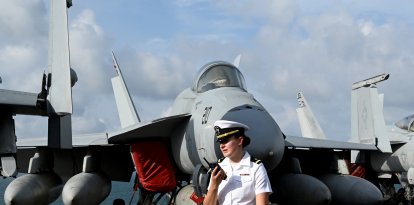
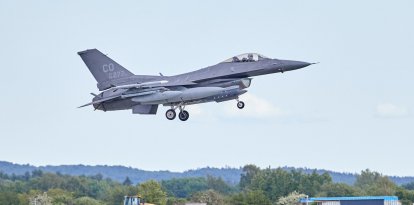
The US Navy awards Boeing a contract worth more than $20 billion to build its sixth-generation fighter jet
The acquisition of the F/A-XX is part of the doctrine of maintaining peace through military strength in the face of global competitors.
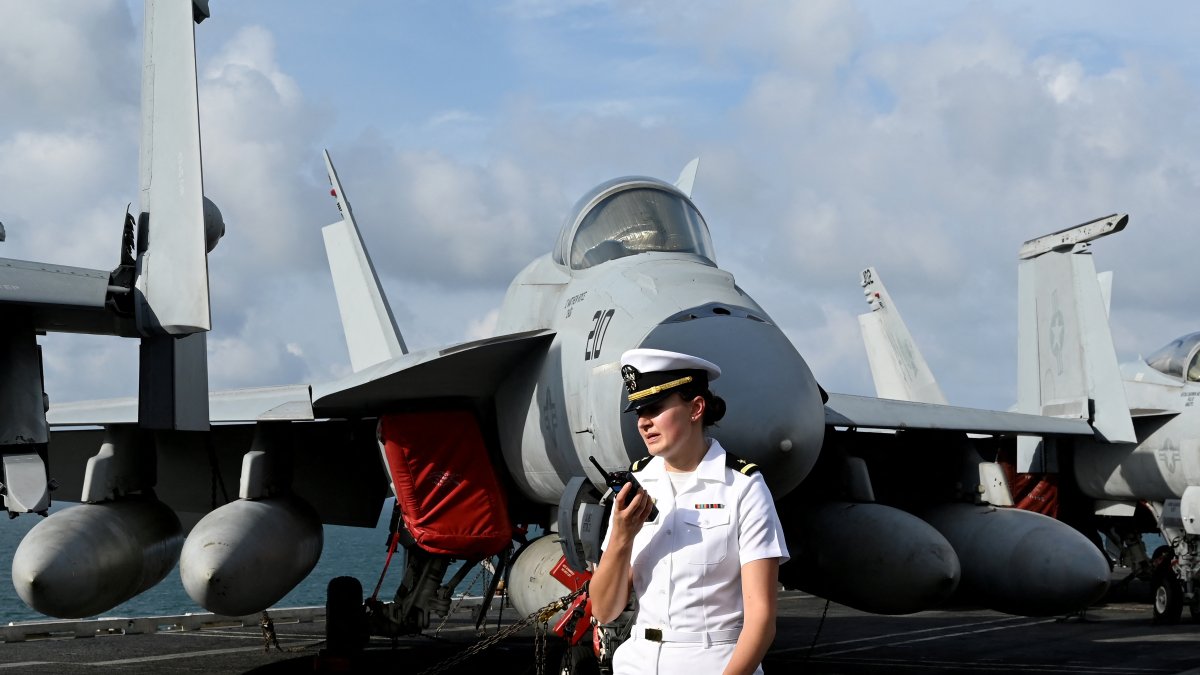
A U.S. Navy sailor stands next to an aircraft on the deck of the aircraft carrier USS George Washington.

The Department of Defense announced on Tuesday that it had awarded Boeing a contract valued at more than $20 billion for the large-scale development of the F/A-XX, the Navy's new sixth-generation strike fighter.
Designed as part of the Next Generation Air Dominance program, the aircraft will operate from aircraft carriers and aims to expand the operational range of naval forces, ensuring deterrence and combat capabilities in highly contested environments.
The investment will fund the construction of multiple test units for ground evaluations, airworthiness testing, and integrating advanced weapons systems. With this contract, Boeing consolidates its second sixth-generation fighter program after previously being selected in 2025 to develop the Air Force's F-47.
Steve Parker, president and CEO of Boeing Defense, Space & Security, noted that the company had previously invested in leading both programs simultaneously from its St. Louis, Missouri, manufacturing facility.
Strategic deterrence and peace through strength
The acquisition of the F/A-XX is part of the doctrine of maintaining peace through military strength in the face of global competitors.
"The F/A-XX is a critical pillar of our commitment to maintaining peace through strength. The F/A-XX will dominate contested airspace, extend operational range, and provide a decisive advantage in combat," Under Secretary of War for Acquisition and Sustainment Michael P. Duffey stated, who described the investment as non-negotiable for national security.
For his part, Acting Secretary of the Navy Hung Cao emphasized that the program's launch marks a new era for naval aviation.
"The sixth-generation fighter represents a generational leap in air superiority and will provide the world's best pilots with unmatched capabilities to fight, win, and return home safely," the military official stated.
Manned integration and generational replacement for the 2030s
Unlike traditional platforms, the F/A-XX will serve as an interconnected core that can operate alongside piloted aircraft and unmanned combat drones (Collaborative Combat Aircraft).
This technological synergy will enhance the fleet's offensive and reconnaissance capabilities, multiplying the tactical effectiveness of the accompanying unmanned aerial vehicles.
Starting in the 2030s, the new fighter will begin to gradually supplement and replace the F/A-18E/F Super Hornet fighters and the EA-18G Growler electronic warfare aircraft. In the Navy's future operational framework, the aircraft will share the deck and engage in high-intensity combat missions alongside the fifth-generation F-35C fighters.

History
Hispanics in World War II: The forgotten effort that changed the United States
Carlos Dominguez

Technology
Elon Musk backs Donald Trump's agenda and foresees an era of superabundance driven by artificial 'superintelligence'
Andrés Ignacio Henríquez

LATEST