ANALYSIS
What is 'Cartel de los Soles' and why is it called that? All the details of the drug trafficking network run by Nicolás Maduro, according to the Trump Administration
Why, for Donald Trump, is this criminal organization to blame for the deaths of so many Americans? Does a cartel really rule Venezuela, or is it an exaggeration?

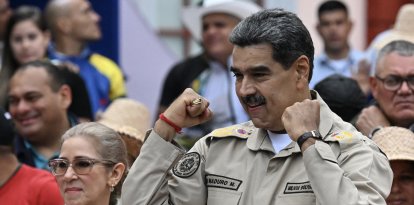
Nicolás Maduro's fence after July 28 in Caracas.

Ever since the Trump administration put them in the bull's-eye by designating them as an International Terrorist Organization, everybody talks about the Cartel de los Soles. For the administration, the Cartel de los Soles is one of the principal causes of the tens of thousands of overdose deaths a year in the United States due to fentanyl and cocaine. Their boss, according to the Department of Justice and the Department of State, is the leader of the Venezuelan regime, Nicolás Maduro.
In response to the administration, some portals and analysts assert that the claims about the Cartel de los Soles are exaggerated. Others acknowledge that while Venezuela has been permissive with drug trafficking, it is false that the regime also functions as a cocaine trafficking organization.
Beyond the noise and rhetoric that has been constructed, it is important to know the elements that have led the U.S. government to consider the Cartel de los Soles as a serious threat to its integrity and a terrorist organization. These are the facts:
The first steps of the Cartel de los Soles
It all began in 2006, when a DC-9 plane, which left Maiquetia, Venezuela's main airport, was detained in Mexico with 5 tons of cocaine. At the time, a DEA investigation revealed that Maiquetia was used as a drug trafficking corridor and that networks operated there.
Those networks, according to several investigative reports, were closely linked to the Sinaloa Cartel.
In 2011, a major drug trafficker from Venezuela, Walid Makled, was arrested in Colombia. From there, Makled revealed that he had paid millions of dollars to high-ranking officials of the Chavista regime and the military to be complicit in his drug trafficking operations. This allowed Makled to operate freely at Maiquetia airport. Additionally, he controlled Venezuela's primary cargo port. According to his testimony, the same Venezuelan regime, at that time in the hands of Hugo Chavez, had authorized him to operate in Venezuela and, in addition, to distribute urea.
In 2004, the DEA had managed to intercept one of Makled's warehouses in Venezuela. Immediately after this event, Chavez expelled the DEA from the country.
After his arrest, both the United States and Venezuela demanded his extradition. Makled was finally sent to Venezuela in 2011 and, in 2015, sentenced to a 14-year prison term.
Justice co-opted
In 2012, a former Chavista Supreme Court judge, Eladio Aponte, began collaborating with the DEA. According to Aponte, President Chávez authorized the development of drug trafficking in Venezuela.
A report by Reuters from 2012 reported that Aponte said the Chavista regime manipulated the courts to prevent military and government officials involved in drug trafficking from being charged or prosecuted. Moreover, according to Aponte, the military officials who had the most influence in the drug trafficking business were the ones closest to Hugo Chavez.
Another former Venezuelan judge, Luis Velasquez, who fled to the United States, began to collaborate and corroborate Aponte's allegations.
"The judicial system and the military in Venezuela were penetrated by drug trafficking," Reuters reads.
The following year, in September, at Paris airport, the French police seized 1.3 tons of cocaine that was in 31 suitcases checked into Caracas - they were from a flight from Caracas to Paris. According to authorities, the stash was worth more than € 200 million. Reports at the time claimed that those responsible were the Venezuelan Bolivarian National Guard and the authorities at Maiquetia airport.
The Cartel de los Soles: We learn their name
In July 2014, at the request of the United States, the Aruban authorities arrested, under accusation of drug trafficking, the former head of Intelligence of Chavismo, Hugo Carvajal. Although a few days later, due to pressure from Venezuela, Carvajal was released. It was the first arrest of a high-ranking official of the regime for his links to drug trafficking.
A few months later, in January 2015, Leamsy Salazar, who was Hugo Chávez's main bodyguard and Diosdado Cabello's then bodyguard, defected and fled to the United States to become a witness for the DEA.
From Salazar's testimony, the name of the regime's drug trafficking structure emerged for the first time: the Cártel de los Soles. The name "Los Soles" refers to the insignias worn by Venezuelan generals, according to Salazar. The brigadier general wears, for example, one sun, while the commanding general wears four suns.

Insignias that identify generals in Venezuela.
In addition, Salazar revealed that the regime, now under Maduro, uses the state oil company PDVSA, the Maiquetia airport and particularly the airport's presidential ramp, for drug trafficking operations. According to Salazar, Diosdado Cabello, the regime's number two, personally watches over the cocaine shipments.
The "narco-brinos"
In November 2015, the DEA arrested two of Maduro's nephews: the young Efrain Campo and Francisco Flores in Port-au-Prince, Haiti.
Under accusation of drug trafficking, Maduro's nephews were arrested while trying to smuggle over 1700 pounds of cocaine into the United States.
The DEA informants and Maduro's nephews met several times in Haiti, Honduras and Venezuela to plan the shipment of the stash. All of the meetings were recorded. There are also videos of Maduro's nephews checking the cocaine and testing its purity.

Maduro's nephews checking the purity of the cocaine.
According to the DEA, the drugs Campo and Flores intended to smuggle into the United States had been produced by the Colombian guerrilla group FARC.
In November 2016, Maduro's nephews were found guilty of conspiring to smuggle drugs into the United States. On December 14, 2017, they were sentenced to 18 years in prison -and later, in 2022, the Biden administration released them in a hostage exchange with Maduro.
Department of Justice indictments
By 2016, it was clear that drug trafficking had penetrated the entire hierarchy of Nicolás Maduro's regime. Therefore, it was time to confront Venezuela's top officials directly. In August, the Department of Justice made its first indictment of a very high-profile official: a New York grand jury indicted then-Minister of the Interior, Néstor Reverol, of conspiring to smuggle cocaine into the United States.
Reverol was also in charge of the National Anti-Drug Office and used his influence and power to facilitate the departure of cocaine shipments from Colombia, through Venezuela, to Mexico, Central America and the United States..
In 2017, the Trump administration began, and the new Department of Justice debuted by indicting the vice president of Venezuela, Tareck El Aissami.
According to the Department of Justice, El Aissami, categorized as "a significant drug trafficker," used "his position of power to engage in international drug trafficking."
Finally, after gathering all the necessary information and amid strong tensions between the Trump administration and Venezuela, the Department of Justice took the step in March 2020 to directly accuse Nicolás Maduro and 14 other high-ranking military and civilian officials of the regime of leading a narcoterrorist network, along with the FARC, which has been in charge "for more than 20 years" of "flooding" the United States with cocaine. The network is referred to, according to the indictment and testimony from multiple sources and informants, as the Cartel de los Soles.
"Approximately 75 unauthorized drug flights entered Honduran airspace in 2010 alone, using the cocaine air bridge between Venezuela and Honduras," the indictment reads.
"For his role as leader of the Cartel de los Soles, Maduro negotiated shipments of several tons of cocaine produced by the FARC; ordered the Cartel de los Soles to provide military-grade weapons to the FARC; coordinated foreign affairs with Honduras and other countries to facilitate large-scale drug trafficking," the indictment continues.
More testimony
In June 2023, former Chavista army commander General Clíver Alcalá pleaded guilty in New York to conspiring with the FARC to traffic cocaine to the United States.
According to Reuters, in his role as military chief, Alcala was in charge of protecting cocaine shipments.
The latest major testimony emerged this year. Hugo Carvajal, although he evaded the American justice system in 2014, was arrested in Spain in 2019. After an intense arm wrestling match spanning several years, the United States achieved his extradition in 2023, and since then, he has been cooperating with authorities.
In June 2025, Carvajal pleaded guilty to drug trafficking charges. And, according to his own confession, the "Cartel de los Soles abused Venezuelans and corrupted Venezuela's institutions - including the military, intelligence apparatus and the judicial system - to facilitate the importation of tons of cocaine into the U.S. The Cartel de los Soles sought not only to enrich its members, but to 'flood' the U.S. with cocaine."
LATEST