ANALYSIS
Argentina, haunted by the ghost of Italy 1990
The "Albiceleste" could become the third national team to successfully defend its World Cup title — something it attempted unsuccessfully 36 years ago.
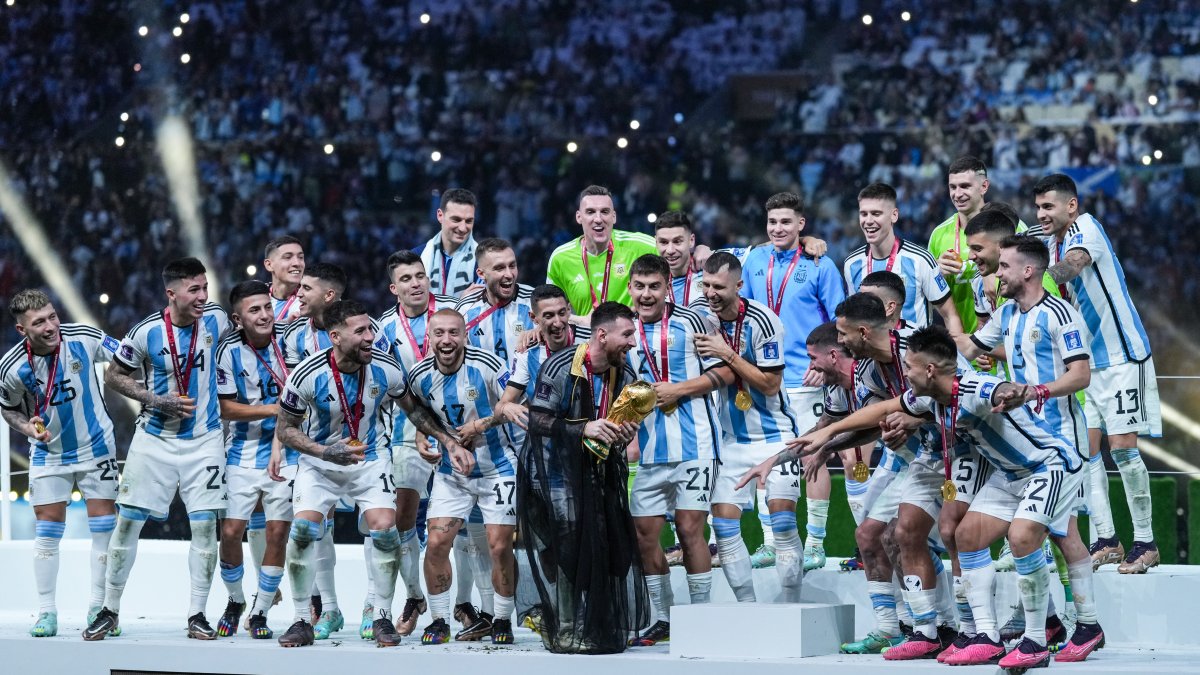
Argentina celebrates its victory at the 2022 World Cup in Qatar. File photo

After its decisive victory over England in the semifinals of the 2026 World Cup — a result that dispelled the doubts that had arisen following the nail-biting victories over Cape Verde, Egypt, and Switzerland — Argentina will have a golden opportunity to defend the title it won at Qatar 2022.
To be crowned champions once again — a feat that only Spain can prevent in this Sunday's final at NYNJ Stadium — would not only add a fourth star to the Albiceleste crest, but would also establish it as the third team in history to win two consecutive World Cup titles. Something it attempted unsuccessfully 36 years ago.
Which national teams have won at least two consecutive World Cups?
To take a look at the first team capable of defending its title, we must go back to the tournament's origins. At the 1934 World Cup in Italy, the second edition of the tournament, Italy — led by a legend like Giuseppe Meazza — earned its first World Cup title in front of its home crowd by defeating Czechoslovakia 2–1 in extra time in the final.
Four years later, at the 1938 World Cup in France, the Azzurri lived up to expectations and returned home with the title. In that final, the Italian team — captained by Meazza — defeated Hungary (4-2), which at that time boasted a level of soccer it no longer possesses today.

Sports
Messi adds to his legacy: He will tie Cafú for the most World Cup finals played
Alejandro Baños
The other national team that, to date, has won at least two consecutive titles is Brazil. The Canarinha, the archrival of the Albiceleste, won the 1958 World Cup in Sweden after thrashing the host nation in the final (5-2). That tournament will be remembered for the emergence of one of the greatest soccer players in history: Pelé.
In the next edition, the 1962 World Cup in Chile, the Brazilians managed to retain the title: they defeated Czechoslovakia in the final (3-1), even though they were without Pelé — the already legendary O Rei — due to a muscle injury.
Three came up just short
Defending the title is nothing new for Argentina. After defeating West Germany in the final (3-2) at the 1986 World Cup, the Albiceleste — led by Diego Armando Maradona — attempted to extend its success for another four years at the 1990 World Cup in Italy. However, it was the Germans themselves — coached by Franz Beckenbauer and featuring players like Lothar Matthäus — who dashed their hopes and snatched the championship away from them (1-0).
Another team whose attempt was in vain was Brazil. After securing their fourth World Cup title at the 1994 World Cup in the United States by defeating Italy in a penalty shootout in the final (0-0), that generation sought to emulate Pelé's team at the 1998 World Cup in France.
But the hosts stood in their way. In that final, France, with Zinedine Zidane as its star player, defeated (3-0) the Canarinha team that featured Ronaldo Nazario, Rivaldo, and Roberto Carlos, among others. A fifth star slipped away, though they would go on to win it four years later at the 2002 World Cup in South Korea and Japan.
Finally, France. The Bleus entered the last World Cup as the defending champions, after defeating Croatia in the final (4-2) at the 2018 World Cup in Russia. However, they were dethroned four years later by one of the teams that will compete in this Sunday's final.
At the 2022 World Cup in Qatar, Argentina dethroned France after prevailing in one of the greatest World Cup finals in history. After tying 2–2 in regulation and 3–3 following two more goals in extra time, the French, led by Kylian Mbappé, lost in a penalty shootout to the Albiceleste, captained by Lionel Messi, who now have the opportunity to win their fourth World Cup title and their second in a row.
LATEST