Alcaraz vs. Sinner: A dream final at Roland Garros – 'It doesn’t get any bigger'
The No. 1 and No. 2 in the ATP ranking will meet for the first time in a Grand Slam final. Although the history between the two is favorable for the Spaniard, the Italian has not lost a set in the entire tournament.
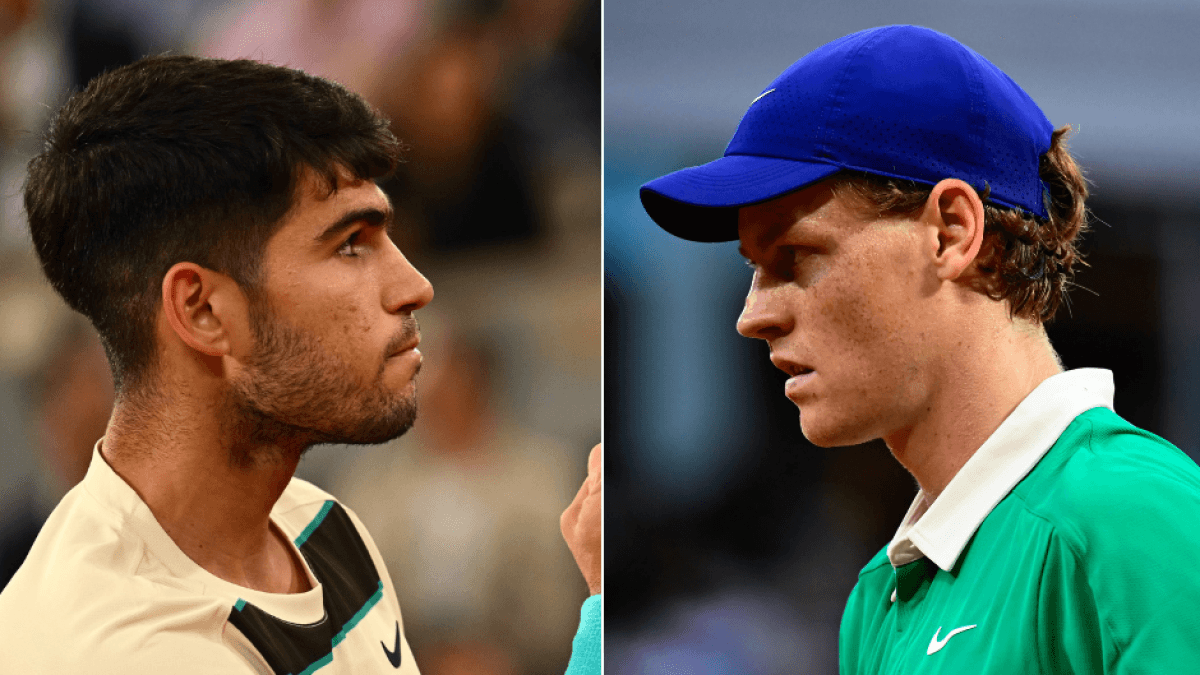

Jannik Sinner and Carlos Alcaraz will face off on Sunday in a highly anticipated showdown—marking their first-ever meeting in a Grand Slam final. Alcaraz, the reigning Roland Garros champion, will look to defend his crown, while Sinner, making his debut in a French Open final, aims to overcome the lingering doubts that seem to surface whenever he stands across from the Spaniard.
"The stage, it doesn't get any bigger now. Grand Slam finals against Carlos, it's a special moment for me and for him, too," said world No. 1 Jannik Sinner on the Philippe Chatrier court. Despite his top ranking, Sinner will look to reverse a difficult trend, having lost their last four encounters to Alcaraz.
"I love that battle. But most of the time is just about suffering, because [he pushes] you to the limit," said Alcaraz (number 2). "It's going to be a really great Sunday for fans of tennis."
On paper, Alcaraz holds a slight edge
The Spaniard comes into the final with more titles this season, having claimed the Masters 1000 events in Monte Carlo and Rome, as well as the ABN AMRO Open in Rotterdam. He also reached the final of the Barcelona Open.
Sinner won the Australian Open. After serving a three-month suspension, he returned to top form and has yet to drop a set at Roland Garros.
Sinner won and honored Djokovic
In his semifinal, Sinner fought for over three hours to defeat the legendary Novak Djokovic (No. 6) with a score of 6-4, 7-5, 7-6 (7-3). The Italian displayed superior play, chasing down every ball against a relentless Djokovic, who ultimately applauded his current ATP No. 1 successor.
Sinner was close to perfection against a Djokovic impotent against an opponent fifteen years younger. Maligned on too many occasions during his career, the Serb had the luxury of listening to the Roland Garros central court in unison: "Novak, Novak!"
But even with that support, Djokovic couldn’t find a breakthrough in the third set against an unshakable Sinner, who played with robotic precision. The crowd, growing more electrified as Friday night fell, appreciated the relentless battle put up by the tennis legend.
Before leaving the court, Djokovic, a 24-time Grand Slam champion, took a moment to thank the crowd and later said in a press conference that it "could have been" his final match at Roland Garros.
Alcaraz stumbled but pulled through against Musetti
In the first semifinal, Lorenzo Musetti (No. 7) retired with a left thigh injury while trailing 4-6, 7-6 (7/3), 6-0, 2-0 after two hours and 25 minutes. Alcaraz called for applause for his opponent, who left the court in tears after pushing the world No. 2 to the limit for two hours.
It was a solid test of maturity for the reigning champion against a peer—22 years old to the Italian’s 23. He weathered the storm and fought hard until he found the key to victory, which was ultimately sped up by Musetti’s injury.
For a match to happen between four-time Grand Slam winner Alcaraz and Musetti—whose best major result before Wimbledon 2024 was the semifinals—the former had to bring his most grounded game, while the latter had to be nearly flawless. That’s exactly what unfolded for two hours: the first set was a tight battle, ultimately decided by Musetti’s total efficiency.
With the Italian maintaining perfect efficiency (3-for-3 on break points), the second set went to a sudden death tiebreak, where Alcaraz finally took control. After a slow start, the No. 2 seed found his rhythm in the semifinal—boosting his consistency, sharpening his slices, and turning his forehand into a weapon to wear down a Musetti hampered by injury.
🛠 Do you think there is an error in this article?
Recommendations


LATEST