






ANALYSIS
The 9/11 Commission | The report that reconstructed the timeline of the attacks: 19 terrorists, 2,977 dead and a government that failed to piece together the facts
The 2004 report commissioned by Congress reconstructs that morning using radar data, black boxes, and in-flight calls—not the mythology that emerged after the attack. It establishes the sequence of the four flights and shows how the Federal Aviation Administration (FAA) and the North American Aerospace Defense Command (NORAD) pursued planes that no longer existed, while the FBI and the CIA had the names of suspects and flight schools without having been able to connect the dots.
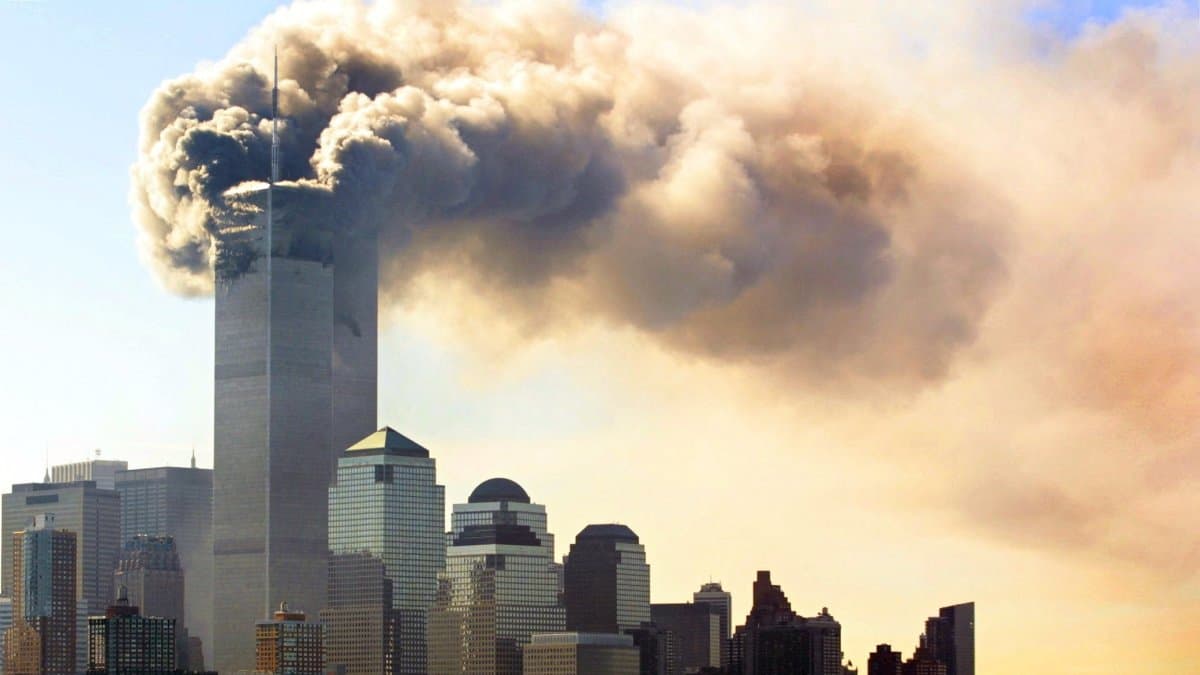

The attacks of Sept. 11, 2001, were four coordinated terrorist attacks, carried out by 19 members of Al Qaeda who hijacked commercial airliners to use them as weapons against symbolic targets of American power.
With 2,996 dead (including the 19 attackers) and more than 25,000 injured, it remains the deadliest terrorist attack in history and the deadliest incident ever for firefighters and police officers in U.S.
What happened that morning
The East Coast awoke to a mild, nearly cloudless morning. This is how the report commissioned by Congress to reconstruct the events describes it in its very first line. The 9/11 Commission Report reconstructs that morning using radar data, black boxes and in-flight calls—not the mythology that emerged after the attack. It establishes the sequence of the four flights and shows how the Federal Aviation Administration (FAA) and the North American Aerospace Defense Command (NORAD) pursued planes that no longer existed, while the FBI and the CIA had names of suspects and flight schools without having been able to connect the dots.
At Boston, Newark and Dulles, 19 men boarded four long-haul flights bound for California, fully fueled. By noon, the Twin Towers were gone, the Pentagon was ablaze and a Boeing 757 had crashed in a field in Pennsylvania.
- "We have some planes": American Airlines Flight 11 was a Boeing 767 bound for Los Angeles. It took off from Logan Airport in Boston at 7:59 a.m. It was piloted by John Ogonowski and Thomas McGuinness. There were 11 crew members and 81 passengers on board, five of whom were hijackers: terrorist Mohamed Atta, who led the group that day; Abdulaziz al Omari, Satam al Suqami, Wail al Shehri and Waleed al Shehri. Atta and Omari had arrived that morning from Portland, Maine.
At 8:14 a.m., routine communication was cut off. The commission places the hijacking at that time, over Massachusetts. Minutes later, flight attendant Betty Ong called the airline from an onboard phone. The cockpit was locked, and crew members had been injured. Amy Sweeney made another call and described the hijackers. At 8:24 a.m., by mistake, Atta broadcast over the control frequency: "We have some planes. Just stay quiet, and you'll be okay." The report uses that phrase as the title for the chapter covering that day.
At 8:46 a.m., the plane crashed into the north face of the North Tower, between the 93rd and 99th floors. No one on board survived. Inside the building, the impact sealed off the exits above the area where the plane struck.
- The second strike, live: United Flight 175 was also a Boston–Los Angeles 767. It took off from Logan Airport at 8:14 a.m. It was piloted by Victor Saracini and Michael Horrocks. There were nine crew members and 56 passengers on board, five of whom were hijackers: Marwan al Shehhi—the pilot of that aircraft—Fayez Banihammad, Mohand al Shehri, Hamza al Ghamdi and Ahmed al Ghamdi. Before boarding, Shehhi and Atta spoke on the phone for three minutes at the airport. It was their last conversation.
At around 8:42:40 a.m., still under the control of its pilots, United Flight 175 notified air traffic control that it had heard a "suspicious transmission" from another aircraft. It was Mohamed Atta, on American Flight 11, speaking by mistake on the open frequency. Shortly thereafter, between 8:42 and 8:46 a.m., they hijacked Flight 175 over northwestern New Jersey. Whoever was already in the cockpit changed the transponder code: on ground monitors, the flight was no longer easy to track.
Passengers and crew members called their families and the airline. They reported that the cockpit had been taken over and that the plane was descending. At 9:03:11 a.m., Flight 175 crashed into the south face of the South Tower, between the 77th and 85th floors. An engine and other debris pierced the building and fell several blocks away. Cameras that had already been focused on the smoke from the North Tower captured the impact. Up until that moment, many people had been talking about an accident. The second plane put an end to that notion.
The 19, according to the commission
The operational mastermind behind the plan was Khalid Sheikh Mohammed. Bin Laden authorized and funded it from Afghanistan. Several of the 19 passed through training camps there.
The core group that ended up at the controls of three planes—Atta, Shehhi and Jarrah—had previously formed in Hamburg, Germany: they shared an apartment, a mosque and the path to Al Qaeda. Atta established himself as the leader on U.S. soil.
Hani Hanjour, a Saudi with prior flight experience, joined as the pilot of the plane that struck Washington. He was accompanied by Khalid al Mihdhar, Nawaf al Hazmi, Salem al Hazmi and Majed Moqed.
Mihdhar and Nawaf al Hazmi had been in the country since 2000 and had lived in California. The CIA had their names, and yet they were allowed to board.
According to the commission, many entered on tourist or student visas and trained at civilian flight schools in Florida and Arizona. The report concludes that no one linked this pattern to the 2001 alerts in time.
The Pentagon, 9:37 a.m.
American Airlines Flight 77 was a Boeing 757 bound for Los Angeles. It took off from Dulles Airport, near Washington, at 8:20 a.m. There were 58 passengers on board—five of whom were hijackers—and six crew members.
The commission places the hijacking between 8:51 and 8:54 a.m. The plane stopped responding, turned off its transponder and veered toward the capital. On the ground, for several minutes, air traffic controllers and military personnel were unsure exactly which aircraft it was or where it was headed. The report describes this gap in information bluntly: as Flight 77 approached the Potomac River, part of the system continued to search for a flight that no longer existed as such.
At 9:37:46 a.m., the plane crashed into the west facade of the Pentagon, the side that was under construction. The commission recorded the deaths of everyone on board and of 125 people in the building, including personnel from the Department of Defense and emergency responders. The impact tore a hole several stories high. The fire and the partial collapse of that section of the building complicated rescue efforts.
The flight that never reached its target
United Flight 93 was a Boeing 757 bound for San Francisco. It was scheduled to depart from Newark at 8 a.m.; it took off 42 minutes late, at 8:42 a.m. That delay, the commission says, changed the course of the day: by the time it was hijacked, the towers were already on fire and the Pentagon had been struck. It was piloted by Jason Dahl and LeRoy Homer. There were seven crew members and 37 passengers on board, four of whom were hijackers—not five, as on the other flights: Ziad Jarrah, the pilot; Ahmed al Haznawi; Ahmed al Nami and Saeed al Ghamdi.
The last routine communication was around 9:27 a.m. A minute later, over Ohio, screams were heard in the cabin. The commission places the hijacking at 9:28 a.m. The plane turns southeast, toward Washington. Jarrah, on the radio, says there is a bomb on board and asks the passengers to sit down.
Phone calls begin from the rear seats. Passengers Tom Burnett, Jeremy Glick, Mark Bingham, Todd Beamer and several others speak with family members and an operator. They are told about New York and the Pentagon. They agree to take action. The black box records the struggle, the "Let's roll!" attributed to Beamer and the moment they attempt to enter the cockpit.
At 10:03:11 a.m., Flight 93 crashes into a field near Shanksville, Pa., at full speed and upside down. No one on board survives. There were no other fatalities on the ground. The report concludes that the most likely target was the Capitol or the White House—Khalid Sheikh Mohammed pointed to the Capitol—and that the struggle prevented the plane from reaching its destination. It was the only one of the four that did not reach the city it was targeting.
New York collapses
At the World Trade Center, evacuation and rescue efforts intersected on the same stairwells. Those who could get down did so. Members of the New York Fire Department, Police Department and Port Authority were heading up, often without knowing which floors were off-limits. The report devotes an entire chapter to that morning in the towers: radios that couldn't communicate with each other, commanders who couldn't be heard on the upper floors and orders that didn't reach those already inside.
The North Tower, struck at 8:46 a.m. between floors 93 and 99, left those above the impact with no way out. The South Tower, struck at 9:03 a.m. lower down—between the 77th and 85th floors—collapsed first, at 9:59 a.m., 56 minutes after the crash. The North Tower held out until 10:28 a.m. In the afternoon, at 5:20 p.m., 7 World Trade Center collapsed, damaged by debris and fire. The commission describes how, on many upper floors, the only certainty was that there was no way down.
The official death toll for that day—the one used in the report and subsequent figures—is 2,977, excluding the 19 hijackers: 2,753 in New York, 184 at the Pentagon and 40 in Shanksville. It was the deadliest attack ever on U.S. soil. Deaths from illnesses among those who worked in the rubble came later and are not included in that Sept. 11 figure.
When the government was preparing for the previous war
When it mattered most, the FAA and NORAD weren't even using the same map. They pursued flights that had already crashed and others that didn't exist. The F-15s and F-16s took off late, often heading toward an empty point, and without clear rules on whether they could shoot down a civilian plane full of passengers. The order to shoot down the planes came after three had already crashed and the fourth was plummeting toward rural Pennsylvania.
The report, published in 2004, rejects the idea of complete surprise. Al Qaeda had bombed the embassies in Nairobi and Dar es Salaam in 1998 and attacked the USS Cole in 2000. In the summer of 2001, the intelligence community was discussing a major attack by Bin Laden. On Aug. 6, the president received the daily briefing titled "Bin Ladin Determined to Strike in U.S."
The FBI in Phoenix had a tip that Saudis were enrolling in flight schools. In Minnesota, it had detained Zacarias Moussaoui, an Al Qaeda operative who was paying for a 747 flight simulator. The CIA had Mihdhar and Hazmi on file, two of the men who later boarded flights bound for the Pentagon. Those names did not make it onto a watchlist in time to prevent them from flying.
The FBI was investigating domestic crimes. The CIA was tracking terrorists abroad. Due to internal regulations and established practice, lists and names were rarely cross-referenced; sometimes not even within the FBI itself. The Commission calls this a "wall": each agency had a piece of the puzzle, and no one put it all together.
🛠 Do you think there is an error in this article?
Recommendations




LATEST