






ANALYSIS
Flying: A game of chance | Aviation sees five consecutive years of delay rates exceeding 20%
According to the Department of Transportation, in fiscal year 2026, one in five flights landed at least 15 minutes later than its scheduled time.
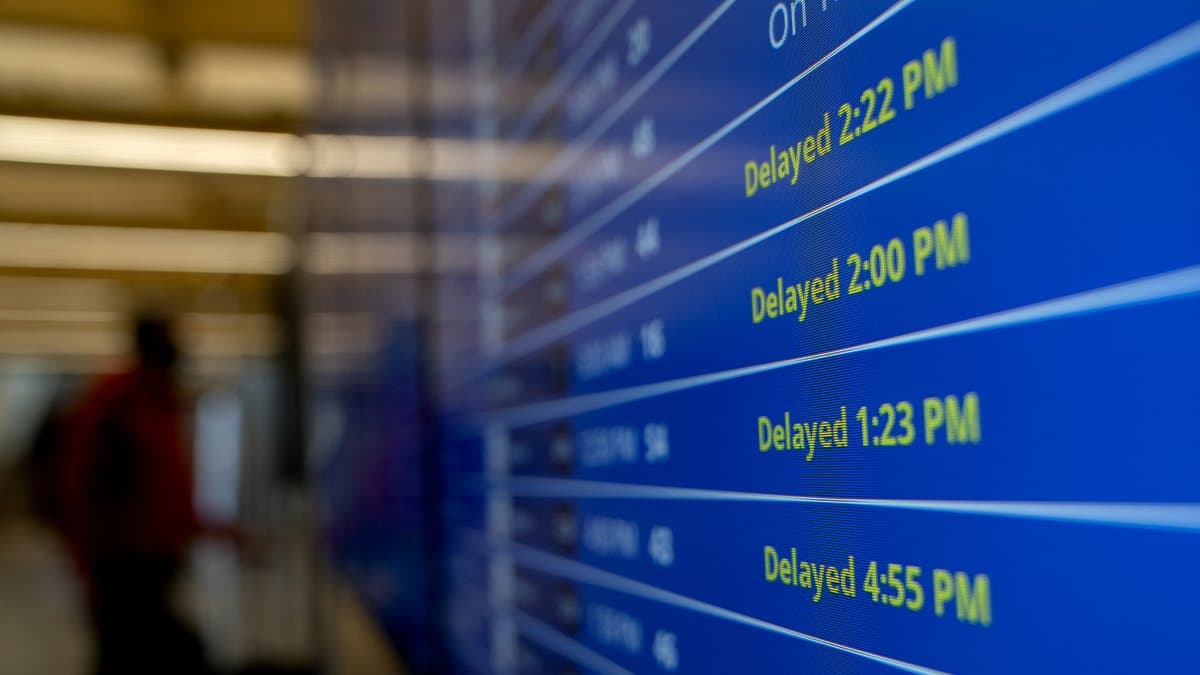

One stimulus after another overwhelms the senses: the constant flickering of lights, the raucous murmur of the crowd, the rush, a maze of security checkpoints to pass through, luggage and other obstacles to navigate around... Often, entering an airport terminal is synonymous with survival, an exercise in which the main challenge is knowing how to stay calm.
Millions of passengers walk through airport corridors every day, trying not to fall victim to the chaos; however, for many of them, that stress eventually turns into frustration when they see the word "delayed" take over the screens and realize that their flight is one of those affected.
That has been the harsh reality for a massive volume of flights so far this fiscal year (which began on Oct. 1, 2025). According to the official records of the Bureau of Transportation Statistics (BTS)—an agency under the Department of Transportation (USDOT)—of the 2,880,796 flights operated to date, a total of 599,685 have been delayed, representing a concerning 20.82%.
One in five flights lands late
It is important to clarify what is meant by a delay: the BTS considers a flight delayed "if it arrived at (or departed) the gate 15 minutes or more after the scheduled arrival (departure) time."
These figures mean that more than one in five flights was delayed, making a lack of punctuality a structural problem. Five years ago, throughout the 2021 fiscal year, only 238,485 flights out of the 2,084,553 operated that year arrived at their destinations late—only 11.44%.
The trend began to rise in the following fiscal year, in 2022, when the percentage of flights that landed at their destination airport skyrocketed to 20.12% —549,942 delays out of a total of 2,733,789 flights. Since then, it has remained above 20% year after year:
- 2017: 439,424 delayed flights (19.07%)
- 2018: 516,015 (17.70%)
- 2019: 565,777 (18.87%)
- 2020: 237,453 (10.22%)
- 2021: 238,485 (11.44%)
- 2022: 549,942 (20.12%)
- 2023: 575,727 (20.83%)
- 2024: 598,702 (21.01%)
- 2025: 571,908 (20.17%)
- 2026: 599,685 (20.82%)
Decline spreading across country's major hubs
BTS statistics also allow us to analyze the performance of the country's major hubs. At Hartsfield-Jackson Atlanta International Airport—the world's busiest airport, with over 100 million passengers per year—16.83% of flights have arrived late this fiscal year (21,614 out of 128,403 operations). While this figure represents a slight improvement compared to the previous three fiscal years, it is nearly double the 2021 rate (8.46%).
The decline in on-time performance compared to 2021 levels extends to the rest of the major U.S. airports. At Dallas Fort Worth International Airport, the second-busiest airport by traffic volume, the on-time rate has dropped to 19.47% (compared to 17.97% in 2021). Chicago O'Hare International Airport is even more striking: its delay rate has more than doubled, rising from 11.02% to 25.02% in 2026.
Meanwhile, Denver International Airport has seen its delays increase from 13.14% to 17.91%, while at Los Angeles International Airport, off-schedule landings have risen from 10.04% to 18.49%. Finally, at John F. Kennedy International Airport, one in five flights (20.50%) experienced delays of at least 15 minutes, a far cry from the 11.48% recorded five years ago.
Weather, "domino effect" and logistics: Triggers of the chaos
While the BTS specifies that nearly one in two delays (46.46%) during this fiscal period was due to bad weather, there are several other factors that can cause a flight to land at least 15 minutes later than its scheduled time:
- Delays that are the airline's responsibility: This includes all setbacks within the airline's control, such as mechanical failures or poor aircraft maintenance, crew management and availability, ground operations, or boarding procedures, among others.
- "Domino effect": In commercial aviation, airplanes rarely fly a single route per day; they operate on continuous itineraries connecting multiple cities. This means that if an airplane arrives late at its destination, the next flight will be affected.
- National Airspace System (NAS): This system encompasses conditions that slow down the flow of air traffic, such as airspace congestion, air traffic control or non-extreme weather that requires aircraft to be spaced further apart as a precaution.
- Extreme weather: This includes severe or dangerous weather phenomena—such as tornadoes, blizzards or severe thunderstorms—that bring all operations to a complete halt and force ground personnel to evacuate the runways.
- Safety-related delays: Those defined as high-impact occur when incidents arise involving security checks or terminal infrastructure.
In addition to these, there are other reasons that cause flight delays: geopolitical events, wildfires, volcanic ash, system failures, radar outages, disruptive passenger behavior, in-flight medical emergencies, a lack of boarding gates or a shortage of ground staff.
Guide to filing a claim if your flight has been delayed
"Your flight is cancelled and the airline does not rebook you: You are entitled to a refund if the airline cancels a flight, regardless of the reason, and does not rebook you on a new flight or you do not proactively accept alternative compensation, such as a flight voucher or miles.""Your flight is cancelled and you do not accept rebooking: If your flight is cancelled and the airline offers rebooking or alternative compensation, but you do not accept these offers, you are entitled to a refund.""Your flight is 'significantly changed' and you do not accept the changed itinerary nor any offers of rebooking or other compensation: If your flight is significantly changed and you do not want to travel with the changed itinerary or a rebooked itinerary and you do not accept any other compensation offered in lieu of a refund, you are entitled to a refund.""Your baggage is significantly delayed: You are entitled to a refund for a checked bag fee if you file a mishandled baggage report and your bag is not delivered within 12 hours of a domestic flight arriving at the gate, or within 15 or 30 hours of an international flight arriving at the gate, depending on the length of the flight.""Extra services are not provided: You are entitled to a refund for the fee you paid for an ancillary service — such as Wi-Fi, seat selection, or inflight entertainment — if an airline fails to provide this service."
🛠 Do you think there is an error in this article?
Recommendations




LATEST