ANALYSIS
Clash between Trump and María Elvira Salazar raises key question: Can GOP afford to lose her seat?
The Republican is seeking reelection as tensions with Trump escalate and the GOP tries to protect its slim majority in the House.
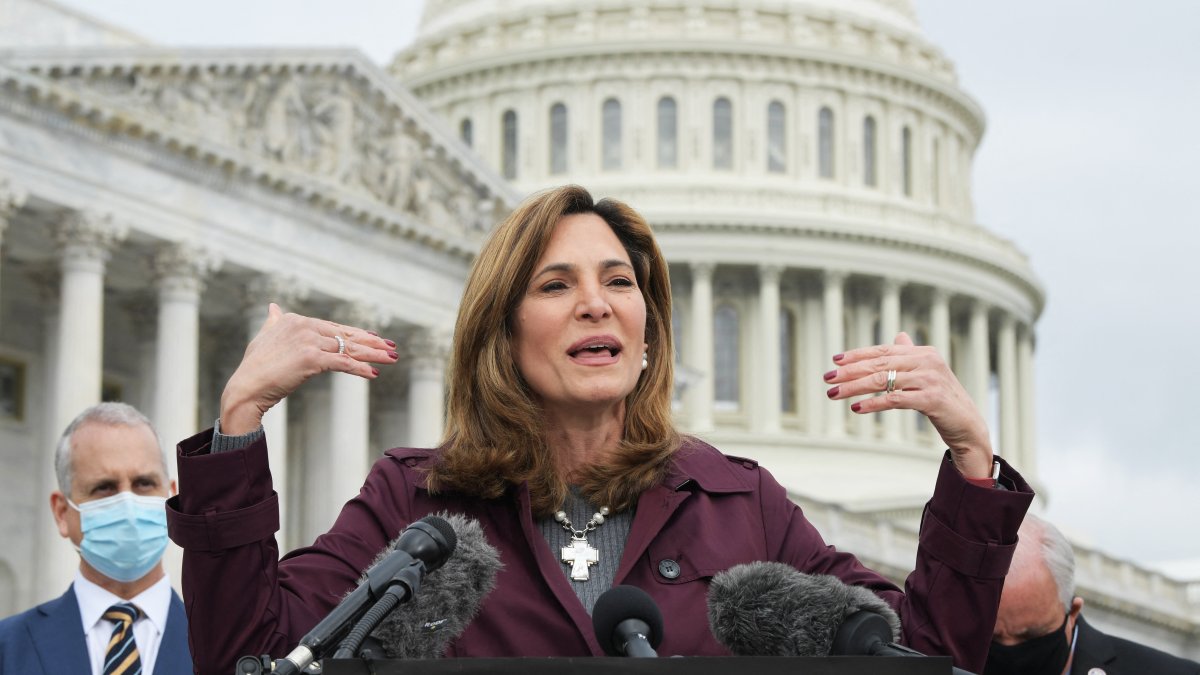
María Elvira Salazar on Capitol Hill/ Lenin Nolly

In recent weeks, María Elvira Salazar has become one of the most-talked-about Republican figures in the country. Whether on social media, in traditional media or on podcasts of any political persuasion, the Republican congresswoman from Florida has been at the center of the conversation due to the statement she released criticizing the immigration policy of President Donald Trump.
Ever since Sept. 17, when Salazar stated that some of the president's immigration control measures had gone "too far," she has received mixed reactions from Republicans. As for the president, he managed to rein in his more confrontational impulses until last Saturday, when he shared a series of posts by others targeting Salazar on his Truth Social account, including some that accused her of being a traitor and called for her replacement.
In this context, the Republican congresswoman's political future hangs in the balance, raising many questions: Will she manage to win reelection? Will she retain the support of Republicans in her district? Even if she wins reelection, is there a future for her beyond 2028? To these questions, we must add one more: Can the Republican Party afford to lose Salazar's seat?
Will Salazar be reelected?
Salazar has represented Florida's 27th congressional district in the House of Representatives since 2021, after defeating the Democratic incumbent Donna Shalala. She was reelected in 2022 and 2024, each time with the backing of President Trump.
In November, the Republican will seek a fourth term in the House of Representatives against Democrat Elliot Rodríguez, a television host who recently spoke with Karina Yapor for Voz News. Like Salazar, Rodríguez has had an extensive career as a journalist and television host. During the campaign, he has sought to portray Salazar as someone more interested in what's happening in Latin America than in her own district.


Politics
New Supreme Court ruling halts Republican congressional redistricting plan in Missouri
Andrés Ignacio Henríquez
Although Salazar was not expected to face any problems securing another term, the decline in support for Trump among some Hispanic sectors and his public clash with the White House could make the race more competitive. For example, on Sept. 25, the Cook Political Report changed its description of the race from "likely Republican" to "lean Republican."
Although the website acknowledges that Salazar has a track record of outperforming pollsters' projections in general elections, it notes that "Trump’s sinking approval rating among Hispanic voters in South Florida will be an anchor on the congresswoman."
Nevertheless, even with a national trend favoring the Democratic Party and a decline in Hispanic support for the GOP, Salazar has won her elections in Florida's 27th District by a comfortable margin. In 2022, she defeated Annette Taddeo by a margin of 14 percentage points, while in 2024 she beat Lucia Baez-Geller by more than 20 points.
Even if Salazar manages to win reelection in November, her relationship with Trump could become one of the factors shaping her political future. If Salazar runs for reelection in 2028, it remains to be seen whether Trump would endorse her again or support another Republican to challenge her for the nomination in the primaries. In this election cycle, Trump has already successfully defeated congressman Thomas Massie from Kentucky and Senators Bill Cassidy of Louisiana and John Cornyn from Texas.
Will she retain the support of Republicans in her district?
When analyzing the midterm elections, various political analysts have used the following phrase to describe them: "The midterms are turnout elections."
In other words, if more Republicans than Democrats turn out to vote, Republicans are more likely to win. Although this analysis always depends on the specific congressional district, if a portion of the Republican electorate decides not to turn out in response to her criticism of Trump, it could make Salazar's task more difficult and increase the chances of a Democratic victory.
In addition, if Trump continues to intensify his criticism of the congresswoman in the coming weeks, the deterrent effect among Republicans could be greater. The risk is not that these Republicans will vote for the Democratic candidate, but that they will decide to stay home.
The possibility of a negative reaction among some Republican voters was recently reported by The Washington Post in an article that quoted Republican residents of the district who were angry with their congresswoman.


However, Salazar is not a creation of the president. She has her own name and influence in her district. Before joining Congress, she worked as a journalist and news anchor in South Florida, which allowed her to forge a special connection with households in her district.
The demographics will also be a key factor in the upcoming elections, and Salazar's announcement could end up benefiting her. Her district is located south of Miami and is home to approximately 73% Hispanic population, an electorate particularly relevant to Salazar amid the immigration debate. A poll conducted in Miami-Dade in August and shared with Axios showed that, although 63% of Hispanics supported the deportation of undocumented immigrants, 58% disapproved of the way the Trump administration was carrying out those deportations.
Therefore, Salazar's announcement — seen as a wake-up call — could even improve her image among this large segment of his electorate, paving the way for her reelection.
Can the Republican Party afford to lose Salazar's seat?
Since her arrival in Congress in 2021, Salazar has stood out as one of the strongest voices against socialism and totalitarian regimes, including Cuba, Venezuela and Nicaragua.
Although she has backed President Trump's major initiatives since his return to the White House in January 2025, she has remained independent on immigration issues. Her main focus in this area is the Dignity Act, a bipartisan bill she introduced alongside Democrat Verónica Escobar in 2025 that seeks a solution for certain undocumented immigrants who have been living in the United States since before 2020 and have no criminal record.
In March 2026, she signed a petition to force a vote on a bill that sought to grant Temporary Protected Status (TPS) to Venezuelans — an initiative originally introduced alongside Democrats Darren Soto and Debbie Wasserman Schultz.
Salazar also has bills that were signed into law by both President Joe Biden and President Donald Trump. Among them are the RENACER Act, signed by Biden in 2021 to strengthen sanctions against Daniel Ortega's regime in Nicaragua, and the TAKE IT DOWN, signed into law by Trump in 2025 to combat the nonconsensual distribution of intimate images, including content generated by artificial intelligence.
However, Salazar's importance to the Republican Party extends beyond her personal profile. Her seat is part of what is currently a very slim Republican majority — one that will be put to the test in the November elections. In this scenario, every district the Republicans manage to hold on to could be crucial to maintaining control of the House.
Furthermore, her seat holds significant symbolic importance due to its high percentage of Hispanic residents. Salazar not only represents a Republican district in Miami-Dade, but she does so in a community where the Republican Party has made significant gains among Hispanic voters in recent election cycles.
For this reason, the fate of the seat goes beyond the clash between Trump and Salazar. For Republicans, the priority is first to defend their majority in the House and then to gauge the extent to which the party can maintain the gains it has made among the Hispanic community in South Florida.
LATEST