ANALYSIS
The Democrats' fragile peace: United by rhetoric, divided by spending and facing the tough test of legislation
Following their victory in the midterms, radical and moderate Democrats feel more united than ever. But this truce has not yet been put to the test by the budget, ideological differences or the race toward 2028.
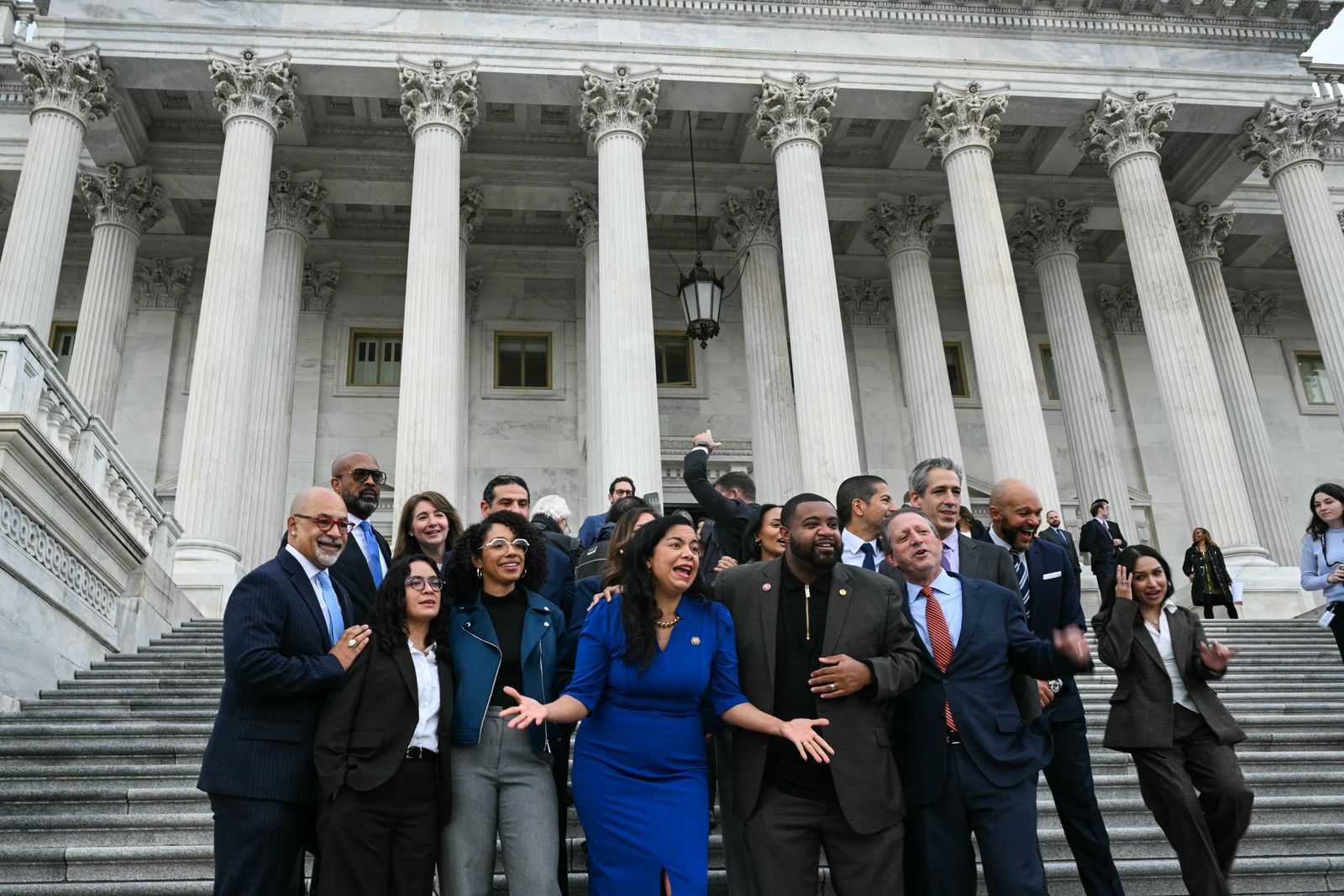
Newly elected members of the House of Representatives

The Democratic victory in the 2026 midterms has temporarily shifted the climate of the party. After the crushing defeat in the 2024 elections, internal tensions and doubts about its ability to win competitive districts, the party enters the new Congress with a larger majority and a coalition that, for now, appears more cohesive than usual.
That truce comes with a condition that has not yet been met: being put to the test by governing. Democrats may share a campaign message about lowering the cost of living, protecting working families and demonstrating that the party can govern, but they have not yet resolved their deep differences over how to achieve this. The first major vote on a budget, tax or regulatory issue will reveal whether electoral unity translates into legislative unity.
Post-election truce
The poll by Politico/PF Global, conducted Nov. 7–10 among 2,000 adults, shows that Democratic voters feel the party is less divided following its sweep in the midterms. Half of the respondents—ranging from the most radical to the most moderate—believe that Democrats are "somewhat" or "much more" united since the election.
The perception of strength has grown especially among the left-wing faction. Two-thirds of Democratic voters in the midterms believe this group strengthens the party, up from 41% before the election. Among moderates, that view rose 26 points, from 33% to 59%; among leftists, it rose from 58% to 74%.
The victory has calmed, at least for now, the internal debate over electability. For years, moderates feared that an agenda that was too far to the left would alienate swing voters, while the more radical members argued that the party needed a more ambitious economic platform to mobilize its base. After the win, both factions have reason to celebrate. The moderates can argue that their approach allowed them to compete in difficult districts, and the leftists can claim that their economic message boosted turnout and enthusiasm.
Cost of living: Easy consensus, hard governance
The area of greatest agreement is the cost of living. Seventy-eight percent of Democratic voters in the midterms say that reducing the cost of living should be the new Congress's top priority, and 71% of Americans agree. It's a message that resonates in urban, suburban and rural districts, allowing the party to address a shared concern without immediately getting bogged down in ideological disputes.
But that consensus is also a political trap. "Lowering the cost of living" is not a concrete public policy. It is a goal that allows for profoundly different solutions. A left-leaning Democrat might interpret it as expanding subsidies, price controls, public investment in housing and energy, or structural changes to the economic system. A moderate might see it as targeted aid, tax incentives, specific reforms and more cautious management of federal spending.
The poll reveals that first rift. Forty-seven percent of Democratic voters in the midterms prefer that the next Congress push for systemic reforms and government intervention to reduce inequality, while 39% prefer pragmatic, targeted economic solutions. Among those on the left, 57% favor systemic reform; moderates are virtually split, with 43% in favor of systemic reforms and 44% in favor of targeted measures.
Politics
This is the Democrats' plan to regulate AI through Congress: more power to the states and controls on data centers
Emmanuel Alejandro Rondón
First budget will decide everything
The true test of Democratic unity will not be a statement of principles on affordability, but rather the first major appropriations bill, the first tax package, and the first attempt to regulate prices, housing, energy or health care. Congress cannot fund everything it promises without deciding who pays, how much is spent and which programs are cut.
The Congressional Research Service warns that "affordability" is not limited to overall inflation. Housing accounts for more than 40% of the Consumer Price Index basket, and prices for housing, food and energy have risen faster than overall inflation since January 2021. Between January 2021 and January 2026, the overall price index rose 24%; food, 27%; energy, 32%; and housing, 29%.
That means a Democratic package focused on the cost of living will have to choose between direct subsidies, investment in housing, regulatory controls, tax changes or market reforms. Each option divides the party in a different way. The most radical members will tend to demand broad, redistributive intervention; moderates will seek to protect competitive districts, contain spending and prevent the agenda from being labeled as radical.
The "big tent" may be a trap
The diversity that is currently presented as an electoral strength could become the main legislative obstacle. The party enters Congress with a broader coalition, but a large majority does not guarantee cohesion when members represent districts so diverse that the same law may be seen as insufficient on one side and excessive on the other.
Recent legislative history makes this clear. In 2021 and 2022, the Democrats controlled both chambers and the White House, but the ambitious Build Back Better (BBB) was drastically scaled back because moderates opposed the scope of the spending and the most transformative policies. The result was a much more limited version. Decades earlier, in 1993 and 1994, Clinton's platform also failed despite a Democratic majority, when radicals and moderates could not agree on the design or the cost of the system. Even the Affordable Care Act of 2010, which was passed, was marked by the same tensions. Leftists demanded a public option and broader coverage, while moderates and the Blue Dog Caucus imposed limits and cuts that shifted the final outcome away from what the Democratic left had promised.
The question is not whether Democrats can pass a symbolic bill on affordability; it is whether they can pass a measure that withstands budgetary scrutiny, Senate rules and the demands of a diverse internal coalition.
Voters may have backed the Democrats for a general reason—the cost of living—without endorsing a specific economic agenda. When that agenda reaches Congress, regional, generational and economic interests within the party will begin to compete with one another.

Politics
From the Church to Washington, DC: Religious leaders elected to Congress this year
Joaquín Núñez
2028 is already shaping the agenda
The truce also has an expiration date: the 2028 presidential primary. The poll shows that half of radicals still believe that a candidate from their faction would have the best chance of winning, while just over a third of moderates—36%—feel the same way about their own candidates.
That means that every major vote in Congress will be interpreted as a signal for 2028. A bill that is too moderate will be portrayed by the left as a capitulation to corporations; one that is too ambitious will be used by moderates as proof that the party is returning to an agenda that scares off voters in competitive districts.
Potential candidates are already trying to manage that tension. Pennsylvania Gov. Josh Shapiro told Politico that voters don't think in terms of factions, but in terms of results, because "prices are still too high"; Democratic Rep. Ro Khanna, on the other hand, stated that the question for 2028 is who has the best vision for the country.
Politics
Pro-life organizations vow to stand up to the Democrats' pro-abortion agenda in Congress
Williams Perdomo
The real test begins in January
The first budget will be the test. If Democrats manage to pass concrete measures that reduce costs without fracturing their coalition, they will have turned their electoral victory into governing authority. If the first major package gets bogged down between the most radical members demanding structural transformation and moderates who fear a program that is too expensive or too left-wing, November's "unity" will reveal itself for what it likely is: a pause, not a peace.
🛠 Do you think there is an error in this article?
Recommendations




LATEST