With John Roberts dissenting, the Supreme Court allows Trump to continue construction of the White House ballroom
The court did not rule on the project's legality but merely stayed a lower court's order that had halted construction while litigation continues.
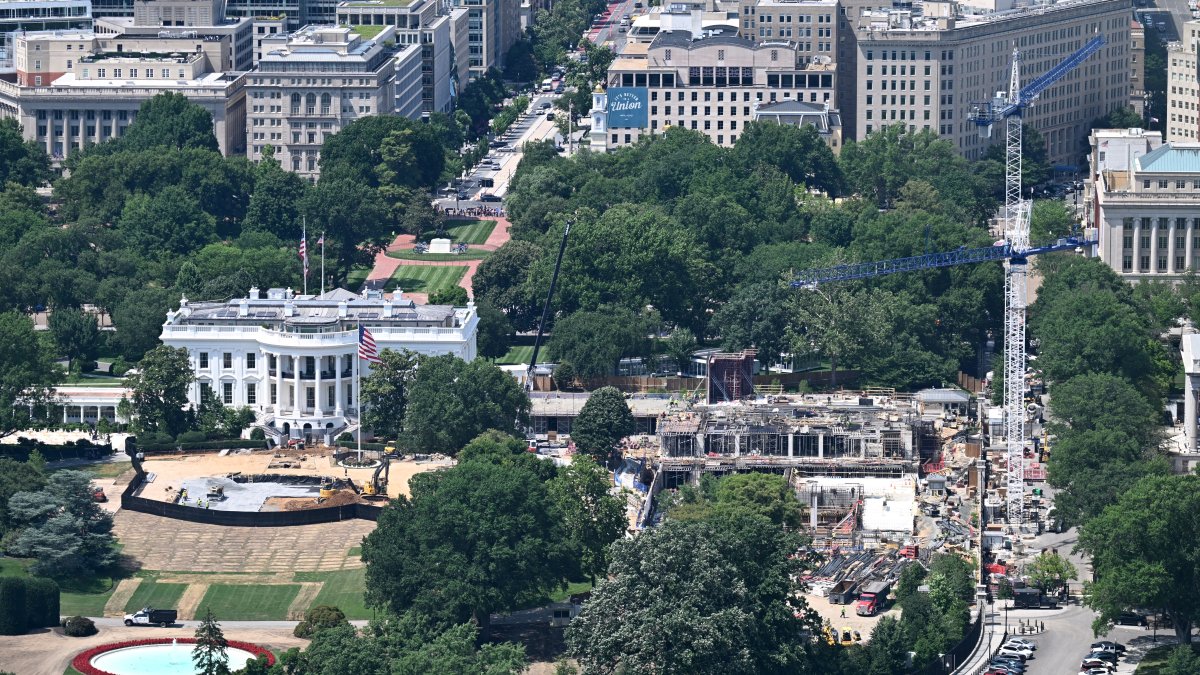
Construction of the White House ballroom / Kent Nishimura

The Supreme Court allowed Donald Trump to continue construction of the White House ballroom. The decision was adopted by a 5-4 majority and represents a victory for the Trump administration, which appealed to the highest court after lower courts ordered construction to halt. However, the court did not rule on the project's legality; instead, it limited itself to suspending a lower court's order that had halted construction while the litigation continues.
Although the ruling was unsigned, John Roberts, Chief Justice of the Supreme Court, signed a dissenting opinion alongside the three liberal justices: Sonia Sotomayor, Elena Kagan, and Ketanji Brown Jackson. This indicates, therefore, that the majority consisted of Clarence Thomas, Samuel Alito, Neil Gorsuch, Brett Kavanaugh, and Amy Coney Barrett.
In the dissenting opinion, Roberts asserted that the decision was "no victory for the separation of powers." Roberts argued that, since Congress has not expressly approved funding for the project, the president lacks the authority to carry out a project of this magnitude.
"That appropriation of a couple million dollars for ordinary Executive Residence maintenance and repairs likely does not authorize the President to use hundreds of millions of dollars in private donations to tear down the East Wing and construct a ballroom in its stead," he added.

Politics
White House calls judge who suspended postal regulations for November election an 'activist'
Andrés Ignacio Henríquez

The case behind Trump's ballroom
The legal battle began in December 2025, when the National Trust for Historic Preservation sued the Trump administration over the demolition of the East Wing and the plan to replace it with a new ballroom.
The organization argued that the federal government had moved forward without complying with legal requirements and, most importantly, that the president could not transform federal property of that magnitude without congressional authorization.
On March 31 of this year, Judge Richard Leon ordered a halt to above-ground construction, ruling that no law authorized the president to proceed with the project unilaterally.
Following an appeal by the Trump administration, the D.C. Circuit Court of Appeals upheld Leon's ruling, leaving the government with no option but to appeal to the Supreme Court. The nation's highest court ruled that the National Trust for Historic Preservation's argument was invalid, finding that it did not meet the legal standing requirement required by the Constitution for a person to bring a case before a federal court.
At the federal level, "standing" means the plaintiff must have suffered "actual harm." In other words, the plaintiff must demonstrate that the matter in question directly affects them, rather than merely disagreeing with it.
According to the majority, the organization failed to demonstrate that any of its members suffered concrete harm as a result of the ballroom's construction.
The court's decision does not end the dispute between the Trump administration and the National Trust for Historic Preservation. The litigation will continue as the case moves forward and, eventually, as the Supreme Court decides whether to review the merits and whether the government had the legal authority to demolish the East Wing and build the ballroom without Congress's express authorization.
"Today, we do not pass upon the legality of the government's East Wing project. We conclude only that, based on the submissions before us, the government is likely to prevail in showing that the [National Trust for Historic Preservation] lacks Article III standing to challenge the project in federal court and that the remaining stay factors favor relief," the majority of justices wrote.
LATEST