Trump reaffirms validity of the Monroe Doctrine on its anniversary: 'The American people will always control their own destiny'
Since his return to the White House, Trump has displayed a painting of President Monroe, placed between Alexander Hamilton and President Andrew Jackson, in the Oval Office.

James Monroe painting in the Oval Office/ Alex Brandon.

Donald Trump highlighted the Monroe Doctrine on the new anniversary of its launch. Through a statement, the president praised the worldview explained by James Monroe in December 1823. In turn, he assured that his administration is reaffirming this through the "Trump Corollary," which starts with the following premise: "The American people, not foreign nations nor globalist institutions, will always control their own destiny in our hemisphere."
Since his return to the White House, Trump has displayed a painting of President Monroe, placed between Alexander Hamilton and President Andrew Jackson, in the Oval Office. To that show of admiration, the Republican added a tribute on the 202nd anniversary of the proclamation of the famous doctrine.
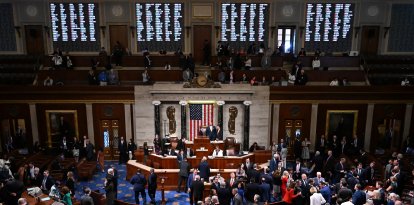
"More than 2 centuries ago, President Monroe proclaimed before the United States Congress what is today known as the legendary 'Monroe Doctrine'—a bold policy that rejects foreign interference of faraway nations and confidently asserts United States leadership in the Western Hemisphere," the president said in a statement released by the White House.


The Monroe Doctrine was formulated on December 2, 1823, by President James Monroe. Its central premise was that the Western Hemisphere must remain free from outside interference—basically, America for the Americans, without further colonization or intervention by foreign powers.
"The American continents, by the free and independent condition which they have assumed and maintain, are henceforth not to be considered as subjects for future colonization by any European powers," President Monroe told Congress in 1823.
Monroe, the fifth U.S. president, uttered these words eight years after the end of the war with England and in a context in which many countries of the American continent were gaining independence from Europe. In that context, the United States sought to assert that the continent should remain free from outside interference.
"Today, we renew our pledge to always uphold American sovereignty, security, and safety first. Above all, we vow to protect our cherished national legacy of republican self-government against all threats, foreign and domestic," he continued.
LATEST