Delays in NY state funding disbursement leave Jewish schools in a lurch
The state funding that covers certain teacher salaries “allows us to keep quality up and keep tuition increases reasonable, all thanks to the state,” Rabbi Bini Krauss, principal of SAR Academy, told JNS.

Since 2017, the New York state budget has included millions of dollars for non-public school teacher salaries in science, technology, engineering and math. The state is seriously behind on distributing those funds. In the 2026 budget, $85.5 million was allocated for STEM teachers in all non-public schools, but none of that money has been paid out.
The last of this money that Jewish schools received was at the end of 2024 and was designated for the 2022-23 school year, according to Sydney Altfield, CEO of Teach Coalition, an Orthodox Union program.
Non-public schools include secular private schools and parochial schools, including Catholic and Jewish educational institutions, and Jewish schools represent about 30% of the STEM teacher program recipients, Altfield told JNS.
Jewish school principals like Rabbi Bini Krauss, of SAR Academy, need New York state to catch up on distributing money that the government has already allocated for paying some teacher salaries.
SAR Academy is a large Modern Orthodox K-8 Jewish day school with 1,050 students in the Riverdale section of the Bronx. Its sister high school, SAR, has another 650 students.
In 2022-23, 140 Jewish schools were awarded the money for STEM teacher salaries, Adam Katz, associate director of government programs at Teach, told JNS.
Since the STEM teacher salary program began, SAR has received between $900,000 and $1 million, which has partly funded salaries of about 50 teachers, Krauss told JNS. State money for STEM teachers “has been very, very important for us,” he said.
Annual tuition at SAR’s lower and middle schools is about $28,000, and for the high school, $37,000. Getting the state money “allows us to keep quality up and keep tuition increases reasonable, all thanks to the state,” Krauss told JNS.
Teach Coalition advocates for 250 Jewish day schools in its network across the country, 120 of which are in New York. They range from community day schools serving Jewish students across the religious spectrum to Yeshiva Rabbi Chaim Berlin, a fervently Orthodox school in Brooklyn, N.Y. Established in 2013, Teach helps more than 30 Jewish schools apply for the state funds.
In addition to the STEM teacher salary funding, money designated for music and art teachers in non-public schools and much-needed security grants are also severely delayed, Altfield told JNS.
The music and art teachers state funding budget was first approved with $5 million in 2024, and the same again in 2025, though none of that money has been disbursed, according to Altfield.
New York State’s Education Department is charged with processing applications and distributing the allocated funds. Multiple messages that JNS left for officials there were not returned.
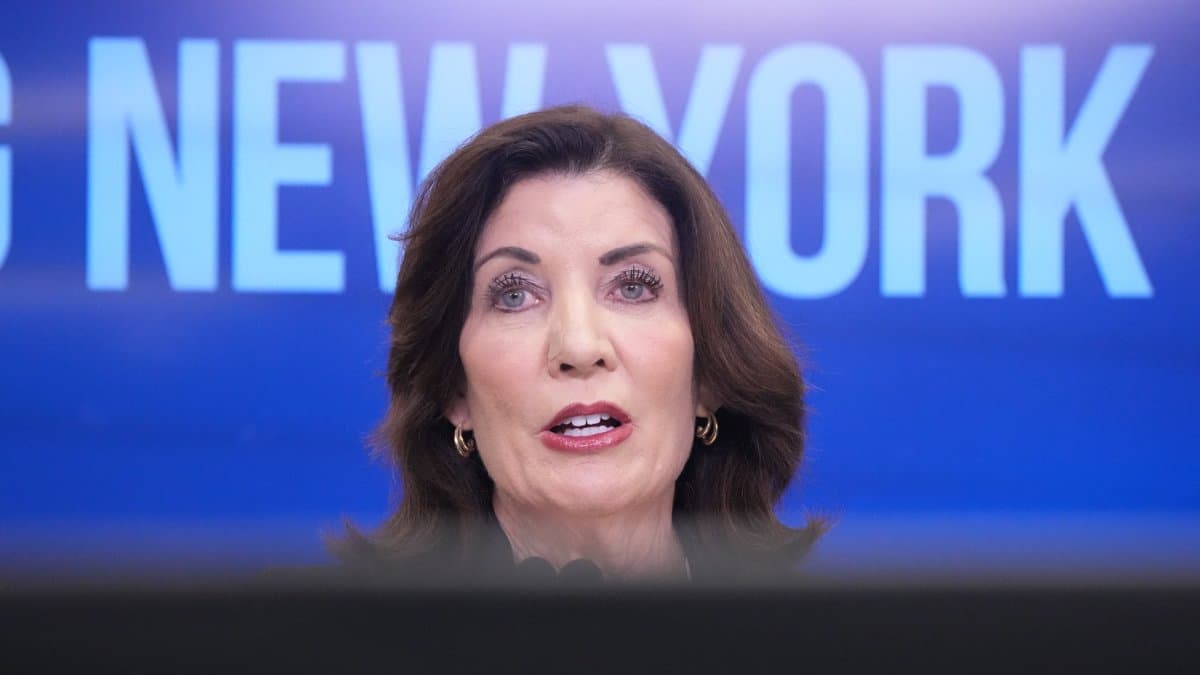
Emma Wallner, deputy press secretary for New York Gov. Kathy Hochul, a Democrat, told JNS that the governor “has committed more state funding for teacher salary and retention efforts than any of her predecessors.”
“The State Education Department, a separate entity from the governor’s office, oversees the dispersal of funding,” Wallner said. “The governor is working closely with them to ensure student and teacher success statewide.”
There are strict requirements to qualify for the teacher salary reimbursement. A teacher must have a master’s degree, for instance, and can’t teach any religious subjects. The graduate school requirement for teachers means that Chassidic yeshivas generally don’t qualify, Altfield told JNS.
To help teachers earn their graduate degrees, Teach has developed a program with State University of New York’s Empire State University, Gratz College and Touro University, according to Katz, of Teach.
State STEM reimbursements don’t cover the entire teacher’s salary, according to Katz, of Teach. The state’s budgeted amount is divided between approved schools which apply. For instance, he said, in the last round for which applications were accepted, $58 million was available, but schools applied for $134 million in total.
The average award for that year was more than $100,000 per school, so schools received 43% of what the funds for which they asked, Katz told JNS.
Delays also cause problems for schools in budgeting, hiring decisions and more, according to Altfield.
“The reality is that without money coming in the door, schools are running in the red,” she told JNS. “They have to dip into other places, reserves or scholarship funding, more fundraising from the community just to be able to stay afloat until that money comes in.”
The federal Education Freedom Tax Credit program, slated to begin in January 2027, will provide a $1,700 tax credit to each family which makes a $1,700 donation to a scholarship-granting organization. That organization will, in turn, provide scholarships of $1,700 to the school of the donor family’s choice.

But states have to opt into the program in order for their residents to be eligible for the scholarships.
Colorado Gov. Jared Polis became the first Democrat considered a possible 2028 U.S. presidential candidate to opt into the program. Kentucky Gov. Andy Beshear, Maryland Gov. Wes Moore, California Gov. Gavin Newsom, Illinois Gov. J.B. Pritzker, Pennsylvania Gov. Josh Shapiro and Michigan Gov. Gretchen Whitmer have not said if they will include their states in the program.
Hochul has also not said if she will sign the state up for the Republican program.
A source in the governor’s office said that Hochul is waiting to review program guidance from the Trump administration, which New York has yet to receive. Given the “constantly changing federal funding landscape and the president’s troubling track record,” Hochul cannot commit until she does, the source said.
“A lot of our families would benefit from this program,” Krauss, of SAR, told JNS. “It would be a real game changer.”
🛠 Do you think there is an error in this article?
Recommendations



LATEST