Nigel Farage shakes US Congress with explosive speech about lack of freedom of speech in the UK
The Briton, leader of the Reform UK party, claimed that the UK government is in a "war on freedom" situation. Farage warned Americans that these restrictions could come to their country.

Nigel Farage, leader of Reform UK.

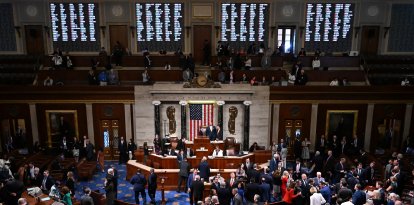
In explosive testimony, Nigel Farage, leader of the Reform UK party, appeared before U.S. Congress to denounce what he called a "war on freedom" in the United Kingdom. His speech, loaded with criticism of the British government and its legislation on freedom of expression, has ignited the debate on censorship in Europe and its possible repercussions on the other side of the Atlantic.
As reported by The Telegraph, Farage used his hearing in Washington to expose emblematic cases and warn about British laws that, in his opinion, threaten not only UK citizens, but Americans as well.
Farage asserted that the UK is in a situation of a "war on freedom." Speaking before the House Judiciary Committee, the Reform UK leader pointed out that the British Online Safety Act, known as Online Safety Act, is so "open-ended" in its wording that it "could literally mean whatever you want it to," leaving key decisions in the hands of local police forces. This ambiguity, according to Farage, allows for subjective interpretation that put freedom of speech at risk.

The Graham Linehan case
One of the cases Farage vehemently highlighted was that of the comedian Graham Linehan, creator of the Father Ted series, who was arrested by five armed officers at London's Heathrow airport because of publications on the social networking site X about transgender people. Farage described this incident as a clear example of the "war on freedom" and used it to illustrate what he considers an authoritarian overreach by the British government. "What happened to Linehan could happen to any American," he warned, underscoring the potential impact of these laws beyond British borders.
The Lucy Connolly case
Another case Farage brought to the center of his speech was that of Lucy Connolly, a woman jailed after posting a message on social networks following the Southport riots. Connolly, whom Farage described as a "political prisoner" of the Keir Starmer government, was convicted of a comment that British authorities said incited racial hatred. Farage planned to take Connolly to Congress, but her conviction prevented her from traveling to the United States. Instead, the Reform UK leader used her case to criticize what he called a "two-tier system" in the U.K., where laws are applied unequally. "Lucy Connolly is now a symbol of Keir Starmer's authoritarian and broken U.K.," Farage said.
Attacks on J.K. Rowling
The Reform UK leader also defended public figures such as author J.K. Rowling, author of Harry Potter, who he said has faced "abuse on a grand scale" for her views on the safety of women-only spaces. "She historically comes from the progressive wing of politics, but she has taken the position that women should be safe in women-only spaces. That means changing rooms," Farage noted, The Telegraph picked up. His defense of Rowling added another layer to his argument that the cancel culture and legal restrictions are stifling public debate in the UK.

JNS
US, Israel applaud France, Germany, UK decision to reimpose sanctions on Iran
JNS (Jewish News Syndicate)
Farage's appeal to Americans
Farage did not limit himself to criticizing the domestic situation in his country. In a direct appeal to the Trump Administration, he urged initiating talks with British authorities on the impact of the Online Safety Act on the rights of U.S. citizens and businesses. "I think there is a conversation to be had with the British government about the shape of their legislation and the impact it may have on American individuals, their freedom and American businesses," Farage said.
Crossovers with the Democrats
Farage's intervention was not without tension. The Democrats, led by Congressman Jamie Raskin, responded with scathing criticism. Raskin, according to The Telegraph, ironized about Farage's departure from the hearing, insinuating that the Reform UK leader was "late for a lunch with Donald Trump." Another Democrat, Jared Moskowitz, tried to pump Farage for his further plans, asking, "Free speech ... aren't you going to tell me what you're going to do this afternoon?" Farage, true to form, evaded the question with a smile.
The contrast between Farage's and the Democrats' positions became even clearer when Raskin recommended Farage bring the idea of a written constitution to the U.K., arguing that in the U.S. "freedom of speech applies 365 days a year."
Israel pulls out of major UK defense exhibition
The restrictions at the DSEI UK 2025 exhibition, scheduled to take place on Sept. 9-12, “amount to a deliberate and regrettable act of discrimination against Israel’s representatives,” a defense ministry statement read. “Accordingly, the Israel Ministry of Defense (IMOD) will withdraw from the exhibition and will not establish a national pavilion,” it continued.
Israeli industries that are not state-owned and “that choose to participate will, however, receive the Ministry’s full support,” the statement added.
“At a time when Israel is engaged on multiple fronts against Islamist extremists and terrorist organizations — forces that also threaten the West and international shipping lanes — this decision by Britain plays into the hands of extremists, grants legitimacy to terrorism and introduces political considerations wholly inappropriate for a professional defense industry exhibition,” it continued.
LATEST