Welcome to the Obamalisk
The inauguration lived up to the grandeur of the building. The four living former presidents—Obama, Clinton, Bush and Biden—were in attendance, with just one notable absence: Donald Trump, who was not invited.
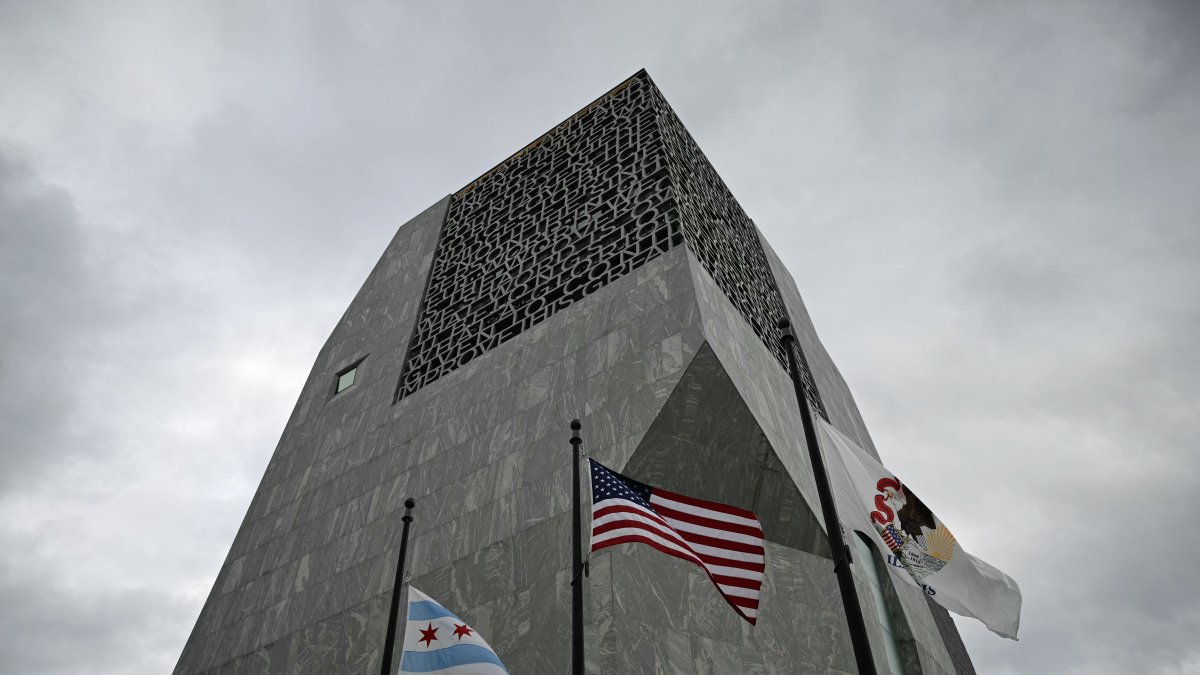
The Barack Obama Presidential Center in Chicago
The Barack Obama Presidential Center in Chicago’s Jackson Park has finally opened. Hard to miss, the nearly 230-foot-tall granite tower looms over the park on a pharaonic scale. The complex’s grounds cover an area of nearly 20 acres. The top of the tower features 91 words from Obama’s speeches carved into 433 concrete letters, each one 5 feet tall. The monstrous building quickly earned countless nicknames: the "Obamalisk" seems to be the one favored by locals. But the public’s imagination didn’t stop there. Architecture critics have described it as "a Klingon prison," "a boulder in a park," and "a shrine to [Obama] himself." On social media, it was compared to a trash can and to the set of a dystopian movie.
That final jab came recently on "Real Time with Bill Maher," when the host put a photo of the building on screen and wondered aloud why progressives like such a thing. Politico journalist Jonathan Martin completed the picture with a succinct "the Death Star," and Maher added that the building looked like "something aliens built in Dubai." He then accused his own audience of lying when they swore they planned to visit it. With headlines that kept raising the stakes: The American Spectator went so far as to call it "the nation's ugliest presidential library"; American Thinker preferred "the ugliest thing on Earth."
The most fascinating thing about this is that none of it seems to be an accident. The architects themselves almost confirm this. Tod Williams and Billie Tsien recounted that the former president repeatedly pushed them to be "bolder," that he even marked up their sketches with a bold stroke to indicate they weren’t going far enough, and that he invoked the Romanian sculptor Constantin Brâncuși because he wanted his library to be perceived as a work of art, not as a building. The shape, they say, evokes four joined hands; it also, according to Tsien, resembles a mysterious stone they found at a bazaar in Aksum, Ethiopia. When the mockery intensified, structural engineer Chris Bird came to the building’s defense, insisting that it is not a monstrosity but a "grand gesture" without architectural precedent. It’s the classic alibi: let’s claim that this horror was the plan all along.
And for those who want to take this monstrosity home, the former president’s foundation is selling $30 pins featuring the silhouette of the center, handmade from paper clay, a souvenir as oversized as its model. It is an excellent metaphor for the project: a hideous monolith turned into merchandise.
A celebration for the mausoleum
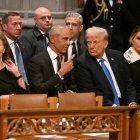
The inauguration lived up to the building’s grandiosity. In attendance were the four living former presidents—Obama, Clinton, Bush and Biden—with just one notable absence: Donald Trump, who wasn’t invited. The CEO of the Obama Foundation, Valerie Jarrett, explained that it was "a celebration for those who helped get President Obama where he is." The lineup was like an awards show: Bruce Springsteen, Stevie Wonder, Bono, Christina Aguilera, John Legend, Common and Jennifer Hudson on stage; Oprah, Tom Hanks, Anne Hathaway and Stephen Colbert in the audience. The finale featured half the pantheon of pop music singing "Higher Ground." In his speech, Obama played the modesty card: he asked the hurried attendees to "skip" the clips of his own speeches. This was endearingly contradictory for someone who had just unveiled an $850 million monument to his administration.
Joking aside, the center has some very unique features. For one thing, it will not house any physical archives, nor is it administered by the National Archives and Records Administration (NARA). It is the first entirely digital presidential library, and the presidential records are held by the federal government elsewhere, being digitized bit by bit. Its many critics argue that what was built is not so much a library as a civic activism center with a panoramic view.
Obama’s biographer and Pulitzer Prize winner David Garrow warned that the absence of a true presidential library will discourage serious research into these years. This is no minor detail. For decades, the reading rooms of these institutions were where historians and journalists pored over, page by page, the boxes of memos that provide insight into how government truly works. Replacing unfiltered access to paper documents with a digital portal curated by the honoree’s own foundation does not increase transparency—it places it under the control of the interested party.
Who’s footing the bill for this monstrosity?
Obama promised in 2018 to finance the construction with private donations, and secured a 99-year lease on the property for the modest sum of $10. What was originally estimated at $300 million ended up costing about $850 million. Along the way, subcontractors were left behind who claim they are owed millions and are facing financial ruin—a claim the foundation denies.
That symbolic rent was, moreover, the subject of a years-long legal battle. The neighborhood group Protect Our Parks took the case all the way to the Supreme Court, claimint it was a "land grab": the seizure of a public park and a ploy to "legitimize" the transfer of protected land to a private entity. Among their arguments was that the center does not even qualify as a presidential library, since it does not house the archives. Jackson Park Watch co-founder Margaret Schmid called it "astounding" to cede an irreplaceable park for $10, and legal scholar Richard Epstein, who advised the plaintiffs, said they were never able to get the foundation to open its books. The courts ruled in favor of the city, citing an exception to the Illinois Museum Act, and the Supreme Court declined to intervene. On a separate note: the center also pays no property tax.
Even more troubling, the foundation had committed to establishing a $470 million reserve fund so that, if the project ran into trouble, taxpayers wouldn’t foot the bill. On the eve of the opening, that reserve fund had about $1 million deposited in it. The foundation insists that the center is "fully funded"; Illinois Republicans insist that local residents will end up footing the bill. And although the project itself is privately funded, public coffers have already disbursed hundreds of millions on infrastructure: an entire avenue had to be demolished and traffic patterns in a protected park redesigned so that the monolith would "function" as its designers intended.
The damage is not merely aesthetic or financial. Jackson Park is not a vacant lot: it was designed by the legendary landscape architect Frederick Law Olmsted alongside Calvert Vaux, and hosted the 1893 World’s Fair. This building is embedded within that historical fabric. To reroute traffic and make way for the complex, the state of Illinois contributed $174 million in public funds to close roads such as Cornell Drive. Preservationists claimed that between 200 and 400 mature trees were cleared, and the federal review itself acknowledged that the project would diminish the park’s historic integrity. The result is a tower with almost no windows that looms, "oppressively monumental," over the low-rise neighborhoods of Hyde Park and Woodlawn, which it had promised to revitalize.
From public archive to private sanctuary
Until the mid-20th century, presidential papers were considered personal property: the heirs of Washington and Lincoln inherited and sold them, and Lincoln’s son eventually donated them to the Library of Congress. It was Franklin Roosevelt who broke the mold by transferring his documents to the National Archives and donating the museum he had built in Hyde Park to the government. The Presidential Libraries Act of 1955, signed by Eisenhower, formalized the system. They were built with private funds and then handed over to NARA, which managed them as both museums and public archives. Over the years, they multiplied across the country; the Ronald Reagan museum, overlooking Simi Valley, even displays the Air Force One he used, and its reading rooms were filled daily with researchers sifting through boxes of memos.
The system has always had its flaws. The Watergate scandal triggered the Presidential Records Act of 1978, which made those documents public, after fears arose that Nixon might destroy his own. The Nixon Library opened in 1990 as a private institution and described Watergate as a "coup d’état"; it wasn’t until 2007, after it had been federalized, that a government-appointed director mounted a controversial exhibition, and Nixon loyalists forced him to resign years later. The Presidential Libraries Act of 1986 added the requirement to establish endowment funds, and with it came even more self-serving money: from Denise Rich’s pledge of $450,000 shortly before Bill Clinton granted a pardon to her fugitive ex-husband, to corporate donors like AT&T simultaneously funding both the Kennedy and Obama libraries.
The true precedent for the Obama model, however, dates back to 2022, when NARA agreed to cede operational control of its library to the George W. Bush Foundation. Obama took that half-open door and walked right through it: total private control, federal archivists sidelined. The museum tells its own story, decides what is displayed and manages access to its legacy. It is the final step in a long shift: from public archives in the custody of the state to a sanctuary managed by a foundation.
Those who defend the monument argue that the project’s success will hinge not on the tower but on how the park and community spaces—such as the public library, the basketball court and the sports center—integrate into the neighborhood. But none of these arguments resolves the core issue. A monument may be bold or inspiring (if it ends up being what its architects envisioned), but at the same time, it strips the presidential library of its essential function: to preserve the documents so that anyone—friend or foe—can review every page. Obama built something horrible, yes. But he also set a precedent: that of presidential libraries that are increasingly shielded from accountability and historical scrutiny.
And the problem with precedents that favor the powerful is that they solidify into impunity. A granite Death Star has been erected in Chicago. What is truly grim is not its silhouette but the model it has put in orbit.
LATEST