ANALYSIS
'Die Mannschaft' caught in a self-destructive cycle
Germany's elimination from the 2026 FIFA World Cup confirms the collapse of a giant that has forgotten how to compete in soccer’s premier tournament.
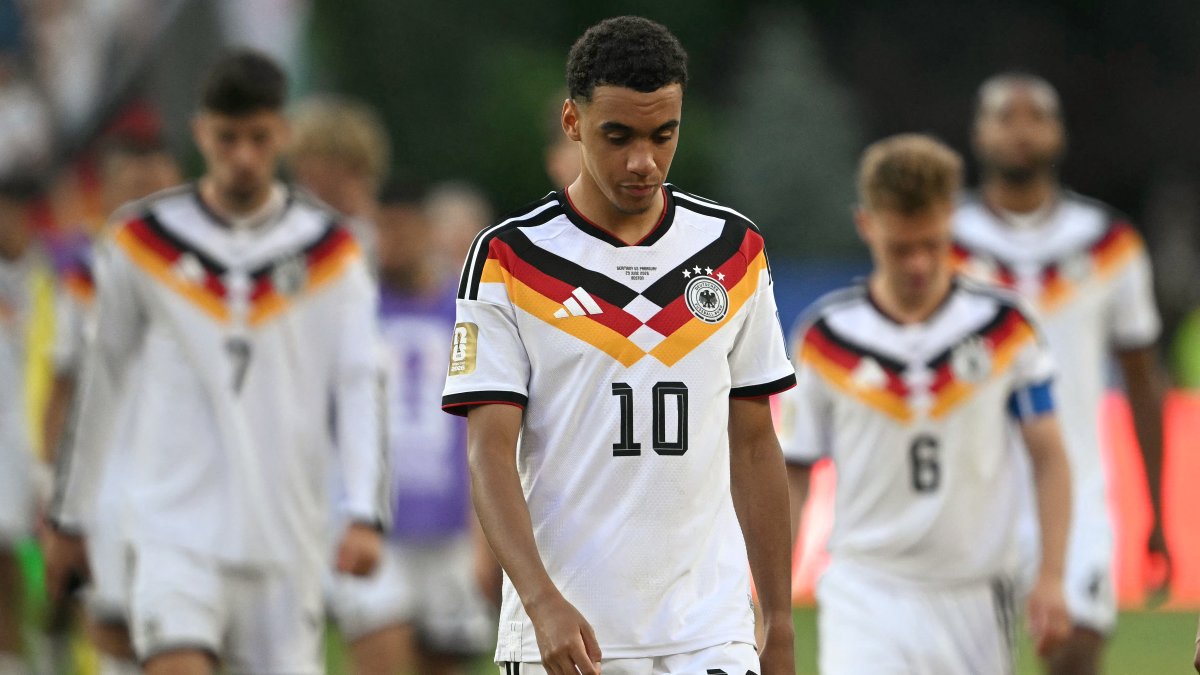
Jamal Musiala (10) dejected after Germany’s elimination from the 2026 FIFA World Cup

Ever since Mario Götze, with a legendary goal scored in extra time, sparked wild celebrations among German fans in that final played on July 13, 2014, at Maracanã Stadium (Rio de Janeiro, Brazil) against Argentina, Germany has not celebrated another victory. That title seemed to mark the beginning of a dominant dynasty; however, it was the prelude to one of the longest-lasting crises for one of soccer’s giants.
The elimination at the hands of Paraguay—a technically and tactically inferior opponent—in the round of 32 of the 2026 FIFA World Cup has confirmed the collapse of "Die Mannschaft," which still stands as the second-most successful national team in the tournament’s history—a status it shares with Italy—with four trophies in its trophy case. Its last three appearances in the tournament have been disappointing, to say the least, marking the lowest point in the modern history of German soccer. What used to be a solid and intimidating team has turned into a predictable squad lacking leadership.
Chronology of a historic crisis
To understand the critical moment the German national team is facing, we must go back to 2018. After winning its fourth and most recent FIFA World Cup title in Brazil, Germany headed to Russia in 2018 with a roster that retained Joachim Löw as head coach and featured players of the caliber of Manuel Neuer, Mats Hummels, Sami Khedira, Mesut Özil, Thomas Müller and Toni Kroos, while bringing in other stars such as Joshua Kimmich, Antonio Rüdiger and İlkay Gündoğan. However, it lost key players such as Götze, Philipp Lahm, Lukas Podolski and Miroslav Klose.
Despite starting as one of the heavy favorites, Germany ended up being the biggest disappointment of that FIFA World Cup. They were placed in a group where, on paper, they were expected to finish first. However, they finished last, behind Sweden, Mexico and South Korea. Their record was one win—against Sweden (2-1)—and two losses—against Mexico (0-1) and South Korea (0-2). In other words, they were eliminated at the very first hurdle.
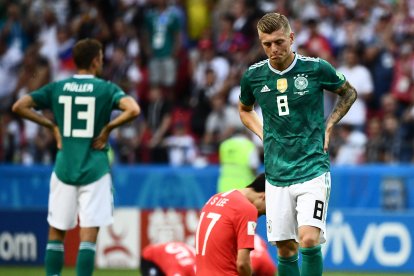
Toni Kroos (8) laments Germany’s elimination from the 2018 FIFA World Cup. File photo
That initial disaster marked the end of Löw’s tenure as head coach of the German national team and the arrival of Hansi Flick, the current coach of FC Barcelona. With him came a revolution in the squad: heavyweights like Kroos, Özil, Khedira and Hummels were no longer called up —either because they retired or because they no longer fit into the new coach’s plans— and promising young players like Jamal Musiala and Kai Havertz arrived, destined to be the generation that would lead the country back to glory. But it didn’t go as planned.
Qatar 2022 rolled around, and once again, it was goodbye before the knockout stage. Japan and Spain finished ahead of Germany in the group stage, where Germany managed to earn only four out of a possible nine points. The loss on the first matchday against Japan (1-2) was the catalyst for Germany's elimination in a FIFA World Cup that Argentina would ultimately win.
In North America, the Germans arrived with a new coach, Julian Nagelsmann, and a revamped roster that included players such as Florian Wirtz and Aleksandar Pavlović, among others. The 2026 FIFA World Cup began in the best possible way for Germany: a resounding victory over Curaçao (7-1). This was followed by a hard-fought win against Ivory Coast (2-1) and a loss to Ecuador (1-2). Despite that last poor result, "Die Mannschaft" advanced to the knockout stage. Their run in the tournament ended when Paraguay knocked them out in a penalty shootout after a 1-1 draw in regulation time.
"Devastating, an embarrassment"
The dire situation facing a team as iconic as Germany’s has sparked a wave of criticism from respected German figures. One of them is Jurgen Klinsmann. The former coach of Germany from 2004 to 2006—who also coached Bayern Munich and the United States—called the loss to Paraguay at the 2026 FIFA World Cup "an embarassment."

Jurgen Klinsmann during a press conference. June 2026
"Obviously it's a very sad day for all of us in Germany, because we didn't expect going out in the round of 32," he said in an interview on ESPN. "And the way we went out is hugely, hugely disappointing. ... It seemed like the team was not prepared to take control of matters during the 120 minutes. They were not energetic enough, decisive enough, aggressive enough to win this battle. ... The way we went out tonight is devastating, is an embarrassment."
"It's pretty much as horrible as the exits were in Qatar four years ago, and in Russia eight years ago. ... So this takes Germany into a huge, huge hole," Klinsmann concluded.
The loss of that competitive and intimidating spirit that Germany has always possessed stems from a clear lack of sports planning—specifically, how to replace the strengths that are gradually fading and how to counteract the persistent weaknesses. Now, it’s up to the German Football Association to decide whether to continue with Nagelsmann at the helm and the same core group of players or to carry out a new revolution that will finally bear fruit. Because Germany, at this moment, is no longer among the elite of world soccer.
LATEST