New era of spending cuts begins: Trump’s rescissions bill heads to Senate vote
The administration has sent a $9.4 billion rescissions bill. The last time Congress approved such a package, proposed by the White House, was for fiscal year 1999.

President Donald Trump/ Brendan Smialowski
It's hard to find a government that wants to cut its own spending. The Trump administration is trying. Last month, it sent Congress the first rescissions package to codify some of the DOGE (Department of Government Efficiency) cuts. This is the first of several packages President Trump wants to send to cut state spending. It has already passed the House and is now in the hands of the Senate.
The last time Congress passed a rescissions package proposed by the White House was for FY 1999. The package already in the Senate seeks to return more than $9 billion previously appropriated by Congress but not yet spent. Only 51 votes are needed for passage, so that they can get it through without Democratic help, but some Republican senators have already expressed doubts about their vote.
Passage would be an essential start to the spending cuts Congress needs to implement this term and to the series of rescission packages the president wants to push through. It would cut $9.4 billion, rescind $8.3 billion from foreign aid programs, including funds from the USAID liquidation, and also cancel $1.1 billion in funding for the Corporation for Public Broadcasting (CPB), which includes funding for NPR and PBS.
In the vote in the House, all Democrats voted against it, and what we are seeing is the opposition of two diametrically opposed ways of understanding the role of the state. While President Trump wants to cut spending on international aid and media funding, Democrats claim that the administration wants to cut the critical assistance and direct that money to the wealthy.
Going more to the heart of the matter, Trump's vision is to generate prosperity through job creation and strengthening the economy. The Democrats' vision is that the only way to help people is through financial aid and subsidies. For Democrats, creating the environment for business generation and entrepreneurial growth is "benefiting the rich," for this administration, and generally for the Republican tradition, that means helping the working class.
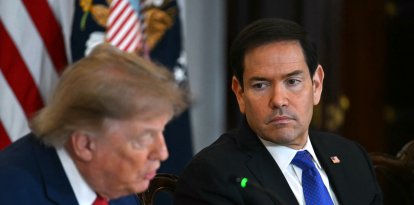
Secretary of State Marco Rubio has been clear that from now on U.S. foreign aid must be conditional and limited, assuring that the U.S. cannot use its taxpayers' money as if they were a charity. The foreign aid issue is the particular reason why a couple of Republican senators have expressed doubts about the package.
While the foreign aid discussion is valid, depending on how you approach it, taking money away to fund NPR and PBS shouldn't even be an issue worthy of debate. In a world where anyone has access to information, even from their phone, what's the point of using taxpayer money to fund media? Less so when it is evident that they have a clear editorial line contrary to the ideas represented by the current Administration.
Indeed, $9.4 billion is not much when put in perspective with the large deficit the country is running. However, this package represents the administration's commitment to turn into law the cuts that DOGE has been achieving. It is also the beginning of several efforts that lawmakers in Congress will surely have to make to move forward in passing cuts.
The passage of this rescissions package marks the beginning of a new era, implying a significantly different political environment than that of the past four years. It is an administration asking Congress to reclaim funds, and Congressmen are willing to cut spending, even if that means enduring criticism and explaining to their constituents the importance of the cuts.
LATEST