The Awakening of Latin America
For the first time in a generation, a significant number of Latin American leaders are attempting structural reforms rather than managerial adjustments.
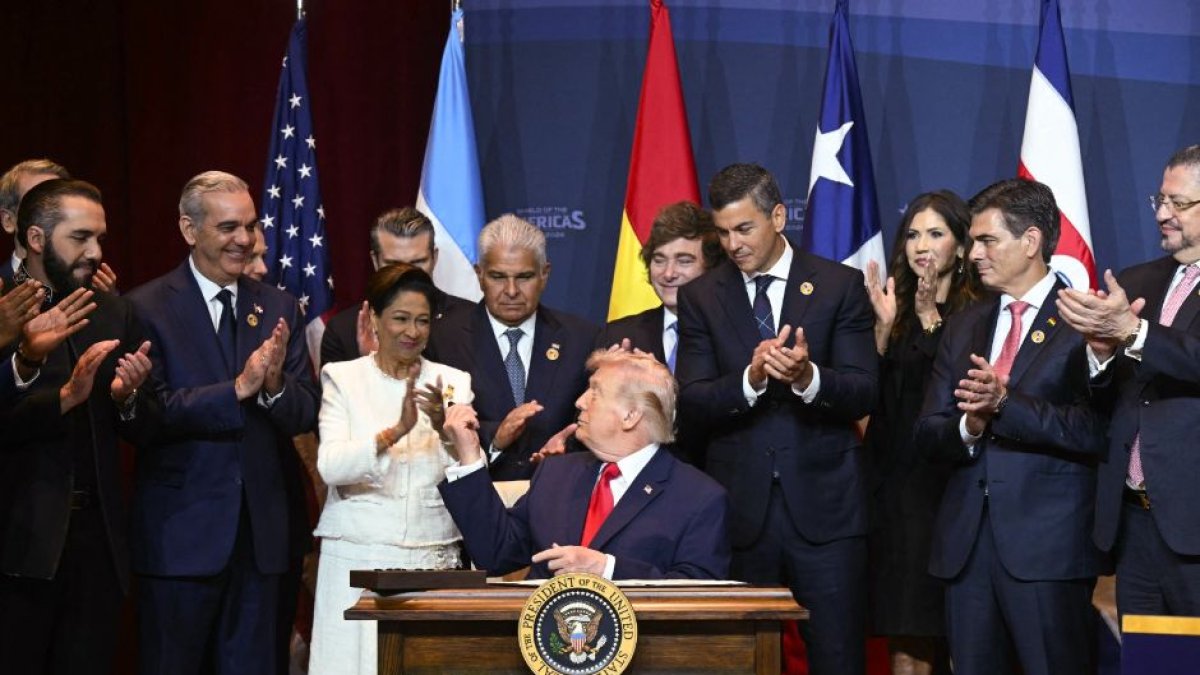
Trump alongside other right-wing leaders from Latin America and the Caribbean
Not long ago, if you had predicted that in 2026, Latin America would be drifting to the political right, most analysts would have laughed.
I know I would have.
Growing up in Bolivia, it often felt like the country—and much of the region—was trapped in a political cycle that never really changed. Populist leftist governments promised dignity, social justice, and redistribution to poor and indigenous majorities. What followed was always the same: corruption scandals, multiplying regulations, weakened political institutions, and stagnating economic growth. Even when voters got frustrated and rebelled, new leaders came in promising to run the same system more responsibly. Then, inevitably, the cycle would begin again.
But something different is happening now. On Wednesday, we saw another conservative president taking office in Latin America. The shocking part about it is that it no longer felt shocking.
We are witnessing a regional awakening across Latin America.
Across Latin America, voters are increasingly electing leaders who are not promising to manage the existing order more efficiently but to challenge it outright. Argentina’s Javier Milei is dismantling a state apparatus that strangled the economy for decades. In Paraguay, Chile, the Dominican Republic, and Costa Rica, conservative movements are gaining ground by arguing that the governing structures of the past generation are simply no longer fit for purpose. This year, Peru, Colombia and Brazil might be next.
What is unfolding in our hemisphere is a complete collapse in patience with systems that stopped delivering security, prosperity, or basic competence. Voters are no longer asking themselves which party will run the current system better. They are increasingly asking themselves whether the whole system needs to be rebuilt.

For years, politics across much of the hemisphere resembled an old, collapsing house. Everyone knew the wiring was faulty, the roof leaked, and the foundation was cracking and unstable. Yet every election produced the same promise: a few cosmetic repairs and maybe even a fresh coat of paint.
Then President Donald Trump arrived on the global stage and showed he wasn’t willing to repair the house anymore, he was ready to start knocking down walls.
President Trump has shown us something that reverberated far beyond the United States: institutions that elites often treat as permanent can be challenged after all. Rules that appear set in stone often endure only because no one has seriously attempted to move them. The limits of the possible were wider than we had all been told.
That realization is playing out differently in each country. Argentina’s long crisis grew from runaway inflation and a bureaucratic state that suffocated enterprise. Venezuela demonstrated the catastrophic endpoint of oil-funded socialism coupled with authoritarian rule. In Mexico, the political establishment long insisted that cartel power was simply a necessary evil or a permanent problem people would just have to learn to live with. What distinguishes many of the hemisphere’s new conservative leaders is not simply their policy agenda but their willingness to confront institutions and ideas that previous generations treated as immovable.
That lesson landed in Latin America at a moment when many societies were already exhausted with systems that no longer worked. For years, we all silently lamented that the system was too entrenched to change.
It turns out it wasn’t.
The failure of socialism, communism, and narco-authoritarian rule was becoming harder to ignore. People were living with the consequences every day—economic collapse, insecurity, corruption—and this was felt across the entire Western Hemisphere. Eventually, people stopped pretending everything was fine.
This does not mean Latin America is becoming a mirror image of American politics, or that it should. No leader in the region is Donald Trump, and no one could be even if they tried.
But Trump changed things for all of us.

For decades politicians were told what could not be done. Now a growing number of leaders are accepting that sometimes the long shot actually works. That discovery is transforming politics across the hemisphere.
The left, on the other hand, often finds itself defending the institutional architecture built during earlier reform cycles, and their instinct is to preserve and repair those systems.
The new right’s instinct is different. If the house is collapsing, stop repainting it. Build something better.
For the first time in a generation, a significant number of Latin American leaders are attempting structural reforms rather than managerial adjustments.
From Washington’s perspective, this moment carries enormous strategic importance. A hemisphere governed by stable, sovereign, and economically dynamic states is the first line of defense for the United States, and it’s in our best interest. Stronger governments across the region reduce migration pressures, weaken transnational criminal networks, and limit the ability of external powers such as China, Russia, and Iran to establish footholds in the Americas.
That is why the renewed attention to the Western Hemisphere from the Trump administration matters.
The United States cannot and should not determine the political future of its neighbors. But it can support governments that pursue economic reform, confront criminal power structures, and defend national sovereignty.
We are already beginning to see that shift take shape. We saw it this weekend at the Shield of the Americas summit, where governments across the region aligned more openly with the United States on security cooperation, cartel disruption, and the need to push back against foreign influence in the hemisphere.
But looking across the Americas today, one thing is clear: the region is no longer content to keep layering another fresh coat of paint on the old house. More leaders are willing to redraw the blueprint entirely.
Once people realize the walls can move, the entire house starts to change.
LATEST