Ayatollah Khamenei rejects White House proposal on nuclear deal: 'You cannot have a say'
On Monday, Donald Trump warned that the U.S. would not allow Iran to enrich uranium as part of any "possible deal," a demand Tehran considers a red line.
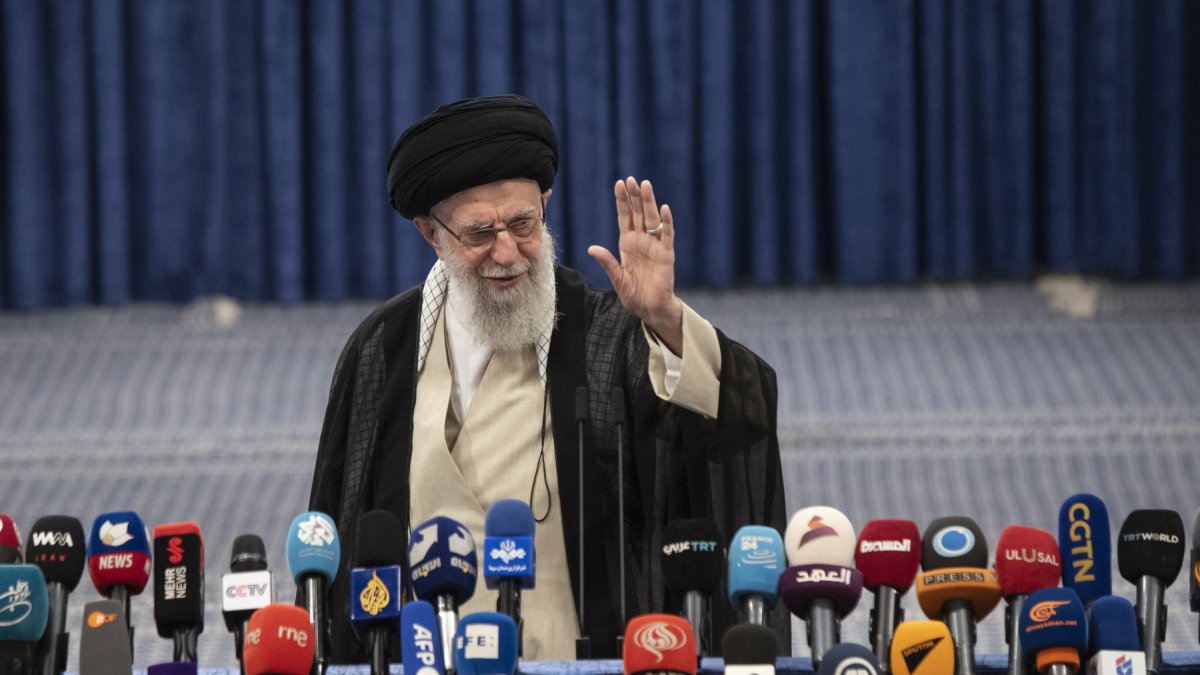
Iranian Supreme Leader Ali Khamenei at a conference after casting his vote.
Iran’s Supreme Leader Ayatollah Ali Khamenei said Wednesday that the U.S. proposal for a nuclear agreement runs counter to the country’s national interests.
Iran and the United States began negotiations in April, with Oman mediating, to reach an agreement on Tehran’s nuclear program. However, after five rounds of talks, the latest session in late May ended without a breakthrough.
The proposal on Iran’s nuclear program put forward by the Americans is 100% contrary to the slogan ‘We Can,’” said Ayatollah Khamenei, referencing a core principle of the 1979 Islamic Revolution centered on the country’s independence.
Witkoff proposal
“Special envoy Witkoff has sent a detailed and acceptable proposal to the Iranian regime, and it's in their best interest to accept it,” Leavitt stated, according to media reports.
The proposal follows a recent U.N. report indicating that Iran has increased production of highly enriched uranium.
On Monday, U.S. President Donald Trump warned that the country would not allow Iran to enrich uranium as part of any "possible deal"—an issue Tehran considers a red line.
In a speech commemorating the 36th anniversary of Islamic Republic founder Ruhollah Khomeini’s death, Khamenei said his country’s independence means "not waiting for the green light" from the United States.
"Why are they interfering in whether Iran should have enrichment or not? You cannot have a say," Khamenei said.
Western powers, led by the United States, accuse Iran of seeking nuclear weapons—a claim Tehran denies, insisting its program is solely for civilian purposes.
In 2015, Germany, China, the United States, France, the United Kingdom, and Russia reached an agreement with Iran to limit Tehran’s nuclear program to civilian purposes in exchange for sanctions relief.
Washington unilaterally withdrew from the deal in 2018 during the first Trump administration, prompting Iran to gradually step back from its commitments.
LATEST