Life imprisonment for former South Korean President Yoon for declaring martial law
The Seoul Central District Court finds him guilty of "leading an insurrection" in 2024, with huge social costs for the country, and without the convicted "having shown remorse for it."
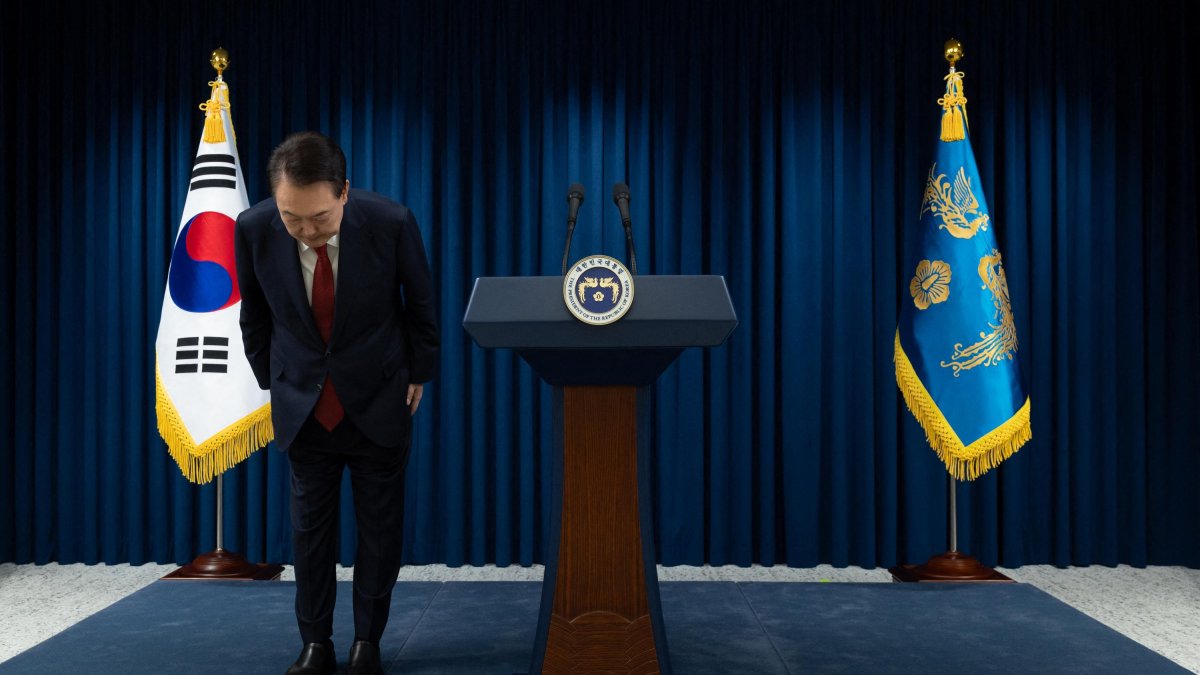
Yoon Suk Yeol apologizes in a message to the nation.

A South Korean court on Thursday sentenced former President Yoon Suk Yeol to life in prison after finding him guilty of leading an insurrection by declaring martial law in late 2024. An act that "resulted in huge social costs, and it is hard to find any indication that the defendant has shown remorse for it," said Judge Ji Gwi-yeon of the Seoul Central District Court.
Yoon declared martial law in a televised message to the country in December 2024, saying drastic measures were needed to eradicate "anti-state forces." The 65-year-old conservative former president was removed from office, detained and charged with a range of crimes from insurrection to obstruction of justice.
Judge Ji recalled that Yoon sent military personnel to the legislative headquarters to silence his political opponents. "The court found that the intention was to paralyze the assembly for a considerable period," the judge said.
Meanwhile, former Defense Minister Kim Yong-hyun was sentenced to 30 years in prison for his role in the crisis.
Prosecutors sought the death penalty for Yoon
Prosecutors pushed for the stiffest sentence on insurrection charges against Yoon, and asked the Seoul court to sentence the former president to death.
Thousands of supporters rallied outside the capital's court with banners reading "Yoon, great again" or "drop the charges against Chairman Yoon." Policemen dressed in neon-colored jackets were deployed in front of the court to prevent any unrest over the verdict.
"Anti-state forces"
On the night of Dec. 3, 2024, Yoon appeared on television to announce the move, citing unclear threats of North Korean influence and dangerous "anti-state forces." He then declared the suspension of civilian rule and the start of military command.
Martial law was lifted six hours later, when deputies, aided by protesters, managed to break through the security forces' siege and vote as a matter of urgency to reverse Yoon's move.
"Safeguarding freedom" in the face of "opposition-led legislative dictatorship"
South Korea has been a beacon of democracy and stability in Asia, but Yoon's failed attempt revived memories of military coups that rocked the country between 1960 and 1980.
Yoon, who has been in solitary confinement, denies wrongdoing and claims his actions were intended to "safeguard freedom" and restore constitutional order in the face of what he called an "opposition-led legislative dictatorship."
The prosecution accused him of leading an "insurrection" driven by a "dictatorship-oriented desire for power and long-term command." Under South Korean law there are only two punishments for insurrection: life imprisonment or death.
Yoon had previously been sentenced to five years in prison for misdemeanors, while a number of senior officials were sentenced for their role in martial law.
LATEST