ANALYSIS
The Hispanic vote in the 2026 midterms: The lesson the GOP can't ignore
In these elections, the majority of Latinos sided with the Democrats, reversing much of the ground Trump had gained in 2024 and leaving the GOP with the urgent task of reconnecting with an electorate that remains open to parts of its agenda, but who felt punished by the perception of indiscriminate immigration policies and by the economic impact.
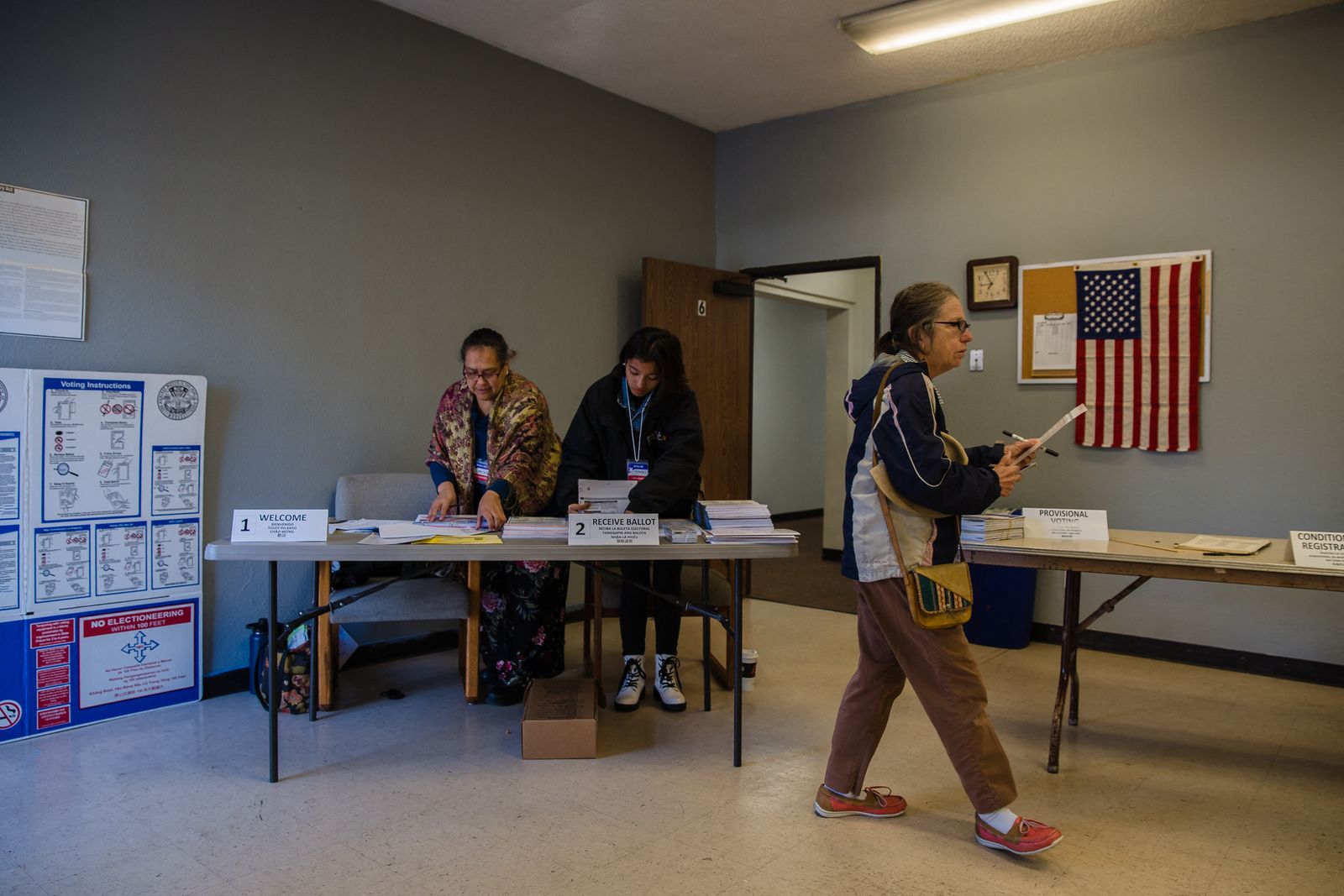
A voter receives assistance at the Hispanic Presbyterian Church

The Hispanic electorate once again demonstrated that it is neither a monolithic bloc nor a captive base for any party. In the midterms, the majority of Latino voters sided with the Democrats in the House of Representatives, reversing much of the ground that President Donald Trump had gained in 2024 and leaving the Republican Party with an urgent strategic task.
The statistic that changed the night
AtlasIntel's national poll, conducted between Oct. 28 and Nov. 1, 2026, among 3,566 U.S. adults with a margin of error of ±2 points, gave the Democrats a 14.1-point lead in the generic House race: 55.5% to 41.4% for the Republicans.
But the most significant finding for the GOP was the weight of the Latino electorate. AtlasIntel estimated that approximately one-third of the night's surprise was attributable to the Hispanic vote, a group that in 2024 had shown a shift in support toward the Republican Party but that in 2026 largely returned to the Democratic side.

The setback of 2024
In the 2024 presidential election, Trump won nearly 44% of the Hispanic vote and came close to tying with Kamala Harris, a historic result for a Republican candidate. That gain was driven by the strong mobilization of conservative Latinos in Florida, the growing receptiveness of voters of Cuban and Venezuelan descent, and gains among sectors that traditionally supported the Democratic Party.
Two years later, much of that progress had evaporated. According to AtlasIntel's exclusive poll of Latino voters, more than 60% of those who participated in the 2026 midterms voted for the Democratic candidate for the House.
The message is not that Hispanics have massively abandoned the Republican Party for ideological reasons. Rather, a significant portion of the voters who supported Trump in 2024 no longer saw his administration as a satisfactory response to their immediate priorities.

Immigration: The issue that weighed heaviest
Immigration was the most decisive factor. The 64% of the Latinos surveyed believed that the administration's immigration policies were "biased and unfair" toward their community, a perception fueled by ICE and by the feeling that law enforcement does not distinguish clearly enough between undocumented immigrants, legal residents and U.S. citizens of Hispanic origin.
For a party that has made border security one of its strongest platforms, the challenge is not to abandon that agenda, but to better explain its scope. The Latino electorate does not necessarily reject order at the border; it rejects the perception that immigration enforcement operations indiscriminately extended to neighborhoods, workplaces, and communities where law-abiding families live.
Trump's approval rating among Hispanics fell considerably below the national average. Other polls published on the eve of the election already showed a sharp decline. According to the Pew Research Center, the presidential approval rating among Latinos fell from 38% recorded at the start of his second term to levels close to 24% in October 2026.

A real, but not automatic, Republican base
It would be a mistake to interpret the result as a definitive defeat for the GOP among Hispanics. The reality is more complex. Although most Latinos do not strongly identify with any party, among those who do have a partisan identity Republican identification predominates, in part due to the historical influence of the Cuban and Puerto Rican communities.
Furthermore, the Latino electorate did not reject all elements of the conservative agenda. As AtlasIntel points out, because they are less ideologically anchored, Latinos are more open to Trump's agenda than the rest of the electorate. Their support on specific issues ranges from a net positive of +20 points on fossil fuels to +10 on recognition of the gender binary, figures that contradict the notion that this demographic automatically shares the priorities of the progressive left.
Trump's intervention in Venezuela also had the support of the majority of Latino respondents, although it was not a decisive factor in their voting decisions on Nov. 3.

The weak point: Medicaid and the economy
The greatest disagreement was not over foreign policy or cultural values, but over the economy and social programs. Cuts to Medicaid resulted in a net −31 points among Latino voters, the most negative result in the poll.
This finding ties into a broader concern about the cost of living. Pew Research identified that the 86% of Latino voters consider the economy "very important," and details concerns about the cost of housing (80%), gas and energy (80%), food (78%), health care (77%) and unemployment (59%). Immigration also ranks as a key priority (64%).
For the GOP, the conclusion is clear: an agenda focused on growth, jobs and relief from the cost of living can effectively compete for the Hispanic vote; a narrative perceived as cuts to healthcare and indiscriminate immigration pressure, however, cannot.

A Message for the GOP
The Republican Party has a real chance if it articulates a message that clearly distinguishes three things: controlling crime and smuggling at the border, protection of working families and respect for those who live and work legally in the United States.
The alternative is to repeat the mistake of 2026: assuming that the gains of 2024 were permanent and discovering, on election night, that the Hispanic electorate remains one of the most decisive and least predictable in the country.
🛠 Do you think there is an error in this article?
Recommendations





LATEST