





White House highlights Christopher Columbus' perseverance: Seven years of setbacks and his determination not to turn back until he found the New World
The initiative, marking Columbus Day, is part of President Donald Trump's effort to restore a historical figure whom the cultural left has tried to consign to oblivion for years.
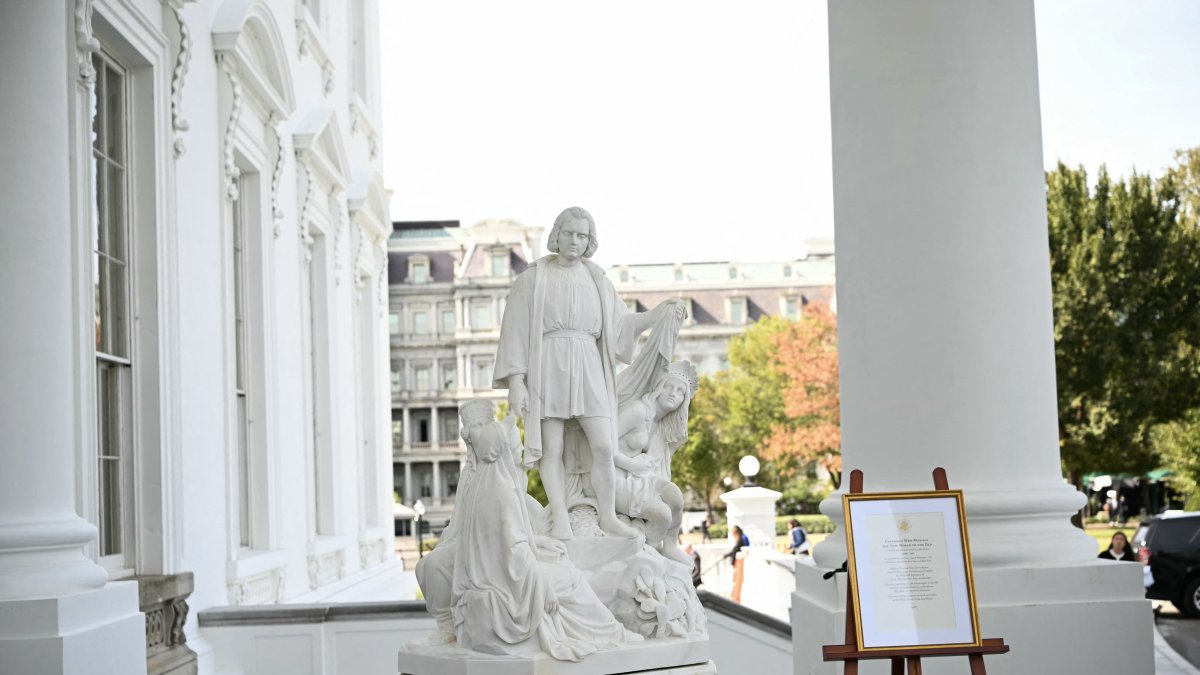
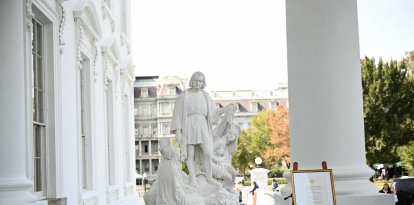
A statue of Christopher Columbus ahead of its permanent relocation in the White House

The White House has published an extensive tribute to Christopher Columbus on the occasion of Columbus Day, in which it presents the Genoese navigator as the man who paved the way to the New World and established the first permanent contact between Europe and the Americas.
The initiative is part of President Donald Trump's effort to restore a historical figure whom the cultural left has tried to consign to oblivion for years.
A sailor trained in the Mediterranean
According to the official account, Christopher Columbus was born in 1451 in the Republic of Genoa, one of the leading maritime powers of the Mediterranean, and was the son of Domenico, a wool weaver. From a very young age, he took to the sea, and years later, he settled in Lisbon after surviving a shipwreck off the coast of Portugal.
In 1476, off Cape St. Vincent in Portugal, his ship was attacked and set on fire. Wounded, he clung to an oar and swam several miles until he reached the coast, after which he settled in Lisbon. There he married Filipa Moniz Perestrelo, drew up navigation charts with his brother Bartolomé, and sailed to the Portuguese fort at Elmina on the Gold Coast.
Columbus observed the winds blowing westward near the Canary Islands and those blowing eastward further north, and devised his plan to reach Asia by sailing directly west.

Seven years of rejections
The tribute highlights Columbus's persistence in the face of years of rejections. King John II of Portugal rejected his proposal in 1484, and two years later, the Catholic Monarchs referred the plan to a commission that took years to respond.
In January 1492, following the conquest of Granada, the court once again rejected his terms. Columbus set out on a mule, but the royal treasurer, Luis de Santángel, convinced the queen that the risk was small and the reward enormous. A royal messenger caught up with him at the Pinos Puente bridge and ordered him to return.
History
Hispanics in World War II: The forgotten effort that changed the United States
Carlos Dominguez
The agreement that changed history
On April 17, 1492 in Santa Fe, on the outskirts of Granada, the Capitulaciones were signed. Columbus was granted the title of Admiral of the Ocean Sea, governance over the lands he discovered, and one-tenth of the riches they produced—rights that could be passed on to his heirs.
On August 3, 1492, the expedition set sail from Palos de la Frontera with three ships and about 90 men: the Santa María, commanded by Columbus; the Pinta, under Martín Alonso Pinzón; and the Niña, under Vicente Yáñez Pinzón. After repairing the Pinta's rudder on La Gomera, the fleet set sail westward on September 6.
Columbus kept two navigation logs: one recording the actual distance traveled and a shorter one for the crew, so as not to alarm them. On October 7, he altered the course to the west-southwest after observing large flocks of birds. Three days later, the crew demanded to turn back, but Columbus refused and stayed the course.

The landing that connected two worlds
On the night of October 11, Columbus thought he saw a light on the horizon. At 2:00 a.m. on the 12th, the lookout on the Pinta spotted land. At dawn, Columbus disembarked carrying the royal standard, knelt on the sand, and named the island San Salvador; its inhabitants, the Lucayos, called it Guanahani.
For the White House, that moment marked the beginning of an irreversible connection between two worlds that had been unknown to each other until then. Columbus later undertook three more expeditions, completing a total of four transatlantic voyages.

From the beach to Columbus Day
The commemoration of the landing became one of the oldest traditions in the United States. In 1792, the St. Tammany Society of New York celebrated the 300th anniversary of the voyage; in 1882, Father Michael McGivney founded the Knights of Columbus; and in 1892, President Benjamin Harrison called on the nation to commemorate the 400th anniversary.
The World's Columbian Exposition in Chicago attracted some 27 million visitors in 1893. In 1937, Franklin D. Roosevelt proclaimed October 12 as Columbus Day, a holiday that was moved to the second Monday in October in 1971.
History
The indelible Hispanic heritage in the US: Even cowboys and mustangs have Spanish origins
Juan Carlos Téllez
Trump revives Columbus
In 2025, Trump reinstated the name "Columbus Day" and described the explorer as "the original American hero, a giant of Western civilization, and one of the bravest and most visionary men ever to walk the Earth."
The White House's message is clear. Columbus is not a figure who should be erased from history, but a symbol of boldness, faith and determination who paved the way for the creation of the most prosperous nation in history.
LATEST