Neither Democrat nor Republican: Why the Hispanic voter remains the ‘swing voter’ who decides US elections
To try to answer this question, Voz spoke with several Hispanic experts in the U.S.: David Alandete, a Spanish journalist and White House correspondent for the newspaper ABC with several years of experience in Washington; Emmanuel Rincón, a writer, consultant and political analyst based in the U.S.; Daniel Chang, a political scientist with a master's from American University; and Andrés Guilarte, a conservative pollster and vice president of public opinion research at EyesOver Technologies and Stratus Intelligence.
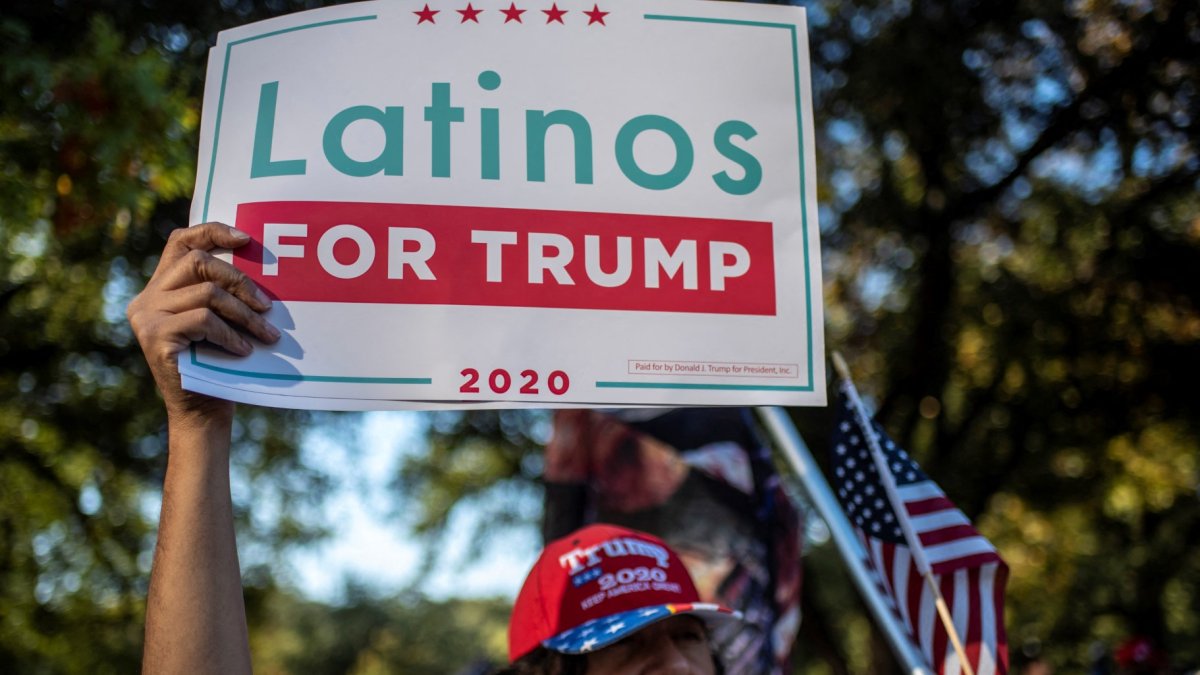
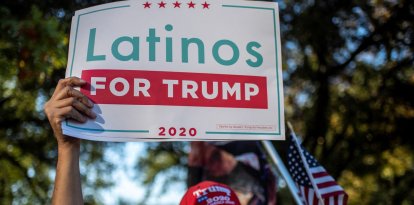
A man holds a "Latinos for Trump" sign at a protest following Joe Biden's victory in 2020

The U.S. has officially entered the final stretch of the campaign leading up to the midterms on Nov. 3. These pivotal elections could determine how President Donald Trump will end his second term — with or without the support of Congress — and, therefore, how his legacy will shape future generations and the Republican Party itself, which is already assessing what life will be like after the Trump phenomenon leaves the political arena.
As the elections approach, with so much at stake — inflation, the cost of living, the AI race, the immigration debate, war in Iran and the situations in Venezuela, Cuba and Latin America — there is an electorate that could tip the balance in many swing counties: Hispanics.
Although the Hispanic electorate has historically been significantly more Democratic than Republican — due to sociopolitical factors that are more circumstantial than ideological — this trend has shifted considerably over the past 10 years. Hillary Clinton was the first to see this trend reverse. While former President Obama won 71% of the Hispanic vote in 2012, the Democratic candidate only received 66% against President Trump in 2016, who performed similarly to Romney in 2012 — and this was decisive in winning swing states that were decided by a narrow margin: Florida, Nevada, Arizona. In addition, Hispanic voter turnout increased slightly, rising from 11% to 12%. In 2018, the Democrats slightly improved on Clinton's performance, reaching 69% of the Hispanic vote, but the key figure was how many people actually turned out to vote: "A record 40% of the Hispanic population eligible to vote turned out in 2018. That was an increase of approximately 50% from 2014, which was roughly double the increase observed among non-Hispanic white Americans," CNN reported.
By 2020, to the surprise of many, Hispanic voters began to shift considerably to the right. Trump won 32% of the vote among this demographic, with Republicans consolidating Florida — once a swing state — as a red stronghold. Something similar happened in Texas, a state that Democrats have targeted for decades and which actually shifted even more noticeably toward the GOP, even in border counties like Zapata.
By 2024, Hispanic voters had definitively shifted: Kamala Harris garnered only 53% support, while Trump received 45% among this group. In other words, Hispanic support for Trump surpassed the results achieved by Ronald Reagan (37% in 1980 and 34% in 1984) and George W. Bush (44% in 2004). However, two years later, with the midterms approaching, it appears that Hispanics might return to the Democratic Party, driven especially by the cost of living, inflation and hardline immigration policies associated with ICE.
Therefore, the immediate questions are: Why are Hispanics considered "swing voters"? Why do the two major parties struggle to understand Hispanic voters? And what could the parties do to secure this crucial voting bloc in Florida, Texas, Arizona, Nevada, Georgia and other swing states that consistently determine the outcomes of general elections and midterms? To try to answer these questions, VOZ spoke with several Hispanic experts in the U.S.: David Alandete, a Spanish journalist and correspondent for the newspaper ABC at the White House with several years of experience in Washington; Emmanuel Rincón, a writer, consultant, and political analyst based in the U.S.; Daniel Chang, a political scientist with a master's from American University; and Andrés Guilarte, a conservative pollster and vice president of public opinion research at EyesOver Technologies and Stratus Intelligence.
The four agree on one basic premise: talking about "the Hispanic vote" as if it were a homogeneous bloc is, from the outset, a mistake in analysis. "There is no single Hispanic voter," Alandete warns. "A Cuban from Miami, a Mexican from South Texas, a Puerto Rican from Orlando, and a recently naturalized Venezuelan may share a language but little else politically."
Pollster Guilarte offers a similar explanation: "The behavior of Hispanic voters varies considerably depending on their country of origin or cultural heritage, as well as on the state or region of the United States where they live."
Chang reaches the same conclusion from a different angle — that of length of time in the U.S. and the importance of foreign policy. "There are first-generation Hispanic voters, others who are second-generation, and still others whose families have been in the United States for generations," he says. "There are voters who have come from Venezuela or Cuba, for whom foreign policy matters a great deal, and voters whose families come from Mexico or have been in Texas for hundreds of years, for whom those issues do not matter as much." Rincón agrees with this specific example: Venezuelans and Cubans in Florida "tend to be more Republican because of their anti-communist struggle," while other Hispanic groups react more strongly to the foreign policy of the White House toward their own countries, depending on who is in power at any given time.

The economy above all else
If there is one thing that unites these four analyses, it is the centrality of the economy. Rincón sums it up this way: "Naturalized Hispanic U.S. citizens do not differ from traditional voters in terms of their primary needs, and the economy is always the No. 1 priority."
Guilarte adds several other issues that tend to matter to Hispanics, but always keeps the economy as the top priority: "Contrary to what Democrats have often assumed, Hispanic voters are not mobilized solely by issues of identity or immigration, but primarily by the economy. The economic situation goes through cycles of growth and contraction, driven by factors both within and outside the United States, and this leads a significant portion of this electorate to adjust their behavior according to current conditions and their perception of the status quo.
After the economy, issues such as immigration, security and education also tend to rank high among the priorities of the Hispanic electorate."
Chang, from his perspective as a political scientist, describes the Latino voter as someone who is "quite pragmatic," who "is not necessarily aligned with a particular party," and who "seeks to reward or punish the party that offers the results they need."
Alandete supports this interpretation with data from Pew Research, explaining that, in 2024, 85% of Hispanic voters said the economy was very important in deciding their vote, a figure that rose to 93% among those who supported Trump. "That says much more than many theories about identity," the ABC correspondent argues. As he explains, that was precisely Trump's achievement in 2024: making the election "less like a debate about identity and more like a referendum on the economy, security and the border."
Chang offers a historical contrast that explains the current shift. In his view, in 2024, "following a series of setbacks—particularly under the Biden administration and regarding inflation” — Hispanic voters backed Trump and the Republican Party in an effort to recapture "that economic boom of Trump's first term," when minorities — Asians, Hispanics and Blacks — enjoyed record gross incomes until the pandemic hit the global economy. But in 2026, with the economy "in a complex situation, especially due to oil prices and the war in Iran," many Hispanics have simply become more skeptical of the Republicans.
That said, Chang clarified that "this does not mean that Hispanics have returned to the Democratic Party," but rather that Hispanic voters continue to evaluate results, and at this moment "they are not as happy with the Republican Party's performance in government."
Just The News
Hispanic voter shifts could threaten Republican redistricting advantage in midterms
Just The News/Steven Richards
Why the traditional parties fail to understand this
Experts agree that both parties have misread the situation, although they differ slightly on the nuances. Rincón asserts that the Democrats did not deliberately seek to lose the Hispanic vote — something the Republicans do seem to be aiming for with their harsh immigration policies, especially with ICE detentions of immigrants seeking asylum in counties with high Hispanic populations.
"I genuinely don't believe the Democrats had any specific policy aimed at opposing Hispanics," he said. "What happened is that they veered into such foolish radicalism, with their woke policies completely out of step with the values of Hispanic voters, which ultimately forced them to reject these policies."
Chang offers a more structural explanation, linked to the very nature of the bloc. According to him, Hispanic voters are "the only demographic bloc in the United States that is not currently truly partisan," unlike other electorates already consolidated around a party, where "it is difficult to sway them from one side to the other." That lack of structural loyalty, he argues, ultimately worked against both parties equally: the Democrats "believed that Latinos would vote for them indefinitely," mistakenly assuming that the Hispanic vote depended solely on the issue of immigration, and the Republicans, after winning in 2024, "considered them basically in the bag," without subsequently delivering on their promises.
Alandete frames this within a broader problem inherent to the U.S. capital itself. "Washington tends to reduce highly complex communities to electoral categories," he says. "People talk about the 'Latino vote' the way they used to talk about the 'Catholic vote' or the 'union vote.' But the more a population integrates into the United States, the less it votes exclusively based on identity issues." Added to that is a problem of pace: "The Hispanic electorate changes very quickly. There are millions of new voters, different generations and enormous geographic and social mobility. The parties develop strategies based on the previous election, and by the time the next one rolls around, the landscape has already shifted."
Meanwhile, Guilarte notes that both parties have had their successes and failures. For example, he explains that the Democrats have managed to win the Hispanic vote in progressive states like New York and California, while the Republicans have been more effective at engaging Hispanics in Florida and Texas. Likewise, while the Republicans have made inroads among South Americans, the Democrats have done the same with Central Americans.
"This is due to historical and political factors specific to each community. For example, among some Hispanic Republicans there is a strong aversion to socialism, which they associate with sectors of the Democratic Party," said Guilarte, who then elaborated on both parties' campaigns targeting Hispanics. "Second, the Democrats have understood for many years the importance of communicating in Spanish with Hispanics in the United States. Meanwhile, the Republican Party still resists, in some parts of the country, fully incorporating Spanish into its campaigns and communication strategies. The Democrats have also made a considerable effort to include Hispanic candidates and staff members, which can foster a greater sense of representation and belonging among these voters."
ICE: The point where the Republican strategy fell apart
If there is one issue on which nearly all voices agree almost word for word, it is the assessment of immigration raids. No one questions border control itself, which they describe as a genuine demand shared by a large portion of the Hispanic electorate. The problem, they insist, lies in enforcement within the country.
Rincón puts it bluntly. He acknowledges that closing the border "was a very important necessity for the United States" and even "one of Trump's best policies," but he questions what came next: "What's the point of closing the border if you then start, within the country itself, to deport people with pending cases — or at least those who didn't yet have a final deportation date — to imprison people with no criminal record whatsoever, and to do all these kinds of things that are very unpopular across the political spectrum, but particularly and especially among Hispanics?" His final warning is aimed directly at the midterms, since that unpopularity, in his view, could end up returning power to the Democrats without the political sacrifice having been worth it.
Chang agrees with this assessment, though he emphasizes voters' surprise at the actual scale of the raids. "While it is true that Donald Trump ran on an explicit promise of mass deportations, I think many Hispanic voters did not imagine it would be carried out in this way." As he explains, most Hispanic voters are not directly affected by the detentions, but they do have family members or friends who have been, "and I think that has hit them hard."
Alandete provides statistical support for this interpretation. According to an August poll of 1,500 Latino voters in competitive districts cited by the journalist, ICE had a 64% unfavorable rating, while the economy remained a greater concern than immigration itself.
"There's a difference between supporting border control and supporting a policy of indiscriminate raids that target communities, workplaces or families that have been established for years — especially against people who are in the asylum process or who have just lost temporary protection," he said. "Trump gained ground among Hispanics precisely because he stopped treating them exclusively as immigrants. The risk for Republicans now is to turn them back into nothing more than immigrants."
Guilarte also explained that three factors during the Biden administration account for the historically high level of support the Republican Party among Hispanics in 2024: the handling of inflation, the narrative that new immigrants were "cutting in line" and accessing benefits that other, long-established Hispanics did not have, and the rejection of socialism among new voters of South American origin. These three factors, he argues, gradually faded during the first two years of Trump's second term, especially because the economy did not improve and because the rejection of newcomers was replaced, in certain sectors, by the perception that immigration policy no longer distinguishes between undocumented immigrants and Hispanics in general, "fueled by reported cases of U.S. citizens of Hispanic origin being detained, as well as by the detention and deportation of individuals who had pending cases with the federal government and no criminal records."
What each party still needs to do
The recommendations of the four experts, looking ahead to the midterms, ultimately converge on separating the enforcement of immigration law within the country from the border debate, and putting the economy back at the absolute center of the message.
Guilarte also believes that Republicans should make a stronger commitment to communicating in Spanish and to bringing more Hispanics into the party, something that, according to him, has nothing to do with "identity politics" but rather with competing in an arena where Democrats have had a decades-long advantage. He also argues that immigration policy needs a clearer and better-communicated message: many Hispanics who supported Trump wanted order at the border and the deportation of people with serious criminal records, but that support erodes when law enforcement seems unable to distinguish between those who followed the legal process and those who truly pose a threat.
Finally, the pollster called for deepening the hemispheric focus already being promoted by Trump and Rubio through the Shield of the Americas, by adding economic alliances and support for democratic institutions in countries such as Venezuela, with the idea that a stronger region would reduce migratory pressure and allow the Republican Party to present itself to Hispanic voters as a defender of those same values.
Chang frames this in terms of historical continuity. He points out that Republicans such as Bush Sr., Bush Jr., and Trump himself managed to win over the Hispanic vote when they focused on the issues that truly mattered to that community: "the economy and security" in 2004, and "the economy and immigration — especially at the border — in the case of 2024." His recipe for the present combines low taxes and economic stability with a specific approach to immigration, in which the White House and the GOP remain strict at the border, but seek "some kind of immigration settlement" for those who are already in the country, pay taxes, and have not committed crimes. "I think the majority of the American public agrees with that," he argues. "It's just that neither party has managed to translate that common ground into concrete public policy."
Alandete proposes a similar roadmap. He suggests that the White House emphasize that "ICE's priority is criminals and people with deportation orders", thereby reducing cases that create a sense of arbitrariness, and that it clearly separate border policy from policy toward those who have been living in the country for years. But he places the real focus on the economy, citing a recent survey at Texas where 70% of Hispanic voters disapproved of how the cost of living and gas prices were being handled, while also noting that Democrats have regained the lead in the question of who can lower prices in the most competitive districts.
Rincón concludes with a similar idea, but set in the specific context of Florida. He mentions the pent-up discontent among Cubans and Venezuelans due to the lack of concrete progress in the democratic transition that Trump promised for their countries of origin, and emphasizes that this specific discontent adds to— rather than replaces — the economic and immigration concerns shared equally by the entire Hispanic electorate.
Ultimately, all three agree that no party will be able to consistently retain this electorate by appealing solely to identity or campaign promises without verifiable results. "For decades, Washington viewed Hispanics as an electoral minority. They are increasingly coming to resemble what they actually are: a huge and diverse segment of the American middle class," Alandete stated.
LATEST