







Spain: General strike organized by the left against opposition conisidered a 'failure'
The two main labor unions, which are aligned with left-wing party PSOE and Prime Minister Pedro Sánchez, called for a general strike that did not draw the level of participation they had hoped for.
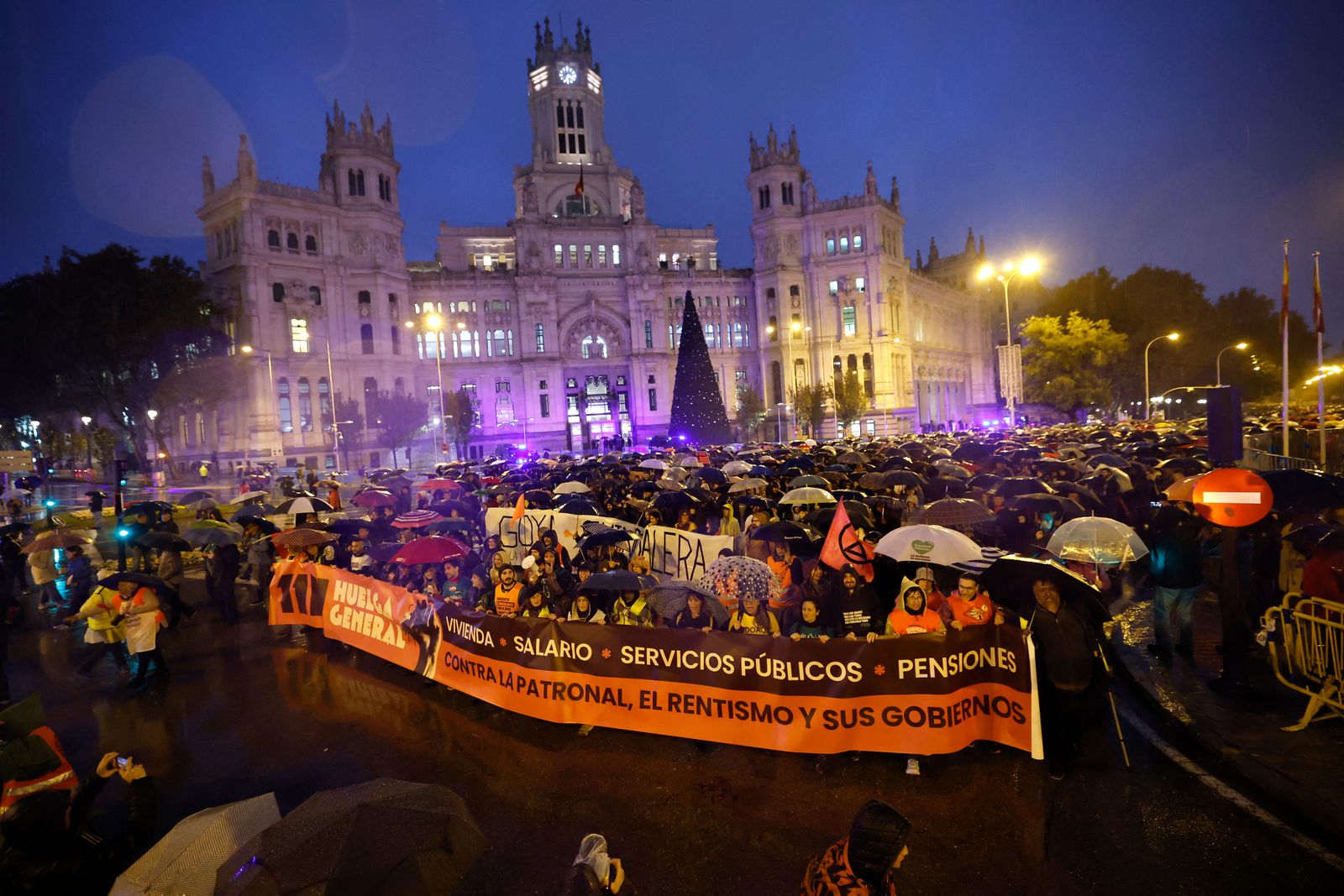
Protest in Madrid, Spain, on Nov. 11, 2026, during the general strike called by the unions

The general strike in Spain called by the country's two main unions three weeks before the general election ended up being a "failure."
The work stoppage, organized by the General Union of Workers (UGT) and the Workers' Commissions (CCOO)—both loyal to the Spanish Socialist Workers' Party (PSOE) and the government of Pedro Sánchez, did not attract the level of participation that Spain's two most powerful labor unions had been hoping for over the past few weeks.
In Spain's major cities, including Madrid and Barcelona, thousands of people represented by the UGT and CCOO took to the streets to protest against high rent prices and precarious wages—the alleged reasons behind this strike.
However, the demonstrations did not draw the turnout both unions had hoped for.
According to the Spanish Confederation of Business Organizations (CEOE), the this day of general strike was a "failure."
"It was a strike of historic lows at both the sectoral and regional levels. In short, it was a failure," the CEOE stated in a statement.
"Business activity is proceeding normally in most sectors and regions, with the strike having a greater impact in areas and sectors with higher union membership. Thus, according to the data received, participation averaged less than 5% at the regional and sectoral levels. In any case, the highest participation rates were recorded sporadically in large, heavily unionized companies based in major cities," it added.
What did occur were various altercations that resulted in dozens of arrests, blocked roads and damage to businesses and urban property, according to police sources.
A general strike "against the opposition"
Although both the UGT and CCOO maintained from the outset that this general strike was over housing costs and low wages, Pedro Sánchez's own government was pointing in another specific direction.
Maria Jesus Montero, a prominent PSOE figure who until recently held the position of deputy prime minister and minister of finance, stated a few weeks ago that the general strike was called to protest "against the opposition."
"Generally, general strikes are called against governments, and in this case, it is being called against the opposition," Montero said on Oct. 6.
PSOE attacked the two main opposition parties, the People's Party (P.P.) and Vox, for "blocking" two measures proposed by the Sánchez administration that were supposed to improve the housing market. That is why Montero and other socialists cited the opposition as the reason for calling the general strike.
On Nov. 29, Spain will hold general elections, which were called a few weeks ago by Prime Minister Pedro Sánchez. Virtually all polls, with the exception of those conducted by the government, show a shift, with P.P. winning the election and Vox entering the Spanish government for the first time in its history.
🛠 Do you think there is an error in this article?
Recommendations





LATEST


