







Iranian regime threatens to attack US bases in Europe if Washington uses them to bomb Tehran
Rezaei's threat is not the first of its kind. In late September, an adviser to Iran's new Supreme Leader, Mojtaba Khamenei, hinted that the war could "spread even further, reaching the Indian Ocean and perhaps beyond."
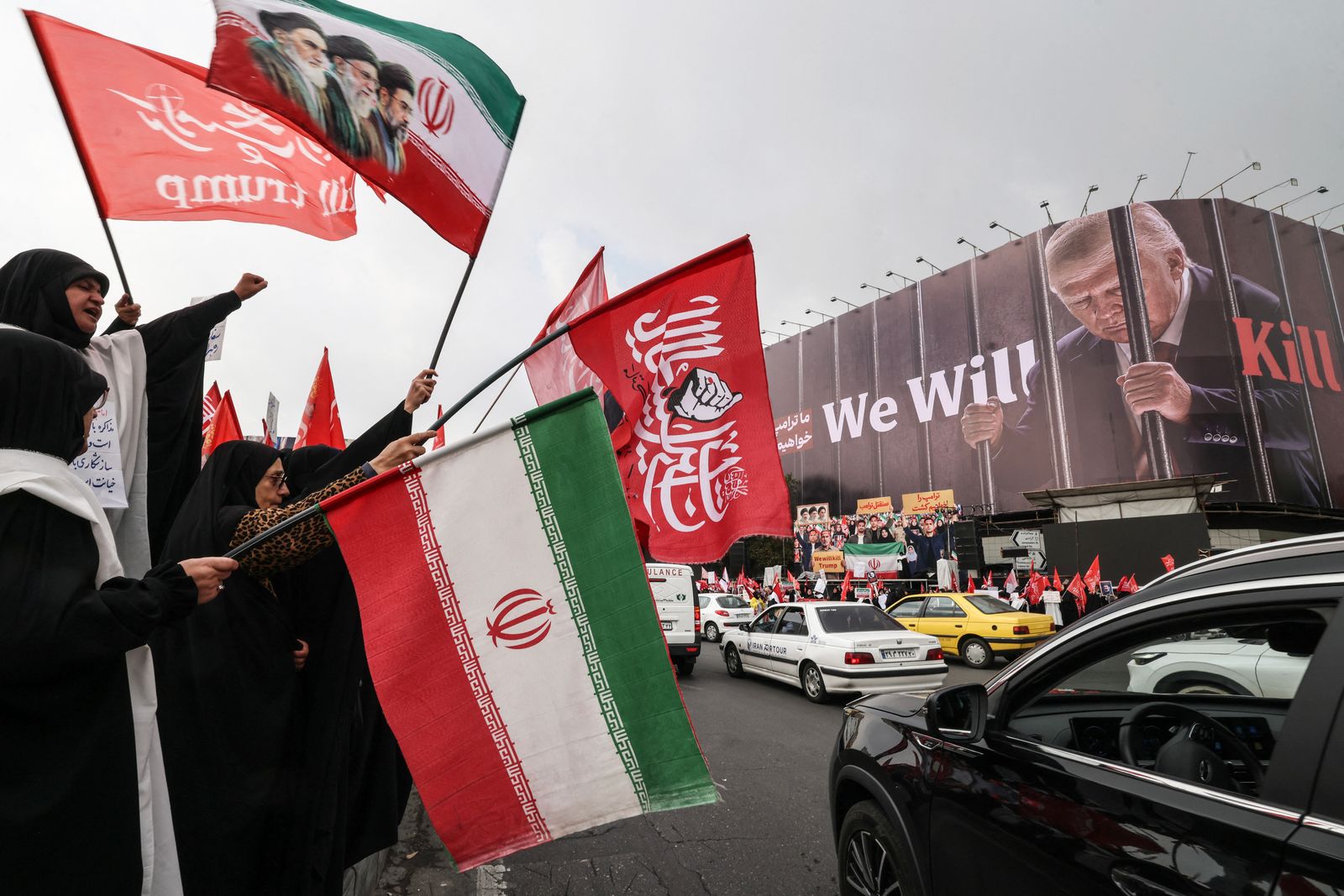
A protest in front of a billboard criticizing the U.S.

The secretary of the Iranian regime's Supreme National Security Council, Mohsen Rezaei, warned on Wednesday that Tehran would attack U.S. bases outside the Middle East, including those located in Europe, if Washington uses them to launch attacks against Iran.
"If U.S. aircraft take off from a U.S. military base—even one located in a European country or some other distant region—to bomb Iran, we will also attack those bases," Rezaei said in an interview with the Al Mayadeen, based in Lebanon.
A threat that extends beyond the region
The Iranian security official added that Tehran's response could target "more distant U.S. military installations" and, potentially, "certain islands they consider to be beyond the range of our missiles." The warning represents a rhetorical escalation, as it suggests that Iran does not rule out extending the conflict to European territories or the Indian Ocean.
Rezaei's threat is not the first of its kind. In late September, an adviser to Iran's new Supreme Leader, Mojtaba Khamenei, hinted that the war could "spread even further, reaching the Indian Ocean and perhaps beyond." The Indian Ocean is home to the Diego Garcia military base, operated by the U.S. and the United Kingdom, which was already the target of a missile attack in March.
Europe in the crosshairs
The explicit mention of European bases marks a new development in Iranian rhetoric, which until now had focused on U.S. facilities in the Middle East. The warning takes on greater significance following the revelation, in September, of an alleged Tehran-backed plot against the British air base at RAF Fairford, used by the U.S. military for operations related to Iran.
The Department of Justice (DOJ) announced on Tuesday that it had filed charges against three Iranian-backed operatives—Mohammad Baqer Saad Dawood al-Saadi, Mohsen Mohajeri and Mohammad Ali al-Hassani—for their involvement in nearly 20 terrorist attacks and attempts in Europe and the United States in support of the Iranian Revolutionary Guard Corps (IRGC) and Kata'ib Hizballah. Among the incidents are the foiled plot against the RAF Fairford base, as well as attacks against Jewish institutions in Europe and an attempted attack on a synagogue in Manhattan. One of the defendants, al-Saadi, was already in custody in the United States and, according to the indictment, continued to coordinate operations from prison using coded messages.

Economic pressure and negotiations
Despite the threatening tone, diplomatic efforts continue. Qatar and Pakistan are leading negotiations to find a way out of the conflict, while Washington has softened its rhetoric following the Republican defeat in the midterm elections, partly due to the war's unpopularity.
Secretary of State Marco Rubio stated on Tuesday that it was not necessary to resume large-scale combat operations against Iran, citing efforts to weaken its economy. The Iranian regime, for its part, is demanding the unfreezing of assets and the lifting of sanctions in exchange for reopening the Strait of Hormuz, which has been blocked since the start of the conflict.

The nuclear program is off the table
Iran's nuclear program, with uranium enriched to 60 percent—close to the 90 percent threshold required for an atomic bomb—has been one of the main sources of tension between Iran and the West for years. The United States and Israel have repeatedly cited the nuclear program as part of their justification for war, although Rezaei made it clear that Tehran is not willing to negotiate on this front for now.
🛠 Do you think there is an error in this article?
Recommendations




LATEST


