The Trump administration bans the import of new Chinese humanoid robots to protect AI development in the United States
The decision stems from concerns that AI-powered robots could collect confidential information at strategic facilities in the country and transfer it to the Chinese regime.
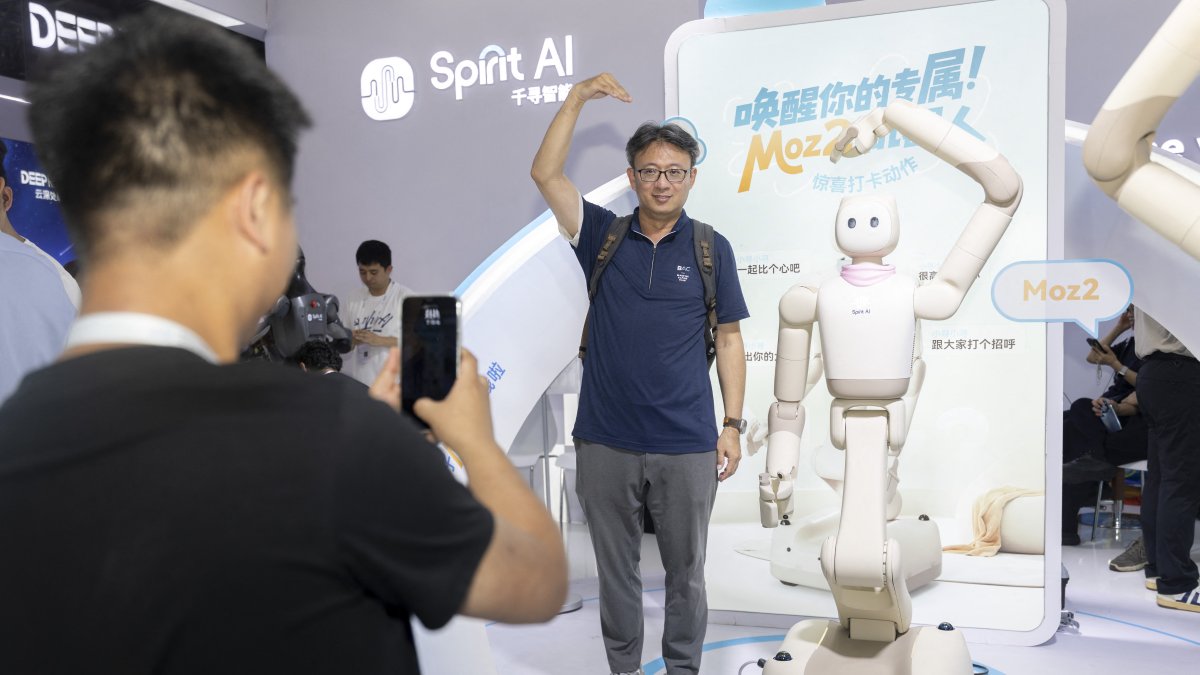
A visitor and a humanoid robot make heart gestures while posing for photos during the 2026 World AI Conference in Shanghai.

President Donald Trump's administration announced on Tuesday a ban on the importation of new models of humanoid, quadruped, and AC-powered robots from China.
The restrictions, effective immediately, aim to safeguard the U.S. artificial intelligence ecosystem against risks of espionage and cyberattacks, according to an exclusive report by the agency Reuters.
The measure, made official by the Federal Communications Commission (FCC), covers devices critical to the operation of data centers and power grids. According to the regulatory agency, this Chinese-made equipment poses a direct vulnerability that hostile actors could exploit to disrupt economic activity or compromise national security.
A regulatory shield against espionage and data vulnerabilities
The decision addresses concerns that robots equipped with artificial intelligence could collect confidential information at strategic facilities across the country and transfer it to the Chinese regime.
"These devices could create vulnerabilities in the supply chain that could disrupt U.S. economic and national security and could create a cybersecurity risk that would threaten U.S. critical infrastructure," the FCC stated in an official press release.
For his part, the agency's chairman, Brendan Carr, emphasized that the FCC will continue to take action to "secure America's critical supply chains."
The ban directly affects leading companies in the sector, such as Unitree, a Chinese firm that dominates nearly one-fifth of the global humanoid robotics market and was recently added to the Department of Defense's list of companies backed by the Chinese military.
Likewise, the restrictions extend to manufacturers of power inverters—devices essential for connecting renewable energy sources and batteries to the power grids that supply AI data centers—a sector led globally by Chinese firms such as Sungrow and Huawei.
Legislative support and redefining industrial competition
The government initiative received strong support on Capitol Hill. Republican Congressman John Moolenaar, chairman of the House Select Committee on China, praised the executive branch's decision, stating that the FCC's measure "protects our country and strengthens our nation's robotics industry."
The restrictions imposed by the Trump administration apply to those robot models and inverters that have not yet received commercial authorization in the U.S. market, although the regulator retains the authority to revoke existing permits.
With this step, the White House seeks to prevent dynamics of strategic dependence similar to those that occurred in the rare earth sector, while promoting the shift of high-value technology manufacturing to the domestic industry.
LATEST