US pledges $2 billion to UN for humanitarian aid in 2026
Secretary of State Marco Rubio stated that the United States remains the most generous nation in the world when it comes to life-saving humanitarian aid. However, he assured that under President Trump's leadership "taxpayer dollars will never fund waste, anti-Americanism or inefficiency."
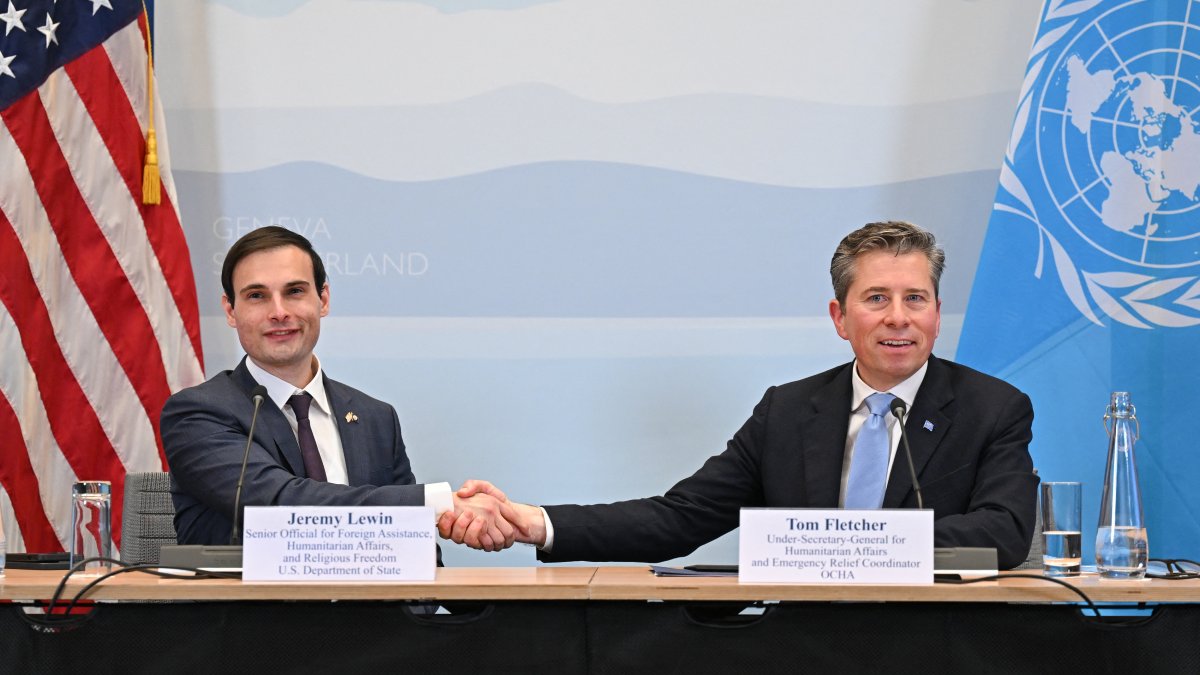
Under Secretary of State for Foreign Assistance Jeremy Lewin with U.N. Under Secretary General for Humanitarian Affairs Tom Fletcher.

The United States pledged $2 billion on Monday for United Nations (UN) humanitarian aid in 2026, against a backdrop of drastic cuts to foreign assistance pushed by President Trump.
The announcement was made in Geneva by Jeremy Lewin, undersecretary for foreign aid, and Tom Fletcher, the U.N.'s emergency relief chief, who presented an adjusted plan calling for $23 billion to assist at least 87 million people at greatest risk.
That "hyper-prioritized" plan, which also calls for reforms to improve the effectiveness of the humanitarian system, is "based on untenable life-and-death decisions," the official said. He said he hoped that making these "difficult decisions" would serve to convince the Americans to return.
For his part, Lewin said at a press conference in Geneva on Monday that "The piggy bank is not open to organizations that just want to return to the old system," and assured that "President Trump has made clear that the system is dead."
A reduction in superfluous spending
Secretary of State, Marco Rubio, declared Monday on X that the United States remains the most generous nation in the world when it comes to life-saving humanitarian aid. However, he assured that under President Trump's leadership "taxpayer dollars will never fund waste, anti-Americanism, or inefficiency."
"Today, the @StateDept and United Nations signed an agreement that radically reforms the way the U.S. programs, funds, and oversees UN-administered humanitarian work, ensuring that more lives will be saved for fewer U.S. taxpayer dollars," Rubio said in a statement.
"This new model will better share the burden of UN humanitarian work with other developed countries and will require the UN to cut bloat, remove duplication, and commit to powerful new impact, accountability and oversight mechanisms," the secretary of state added.
A vote of confidence
For his part, Tom Fletcher welcomed the new funds, saying they would save "millions of lives."
"Just announced $2 billion US contribution in support of our plan to save 87m lives in 2026," he wrote on X.
"Thank you to President Trump, Sec. Rubio and Jeremy Lewin for powerful vote of confidence in Humanitarian Reset: neutral, efficient, lean, locally led humanitarian action. Let’s deliver," he added.
The U.S., a generous country
Among the crises the UN wants to prioritize in 2026, they include Gaza and West Bank, for which the UN is claiming $4.1 billion to assist 3 million people, and another $2.9 billion earmarked for Sudan with the aim of helping 20 million people.
LATEST