ANALYSIS.
Trump 2.0: A hurricane start to a year stalled in courts and streets
From a record 100 executive orders on his first day to unified AI legislation, the president's first year back in the White House has been marked by intense reforms and a heightened international prominence.

Donald Trump at the American Business Forum.

Before his second inauguration, Donald Trump joked about setting up a small office on the Capitol steps and begin signing executive orders right there. While he did not go that far, the president's initial legislative activity broke all existing records, launching an overwhelming start to the legislature across all areas, with special attention to the border, the economy, and his war against "wokeness." This frenetic pace tempered over the months, but the opposition still has not found a way to slow it down, not even with the longest shutdown in history, except through appeals to the courts and the mobilization of the far left in the streets.
The best analogy for this first year is American football. With a quarterback, Trump himself, throws a long pass, then races downfield to catch his own throw. He dodges defenders and drags along those trying to tackle him, slowing but never stopping his relentless advance.
Amid it all, Trump has also shaken the foundations of the world order. His signature mix of punitive and reciprocal tariffs and the agreements arising from that threat with multiple countries, allies or rivals, to balance the U.S. trade balance. This recalibration of foreign policy also extended to the peace agreements he has brokered, even in long-frozen conflicts, the military strike against Iran to halt its uranium enrichment program and curb its path toward a nuclear bomb, and the escalation of the drug war in the Caribbean.
The sprint of the executive orders
While the exact count of executive orders taken by Trump in his first days is debated, depending on whether one counts only formal executive orders or includes proclamations and presidential memoranda, the final tally in his first 100 days exceeded 140. In fact, he had already reached 100 such actions on his very first day.
The highlights that day touched on core issues like immigration. He signed the Declaration of a National Emergency at the Southern Border, which allowed the deployment of the military, resumed construction of the border wall, and reinstated the "Remain in Mexico" policy. He also ended automatic birthright citizenship for children of undocumented immigrants.
Another key initiative was the official redefinition of gender and the elimination of DEI programs across the federal government. By executive order, the administration now legally recognizes only "two sexes, male and female." The president also directed an end to widespread remote work for federal employees and implemented a hiring freeze.
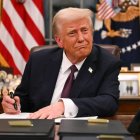
He also initialed the U.S. withdrawal from the Paris Climate Agreement. On climate change and energy, Trump declared an emergency to eliminate restrictions on oil and natural gas, promising to eliminate wind farm leasing and the electric vehicle mandate.
Pardons for Capitol storming. Trump announced the issuance of pardons and commutations for people convicted or indicted for the 2021 Capitol storming.
In these early stages of the legislature, the headlines were shared with the DOGE, led by Elon Musk, which emphatically began its charge to trim the size of government.
A disoriented and radicalized Democratic Party
A situation that has allowed the rise of new leaders within the much more radicalized Democratic Party, such as the socialist Zohran Mamdani, mayor-elect of New York, or an increasingly leftist discourse of Democratic legislators and governors to try to mark territory before Trump and their own voters. A clear example is that of Senate Minority Leader Chuck Schumer, who went from nearly losing his seat for averting Trump's first government shutdown to receiving harsh domestic punishment for prolonging the second despite the cost to citizens.
"The most secure border in history"
Illegal immigration was the defining battle of Donald Trump's campaign for the White House. Faced with record numbers of illegals entering and being released under the Biden administration's "catch and release" policy, the president has pursued a radical agenda of mass deportations and border closures from the very start of his second term.
Thus, Trump boasts of having achieved "the most secure border in the history," with several months in which there are hardly any entries of illegals and, above all, without a single one having been released on national territory in the last six months. The data of encounters, moreover, remain around 90% below those that occurred during the peak of entries with Biden.
In addition, hand-in-hand with border czar Tom Homan and Homeland Security Secretary Kristi Noem, ICE has launched a series of campaigns and deportation raids in major cities across the country that have resulted in the detention and removal of more than half a million irregular immigrants with criminal records and the self-deportation of 1.6 million undocumented immigrants.
The economy, stronger, although there are doubts about the impact of the tariffs on prices
The economy, one of the keys that brought him to the White House again, has been one of his priorities, and the results of his measures have been the subject of in-depth analysis. According to White House estimates, the U.S. has raised trillions in investments from companies and countries. In addition, many companies have announced that they will move production within our borders.
Just The News
Trump calls critics of his tariffs ‘fools,’ says Americans could receive $2k dividends
Just The News/Nicholas Ballasy
Despite initial doubts, especially about the impact of tariffs, the U.S. economy has continued to grow steadily and solidly, with a small scare in the first quarter of the year, with a 0.1% contraction, which was followed by a rebound to 3.8% in the second quarter and an estimated 3.9% growth during the third quarter. The annual projection is for growth of between 2 and 2.5%, half a point higher than the previous year.
Another of his main challenges was inflation. The tariff announcements caused critics to rush to announce a brutal price hike, which has not materialized. So far, inflation remains under control at an average of 2.7%, down from the 3.2% inherited.
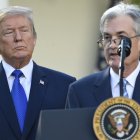
Hence comes one of Donald Trump's main wars in the economic arena: the rate cut, which has led him into a bitter dispute with the Federal Reserve. Led by Jerome Powell, the institution is wary of inflation, which is above its target of 2%, and of the upward pressures it foresees as a result of tariffs, and has followed a cautious rate policy. However, Trump keeps demanding higher and faster rate cuts, even threatening to oust Powell.
On employment, unemployment figures have remained below the historical average (since 1948) of 5.7% and more than 670,000 new jobs have been created, including 400,000 in the manufacturing sector.
But if there is one place where Trump's arrival has been felt, it has undoubtedly been in the markets. U.S. indicators, initially infected by doubts about Trump's economic policy, have broken their historical highs on several occasions during the year. The rise of technology companies, especially Nvidia, lead the gains.

Economy
Global stock market sees record highs on the back of tech and trade optimism
Williams Perdomo
Tariff war
As part of his "America First" policy, Trump shook the foundations of international trade with the announcement of tariffs on products from other countries that wanted to enter the United States. The president's objective was twofold. On the one hand, to end the brutal balance of trade deficit, so he instituted reciprocal tariffs to charge goods from other countries the same rate that U.S. goods received. On the other hand, he established punitive tariffs, such as those implemented against China or Mexico, as a form of pressure to put an end to the fentanyl trafficking that floods the streets of the U.S. and caused a serious national health epidemic.
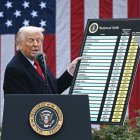
Despite the fact that his image has been mocked for the apparent swings in this section, the truth is that Trump has always made it clear that his objective with the tariffs has been to negotiate with the rest of the countries. In many cases, the agreements have included political and social aspects, and not just economic ones.
Furthermore, Trump has imposed tariffs on specific, critical goods, including steel, aluminum, copper, automobiles, and related derivatives. Pharmaceuticals also faced significant new tariffs set to begin in September, although it is on hold while negotiations with big pharma take place. In all these cases, those companies starting production in the U.S. were exempted or received steep discounts.
War on crime
Reducing the crime rate was another priority, and one of the reasons for the massive deportation campaign launched by the Administration. In fact, Trump began deploying National Guard troops to Washington DC in the face of the crime wave plaguing the capital. However, Los Angeles was the first city to receive federal troops in the framework of protecting ICE agents from aggression during raids in the face of violent demonstrations in the city.

Following the success of the experiment, Trump threatened to do the same in cities such as New York or Chicago, sparking a major dialectical war with Democratic leaders who opposed the measure and went so far as to call for civil disobedience and resistance against federal troops.
So far, troops have been deployed in Portland, where judges have been changing the situation on several occasions, Memphis and Chicago, where some 300 military personnel participated in "Operation Midway Blitz" to support and protect domestic immigration agents from violent protesters.
"The peace president"
The president has launched two major campaigns outside national borders. The first, the bombing of Iran to curb the ayatollahs' regime's nuclear program before it could ever get its hands on the atomic bomb. Earlier, U.S. aircraft and aircraft carriers had participated in defending Israel from Tehran's attacks.
The second, which is still active today, is "Operation Southern Lance," which seeks to end drug trafficking in the Caribbean and the end of Maduro's dictatorship in Venezuela.
Trump has also secured the signing of historic peace agreements, such as the one reached between Hamas and Israel, which is at risk due to the terrorists' non-compliance. In addition, Armenia and Azerbaijan (August); Thailand and Cambodia (October) and Democratic Republic of Congo (DRC) and Rwanda (December) reached agreements to cease hostilities.
The jackpot, however, eludes Trump. Despite the visits of his envoy Steve Witkoff to Moscow and the direct call with Putin, peace in Ukraine is still not initialed on paper, and the positions of the antagonists remain far apart, despite some rapprochements propitiated by the U.S.
Resistance in the courts and in the streets
With the Democrats out of the game, the courts have been the only trench able to stop Donald Trump. However, on many occasions a series of appeals have followed, changing the sign of the rulings until reaching the Supreme Court, which, so far, has almost always ruled in Trump's favor.

Just The News
20-state coalition sues Trump administration over health care, education
Just The News/Dave Mason | The Center Square
The other leg of the resistance has been the mobilization of the street, with two large mass demonstrations "No Kings" against the president joined by numerous Democratic politicians trying to regain the favor of the street.
In addition, numerous leftist groups have taken to the streets in violent fashion, charging ICE agents and raids. The result has been the deployment of the military in cities where the most violent situations have been recorded and the naming of radical groups such as Antifa as a terrorist organization.
Trump's numbers falter, the president remains steadfast in his policies
Hispanics, key to his return to power, are one of the demographic groups that have turned their backs most strongly on the president, mainly because of perceived economic uncertainty and food prices. Mass deportations, though they have changed the minds of some, are still supported by most.
In fact, according to Real Clear Politics, Trump's numbers are rebounding in these early days of December, in which he has managed to reduce the average disapproval rating from 55.6% to 53.7%.
LATEST