Fidel Castro and political prisoners: Two events expose the weakness of US influence over Delcy Rodríguez
A relationship based not on shared values, principles, and interests but on coercion runs the risk of collapsing at any moment.
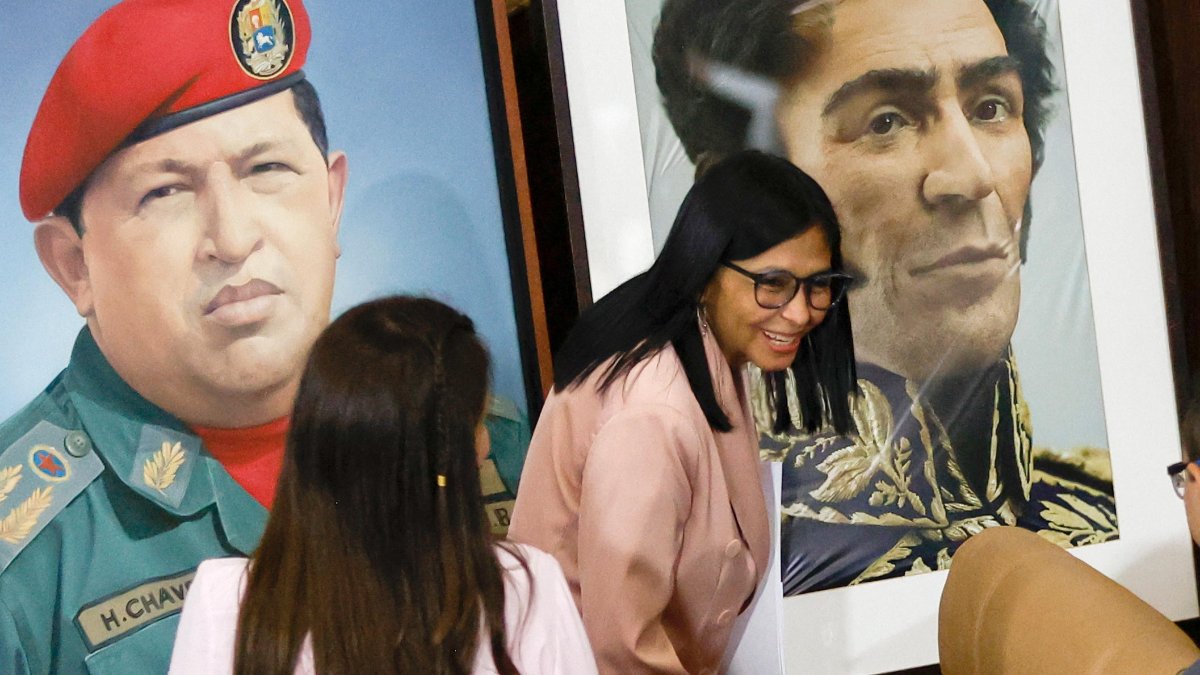
Delcy Rodríguez next to portraits of Chávez and Bolívar.
Delcy Rodríguez is occasionally praised by President Trump because her subservience to the United States, following Maduro's ouster, has made her a seemingly efficient collaborator.
Both in terms of institutional reform and advancing oil agreements, Rodríguez has sought to position herself as indispensable to the U.S.'s plans for Venezuela. For now, the White House's stance toward Venezuela is pragmatic and involves supporting Delcy Rodríguez in her efforts to advance U.S. interests. However, Delcy's capacity for cooperation may be more superficial than it appears, and her very nature makes any genuine agreement difficult.
In the past week, two significant events have exposed the fragility of Delcy's cooperation with the Trump administration. The first we reported on this in Voz: on the 100th anniversary of Cuban dictator Fidel Castro's birth, Delcy Rodríguez shared a message on her X account paying tribute to him.
Rodríguez spoke of Castro as a "leader of integrity" whose ideas "live on" among the peoples of Latin America. Hours later, Senator Marco Rubio, in what appeared to be a veiled jab at Delcy, referred to Fidel Castro as a murderous dictator who impoverished his people and warned regional leaders against looking to him as a role model.
The other event concerns the announcement of release of dozens of political prisoners by the Chavista regime, which was also celebrated by Rubio himself.
In a statement, Delcy Rodríguez announced that 131 political prisoners would be released last Friday. Secretary Rubio welcomed the gesture and noted the number of political prisoners released.
However, nearly four days after the announcement, just over half of the number announced by the Rodríguez regime has been released.
The first fact reveals something obvious but which, aside from pragmatism, seemed to have been forgotten: Delcy Rodríguez carries with her an orthodox communist background. It is in her nature. Her father, a Marxist guerrilla, died in state custody after carrying out one of the most dramatic kidnappings in Venezuelan history against an American. Because of his death, Delcy Rodríguez swore revenge against the United States and against everything that was not communist.
Although she tries to market herself as a technocratic and pragmatic leader, the reality is that Rodríguez harbors a deeply dogmatic spirit. Hence her salute to Fidel Castro, even in a context where the gesture comes at a high cost.
The second fact exposes the fragility of the utilitarian argument in favor of the U.S. working with Delcy Rodríguez. The backbone of that argument is that Rodríguez, coming from the very heart of the Chavista system, guarantees the U.S. tight control over the system so it can meet its demands. However, such control—at least absolute control—does not exist.
The 131 prisoners who were announced have not been released from their cells because their release does not depend on an order. Delcy Rodríguez cannot simply demand that her officials keep their word, because the Venezuelan regime does not function hierarchically like a conventional authoritarian system.
Every prisoner has a "owner." Every prosecutor, every judge, justifies their decision, no matter how criminal it may be. And, at times, the release of a prisoner involves unraveling an entire chain of very powerful interests, which Delcy Rodríguez sometimes has no interest in challenging.
Both of these episodes should be taken very seriously by the Trump administration, because they are just a glimpse of the obstacles that the tutelage dynamic will continue to face in the future. Ultimately, a relationship based not on shared values, principles, and interests but on coercion runs the risk of collapsing at any moment.
Therefore, Delcy Rodríguez, even if it works under certain circumstances, cannot offer long-term stability. Because either her weaknesses or her true nature will eventually come to light. It is inevitable.
LATEST