Hormuz and uranium put Trump’s art of the deal with Iran to the test
Without resolving Tehran’s nuclear ambitions and maritime threats, diplomacy risks becoming an illusion.

The aircraft carrier USS Theodore Roosevelt (CVN 71)
U.S. President Donald Trump has found a way to expose Iran’s true intentions and throw the ball into its court without immediately resuming military action against the regime. By ending U.S.-Iran negotiations in Pakistan while placing the core issues back on the table, he has left the diplomatic door slightly open, making clear that the central questions can no longer be evaded.
Iran today is weakened in nearly every respect except one—its ideological fanaticism, which remains impervious to reality.
Trump terminated the talks and returned to the two primary issues that had previously been set aside: on one side, the future of the world economy, namely passage through the Strait of Hormuz; on the other, the future of Western security—even if Europe does not seem to realize it—the Iranian nuclear bomb. Hormuz and enriched uranium: Without resolving these issues, there can be no real peace deal, only pacifist chatter.
The world’s fundamental waterways must remain open—a difficult and dangerous task—as oil prices rise and efforts to clear the mines Iran has scattered across the Persian Gulf prove challenging. At any moment, the fatal spark leading to escalation could occur. But how can the world allow, for example, Iran-backed Houthis to seize control of the Bab el-Mandeb strait, or other actors to threaten Gibraltar or other strategic gateways of global navigation?

U.S. Vice President JD Vance, who led the negotiations and had been most inclined toward dialogue, remained in close contact with Trump, reporting that there was no flexibility on the two essential points. Ultimately, the diplomatic track reached its limits. Trump then played a surprising card, simultaneously challenging Iran’s international strategy and its most important sources of national revenue.
Since World War I, the United States has made freedom of navigation a cornerstone of its global strategy. That conflict marked the dramatic expansion of the American role in world affairs, placing Washington at the forefront of international leadership as Europe emerged weakened and divided.
Vance attempted unsuccessfully to persuade Tehran to abandon both the maritime threat and its nuclear ambitions. Enriched uranium lies at the heart of the conflict, and Trump has repeatedly stressed that Iran must never become a nuclear power.
Israeli Prime Minister Benjamin Netanyahu said on Saturday that Iran had reached the threshold of constructing a nuclear weapon, warning that Tehran could seek to blackmail the international community and pose an existential threat.
From this reality emerged—with the complex hope of ultimately liberating the Iranian people from a regime that continues to execute young dissidents—the U.S.-Israeli decision to prepare strikes against Supreme Leader Ayatollah Ali Khamenei and his inner circle.
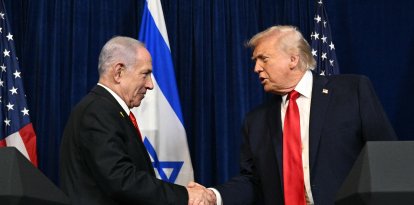
Trump has described the relationship between the United States and Israel as that of “an older brother with his younger brother,” helping explain why Netanyahu understands he may need to accept a U.S.-brokered ceasefire with Hezbollah if the truce with Iran continues, even as he cannot ignore the harm inflicted on Israel by the Lebanese group, a persistent threat that has placed northern Israeli communities under sustained pressure.
For now, Israeli strikes have remained largely limited to Southern Lebanon, regarding which diplomatic discussions are expected to begin shortly.
Trump must now address in practical terms the two main issues he has highlighted: Iran’s nuclear ambitions and freedom of navigation through Hormuz. How he resolves them remains an open question.
One thing is certain: A peace deal to end the war has little meaning if it exposes future generations to the fury of those driven by ideological extremism.
Israel understands this reality deeply. The country is weary of war as few nations are, with some 400,000 reservists mobilized and 18-year-old soldiers once again fighting in the mountains of Southern Lebanon, including in Bint Jbeil—the site where, on Aug. 26, 2006, Capt. Roi Klein sacrificed his life by throwing himself on a grenade to save his soldiers, reciting the central Jewish prayer, Shema Yisrael. It was also in Bint Jbeil that the slain Hezbollah leader Hassan Nasrallah once declared Israel to be as fragile as a spider’s web.
Since then, repeated attempts have been made to destroy Israel. Threats and condemnations, such as the latest anti-Israel rhetoric from Turkish President Recep Tayyip Erdoğan, continue to multiply.
Yet voices across parts of the Arab world and beyond, including in India, Argentina and Uganda, increasingly recognize that a Middle East without Hezbollah, without the Assad regime, and above all without the Shi’ite dictatorship in Iran, could offer the possibility of a more stable and prosperous future for all.
Fiamma Nirenstein
LATEST