Gaza’s Executive Board and the illusion of international salvation
Tyrannies do not change their nature because Western leaders wish them to.
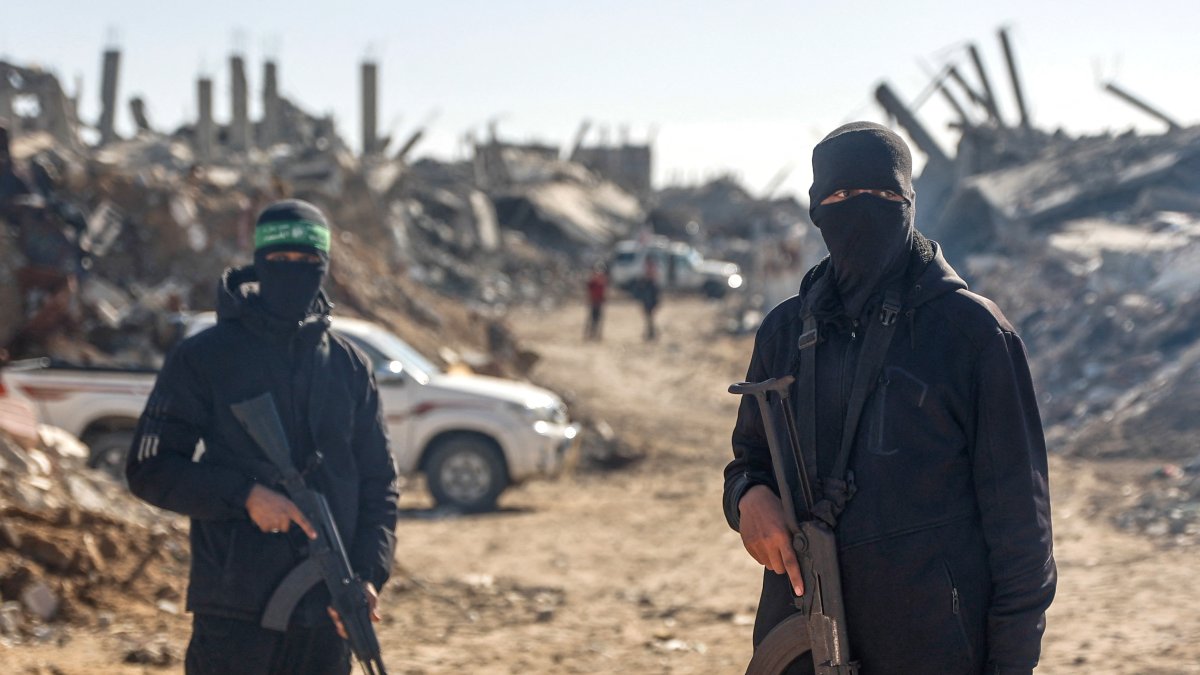
Palestinian Hamas militants in the Jabalia refugee camp
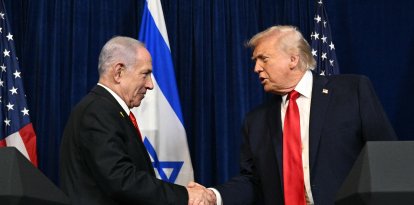
The sudden enthusiasm surrounding the so-called Gaza Executive Board is striking. A mass of countries, a plethora of supervising and sub-supervising bodies, committees layered upon committees—all presented with great confidence in the future and one another. U.S. President Donald Trump unveiled this international architecture to the world as if it were a promise of order, stability and hope.
We have seen this movie before.
It recalls the recent announcement by Steve Witkoff, Trump’s special envoy to the Middle East, that 800 Iranian prisoners on death row would be spared. The Islamic Republic quickly ridiculed the claim, and soon afterward, Erfan Soltani, just 26, was executed along with others by the murderous regime. A scorpion cannot help but sting. Tyrannies do not change their nature because Western leaders wish them to.
Meanwhile, reality intrudes. Forty-eight American F-35 fighter jets are now deployed in Jordan, the aircraft carrier USS Abraham Lincoln moves closer to the region, and logic suggests what diplomacy prefers not to say aloud: Sooner or later, an attack will come.
Back to Gaza—and to hope.
Vast, almost pharaonic structures are being designed to rebuild the devastated Gaza Strip. One hopes quickly, and one hopes well. But hope cannot replace clarity. The announcement of the new Executive Board is not merely broad but dangerously incoherent. Turkey and Qatar—open adversaries of Israel—appear among its members, metaphorically seated on Israel’s border. Soon enough, Pakistan and Russia also surfaced.
Upon hearing the first two names, Israeli Prime Minister Benjamin Netanyahu stated plainly that the decision “was not coordinated with Israel and runs contrary to its policy.”
The reason is self-evident. Qatar is Hamas’s principal financial patron and its most powerful media ally through Al Jazeera, not to mention the generous host of Hamas’s terrorist leadership, which has never concealed its goal: the destruction of the Jewish people.
Turkey, for its part, is the ideological home of the Muslim Brotherhood, the matrix from which Hamas was born. Its president, Recep Tayyip Erdoğan, has plotted against Israel for decades, openly and consistently.
For Phase 2 of any Gaza arrangement to truly begin, two conditions remain unmet: the return of the body of the last kidnapped Israeli, and the complete disarmament of Hamas. These requirements are written into the agreement itself. Yet neither Qatar nor Turkey has the slightest interest in seeing them fulfilled. On the contrary, they seek influence, legitimacy, and above all, continued favor with Trump. They present themselves as “guarantors,” while guaranteeing nothing that matters.
If it plays its cards well, Israel may yet neutralize the damage. This U.S. administration has never told Israel “no,” and Jerusalem will insist that these intrusive actors send no troops, carry no arms and exercise no decision-making or verification authority. They may sit at the table, but they must not touch the cards.

Still, the sheer scale of this project is telling. Between the board, the Executive Committee, the high representative for Gaza and his staff, the NCAG (National Committee for the Administration of Gaza) and the International Stabilization Force, the number of involved states could easily grow from the 60 invited—20 of which have already accepted—to 80 or more. Add to this an army of dignitaries, billionaires, investors, diplomats, democracies and dictatorships, the West and political Islam, rich and poor, allies and enemies.
Does this sound familiar?
Perhaps Trump has simply grown weary of the United Nations. Perhaps he is attempting something unprecedented: the construction of an alternative international forum, not under the shadow of the old Soviet-Third Worldist axis or its ideological descendants, but under an American aegis. If so, it would be a historic shift.
The reaction from Paris strengthens this interpretation. French President Emmanuel Macron promptly declined the U.S. invitation. Though relatively young, he is already a leader on his way out, shaped by a distinctly French anti-Americanism. Macron likes the United Nations. An American center of power—especially one that rebuilds Gaza without delegitimizing Israel—disturbs him. He says so openly.
Israel, meanwhile, bears the cost of unwanted presences as it always has. It must defend itself from the indefensible. Islamist hatred remains an existential threat, not a diplomatic misunderstanding. The first priority is therefore unchanged: disarm Hamas.
If the ayatollahs in Tehran are finally removed from power, the entire terrorist network will lose its strongest patron. The board may be large, the table wide and the players many, but Israel’s red lines are few and nonnegotiable.
If Israel must act again, it will. Another Oct. 7 is not on the agenda. And whatever this new board may declare, Trump will let Israel do what it must to survive.
LATEST