Trump reloads the tariff war—and he knows he’s winning
The president’s ability to wield America’s economic power—sometimes even more effectively than military force—is truly remarkable.

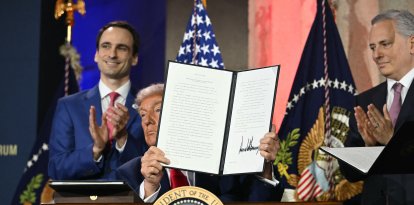
Donald Trump fastens tariff list during Liberation Day.
The bidding around tariffs is back on, and President Donald Trump knows that America's economic power is one of his most powerful weapons to achieve his goals in different fields. After a weekend full of celebration for the MAGA movement following the signing of the "big, beautiful" bill, the administration surprised by announcing an extension of the deadline that had been set to reach tariff agreements with dozens of countries. This time, the markets did not react with panic.
On Monday, Trump announced 25% tariffs on Japan and South Korea, adding, "Whatever the number you choose to raise them by, will be added onto the 25% that we charge.” Threatening the two countries before they reacted with tariffs on the U.S. in response. On Monday and Tuesday, letters were sent to dozens of countries proposing unilateral tariffs and warning that if a deal is not reached by the new deadline of August 1, the higher tariffs announced in April, which Trump referred to as "the day of the release," will take effect.
Regardless of one's position on tariffs, most will agree that Trump, unlike any other president in the country's recent history, is willing to use America's economic power to achieve his goals. Not only in the financial realm, but also in geopolitical matters, Trump is willing to hit other countries' economies hard to achieve his goals.
During his first administration, he significantly weakened the Iranian regime by imposing sanctions. In the first months of this administration, he threatened tariffs and reached agreements with several Latin American countries to receive deported immigrants. He also achieved a great triumph with Panama, using the same threat.
The United States is the main trading partner of many countries, with its large and strong economy; losing it is a risk that most nations do not want to take. Meanwhile, the U.S. can replace a trade agreement with relative ease. Trump has the character and the nerves to withstand criticism from the European Union and every other country, and analysts, and think tanks that want to brand him as an enemy of trade. Knowing the power he has, he proceeds with his plan.
Now, the criticism is not only coming from outside, but even within the MAGA movement. There are concerns about the impact that these tariffs could have on product prices, especially when tariffs exceeding 50% are imposed in some cases. However, the administration has insisted that during its first administration, the tariffs did not cause inflation and that all the deregulation measures and tax cuts will grow the economy at a rate that will alleviate any possible effects of the tariffs.
The future is not so easy to predict, but there are reasons to be optimistic. Indeed, suppose the economy performs well and grows as a result of the pro-business measures. In that case, it is most likely that the tariffs will have only particular effects on the prices of some products, but not on inflation, which is understood as a generalized and sustained increase in prices.
The outcome will also depend on how tariffs are ultimately set. Because even if some countries are punished with very high tariffs, different goods can be obtained from other places. Moreover, the negotiation on tariffs took a very interesting turn when what seemed at first to be a protectionist strategy, which would be a giant mistake since the goodness of free trade is more than proven, ended up becoming a negotiation to get a reduction in the tariffs that other countries impose on the United States.
President Trump has stated that there will be no further extensions, so we will see on August 1 how the chessboard finally looks. But aside from the final situation, Trump's ability to use U.S. economic power as an even more effective weapon, on certain occasions, than military power is quite remarkable.
LATEST