ANALYSIS
Is this the one? Iran’s nationwide uprising puts regime on the ropes
The Islamic regime has cracked down before and held on. Is this time different? Is this the protest that breaks the Islamic Republic’s back? Observers JNS spoke with have never been more hopeful.
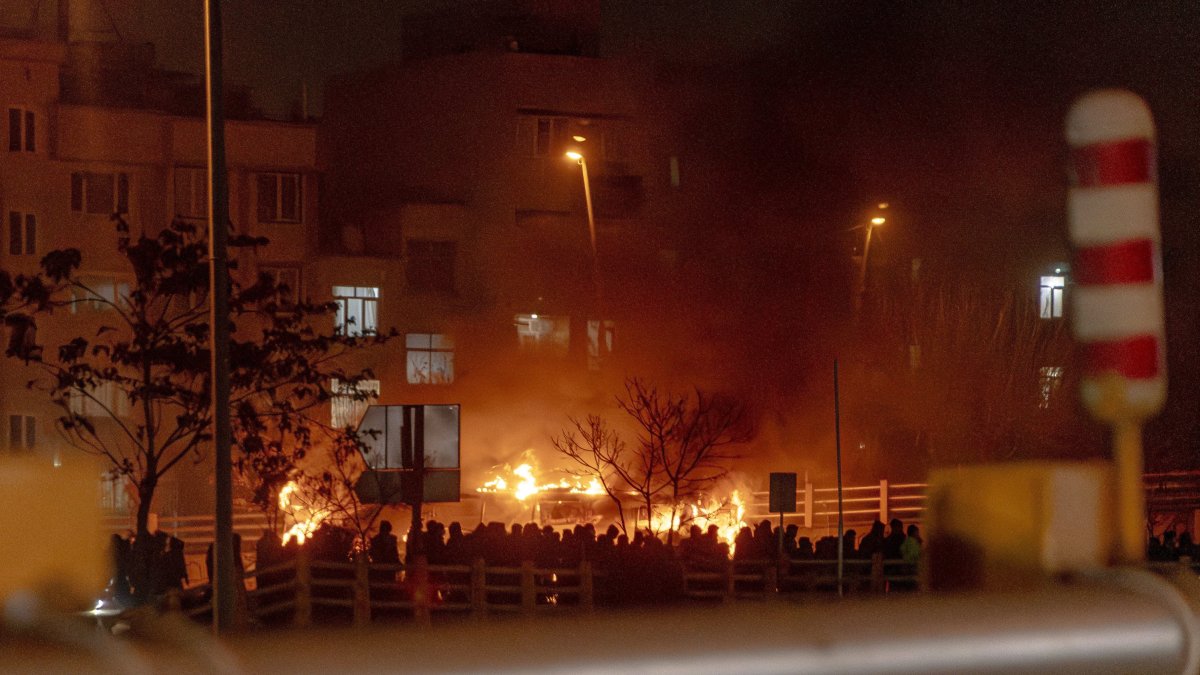
Imágenes de las manifestaciones en Irán

Iran’s anti-regime protests escalated dramatically on Thursday and continued throughout the weekend as observers and rights groups reported millions in the streets. Protesters set government buildings on fire and burned images of regime leaders.
The Islamic Republic responded with brutal force, imposing an internet blackout and reportedly shooting directly into crowds. A state TV anchor on Friday warned parents to keep their children off the streets “if they care about their safety,” telling them not to complain “if a bullet is fired and something happens to them.”
Limited reports and images were available for Saturday, the 14th day of protests, due to the communications shutdown, but the Human Rights Activists News Agency (HRANA) reported that confirmed casualties jumped to 116 (543 on Sunday).
On Friday, day thirteen, the death toll reached 65, up from 42 on Thursday, the U.S.-based group said. Separate reports speak of protesters badly beaten, with head injuries and broken limbs. More than 2,300 have been arrested (10.600 on Sunday).
Is this the protest that breaks the Islamic Republic’s back?
The Islamic regime has cracked down before and held on. Is this time different? Is this the protest that breaks the Islamic Republic’s back?
Observers JNS spoke with have never been more hopeful.
“What makes this moment different is the convergence of mass public anger, economic collapse, elite fragmentation and visible weakness of the state,” Majid Rafizadeh, an expert on U.S. foreign policy and the Middle East, told JNS.
A key ingredient for successful regime change that observers have said was missing from past protests was the existence of an alternative leadership—an individual, or group, who could take the reins from the current regime.
This appears to have changed. Protesters have rallied around Iran’s crown prince, Reza Pahlavi, son of the exiled Shah. They cry out, “Javid Shah”—“Long live the Shah.”
Iranians now view the Shah’s reign as a “golden age”
Ahmad Batebi, who served 10 years in an Iranian prison before escaping to the United States, where he continued his resistance activities, told JNS the widespread support for Pahlavi is a new development.
When the ayatollahs came to power, not only did they try to kill anyone connected to the Shah’s regime, but they also attempted to erase the memory of the Shah, according to Batebi. Through the internet, the younger generation has learned about the modernizing efforts of the Pahlavis. They now view the Shah’s reign as a “golden age,” he said.
Even those who do not want a return to the monarchy support the Shah’s son, said Batebi, as he has made clear his aim is to serve in a transitional role to move Iran from a theocracy to a democracy.
Batebi put the odds of regime change at 90% after protesters on Thursday responded to Pahlavi’s first direct call for action to protest at 8:00 p.m. Iranian local time on Jan. 8 and 9.
Pahlavi said he would return to Iran “when our national revolution is victorious”
Following that success, in a Saturday post, Pahlavi called for citizens to protest over the weekend and take over public places. He also called for a general strike and said he would return to Iran “when our national revolution is victorious.”
Another key difference in these protests is that the merchant class is participating. Demonstrations began on Dec. 28 when shop owners selling electronics and mobile phones in Tehran shuttered their stores in anger over the plummeting Iranian currency, the rial, which made their imported stock unprofitable.
Shopkeepers played a pivotal role in the Shah’s ouster during the 1979 Iranian Revolution. Unhappy with his attempts at economic reform then, their sustained strikes paralyzed the economy. Now the merchants have come full circle and they, too, back Pahlavi. At the Tehran Grand Bazaar on Tuesday they chanted, “Reza Shah, may your soul rest in peace,” referring to the deposed Shah.
"Economic pain exposed the regime’s failure; it didn’t create it"
However, according to Rafizadeh economic collapse is the trigger, not the root cause. “The deeper drivers are decades of political repression, systemic corruption, human rights abuses and lack of dignity. Economic pain exposed the regime’s failure; it didn’t create it,” he said.
The regime’s offer of various economic palliatives, including monthly cash payouts and suspending certain tax penalties, fell on deaf ears as protesters swiftly moved past their economic complaints to call for regime change. “Death to the dictator,” protesters chant, referring to Iran’s Supreme Leader Ayatollah Ali Khamenei. In Qom, a religious city, they shouted, “Clerics must get lost.”
Rafizadeh noted early encouraging reports that local police and security forces had refused to enforce the government’s crackdown in some cities. However, Batebi cautioned against reading too much into videos of police in cities such as Abdanan waving from the roof of their police station as protesters pass.
He noted that when police or military forces feel that they are threatened, they will act as if they are in solidarity with the protesters. “There is no guarantee at this time that they are really with the people.”
"Hostile foreign media"
Batebi worries what the regime may do. So far, the army has sided with the regime. On Saturday, the military leadership said it would act to protect “national interests and public property.” The Islamic Revolutionary Guard Corps (IRGC) warned that safeguarding the revolution constituted a “red line.”
Authorities have attempted to downplay the unrest and project an air of normalcy, describing the demonstrations as “limited protests and gatherings in some provinces, linked to economic difficulties,” which have been amplified by “hostile foreign media.” The regime has blamed the United States and Israel for fomenting the protests.
On Saturday, President Donald Trump posted to his Truth Social account: “Iran is looking at FREEDOM, perhaps like never before. The USA stands ready to help!!!”
On Friday, the president repeated his warning that the United States would intervene if Iran began killing protesters. “Again, I tell the Iranian leaders you better not start shooting because we’ll start shooting, too,” he said.
Batebi said Trump’s statements are important “emotionally” for the protesters.
“While it won’t stop all violence, it can deter large-scale massacres and embolden protesters by reducing their sense of isolation,” Rafizadeh agreed.
Iranian elite are heading for the exits
Of reports that the Iranian elite are heading for the exits, including a story about Khamenei preparing to flee to Russia, Rafizadeh said whether accurate or not, that such reports are taken as credible expresses a certain truth about the situation the regime faces.
Among those reportedly looking for the exits are the family of former Iranian President Hassan Rouhani, and the current speaker of the Islamic Consultative Assembly, Iran’s parliament, Mohammad Bagher Ghalibaf.
Both Rafizadeh and Batebi agreed that Israel’s 12-day war in June 2025 targeting Iran’s ballistic missile production and nuclear facilities played an important role in eroding confidence in the regime.
For years, the Islamic Republic told the Iranian people that money spent for proxies in Lebanon, Syria, Iraq and elsewhere were an investment in their own security, Batebi explained.
Israel killed top commanders and destroyed everything
“What those 12 days showed is, first of all, that all that money amounted to nothing. Israel, the size of one of the smallest provinces of Iran, killed top commanders and destroyed everything, while the Supreme Leader hid for days. It wrecked the picture they created for themselves. The Iranians now know it,” he said.
“Israel’s attack was psychologically transformative,” agreed Rafizadeh. “It shattered the image of strength the state relies on to intimidate its own population. It also accelerated the rial’s collapse, deepening economic panic. More importantly, it empowered Iranians by showing the regime is far weaker than it claims.”
Even if the regime were to fall, there’s no guarantee an enlightened democracy would take its place. The IRGC, which operates as a state-within-a-state, controls vast resources and its own military, could assert control. One scenario would be that the IRGC presents itself as identifying with the people in an attempt to protect its privileges, said Batebi.
However, despite the IRGC’s resources, with its own land, sea and air branches, he said it won’t be difficult to dismantle the group. Only a small segment are hard-core ideologues. The rest are ordinary people looking for jobs. It’s just that they can’t function without the IRGC, which has a hand in everything. Those people want to be free and will exit the IRGC the moment the opportunity allows, said Batebi.
LATEST