Macron Government's Fiscal Adjustment Triggers a Wave of Mass Protests in France
Students erected barricades and set fire to trash containers in Nantes, Strasbourg, Toulouse, and Lille, while authorities reported attacks and intimidation against school principals.
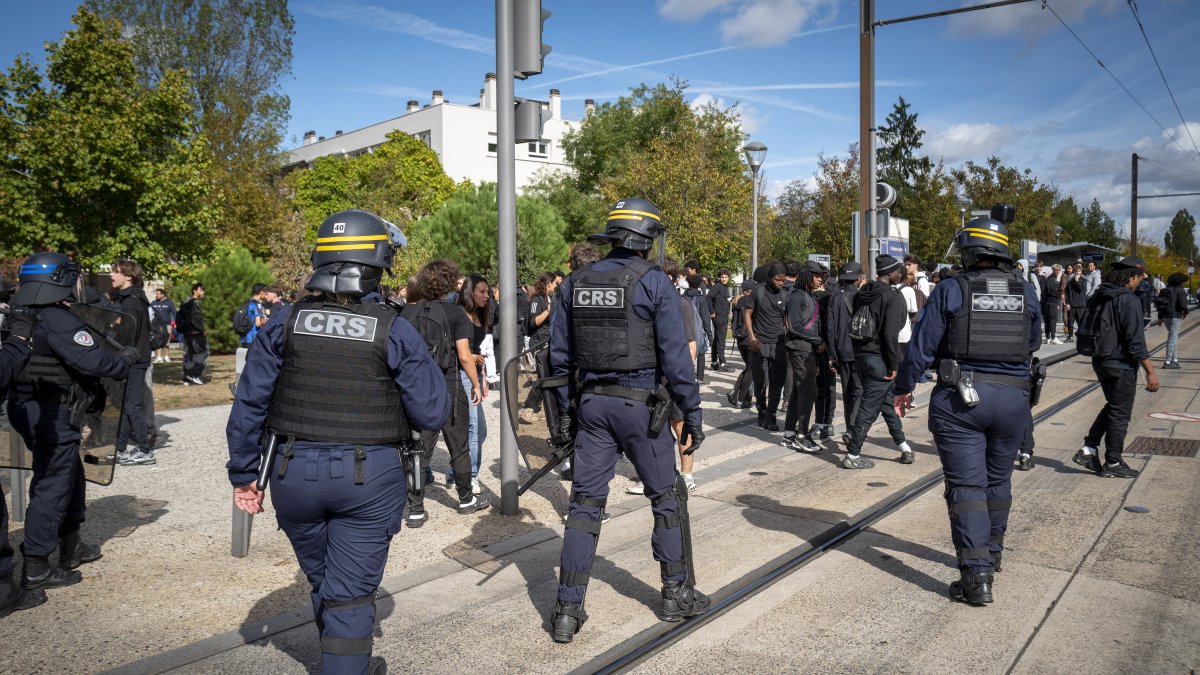
Protests in France.

(AFP) Faced with record public debt and just months before the presidential election, the French government presented a draft budget for 2027 on Thursday that calls for fiscal austerity measures totaling 54 billion euros.
The public finances of France, with record-high debt and a deficit exceeding the limits set by the European Union, are a central issue in next year's presidential election.
Prime Minister Sébastien Lecornu's government faces the challenge of securing approval for the 2027 budget amid growing social unrest over the rising cost of living, while the war between the United States and Iran is driving up fuel prices.
The social movement gained momentum on Thursday with new student protests over the lack of resources for education. More than 160 schools remained closed, and college students joined the demonstrations in Paris, Marseille, and other cities across the country.
Students erected barricades and set fire to trash containers in Nantes, Strasbourg, Toulouse, and Lille, while authorities reported attacks and intimidation against school principals.
The government described the incidents as "urban violence," and the prime minister asked members of his cabinet to postpone their travel around the country.
The Ministry of the Interior reported 1,949 arrests during Thursday's protests and blockades at schools across the country.
On Tuesday, more than 200,000 people took part in public-sector demonstrations against the government's decision to freeze the index used to calculate part of civil servants' pay.
54 billion euros in austerity measures
The budget plan, which will begin to be reviewed in Parliament this Thursday, aims to reduce the growing public deficit to 5% of GDP by 2027 with a total fiscal adjustment of 54,000 million euros (about 61,000 million dollars), according to the draft budget obtained by AFP.
In the document, the government proposes new measures totaling 43 billion euros which, combined with those taken in 2026, bring "the total adjustment" in 2027 to "54,000 million euros," the government writes.
According to the draft, VAT revenue would increase by more than 7 billion euros compared to this year, while income tax revenue would grow by 5.7 billion euros.

In contrast, corporate tax revenue would fall by 1.8 billion euros, reflecting the business-friendly policy promoted by President Emmanuel Macron.
The government also plans to limit the increase in healthcare spending to 2% in 2027 and reduce the Social Security deficit to 12.7 billion euros, down from the 21.8 billion projected for 2026.
To achieve this, part of the burden will fall on retirees. Among the measures under consideration is a less favorable adjustment for pensions exceeding 1,260 euros, which would no longer be fully indexed to inflation.
"It is a significant effort" that requires "collective mobilization," admitted Economy Minister Roland Lescure.
"Unfair"
Lecornu had already indicated in mid-September that his administration was planning a fiscal adjustment of this magnitude in order to restore public finances to health.
The government expects to end 2026 with a fiscal deficit of 5.4%, well above the 3% limit set by the EU, and public debt at 119.3% of GDP—a record high since this statistic was first compiled in 1978.
The cost of that debt has become a growing concern for authorities: interest payments by the government will exceed 79 billion euros this year and could reach 91 billion in 2027, according to the Ministry of Economy.
A sign of investor mistrust toward the EU's second-largest economy, the interest rate on 10-year French debt reached its highest level since 2002 on Thursday.
With seven months to go before the presidential elections that will determine Emmanuel Macron's successor—and with the far right leading in the polls—debates over the budget are expected to be tense.
The opposition has already begun attacking the bill. The Socialists have called it "unfair" and "recessionary," while the risk of a no-confidence motion against the government during the parliamentary process is mounting.
Parliament has already ousted two of Lecornu's predecessors for their attempts to cut public spending, and the risk of a no-confidence vote against the prime minister is rising.
LATEST