Ice storm and winter storm alerts from Montana to Vermont: what they are and how to prepare
The next few days will bring near record low temperatures and dangerous wind chills to different parts of the country.

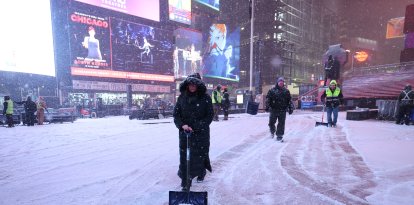
File image of a snowplow

Cold conditions are expected across the northern and eastern parts of the country. The National Weather Service (NWS) issued several ice storm warnings and winter storm warnings through the weekend.
Alerts for low temperatures were issued Friday for two major areas:
- The north-central region: a swath encompassing parts of Montana, Idaho, Wyoming, South Dakota, North Dakota, Minnesota, Iowaand Nebraska.
- A portion of the Northeast: parts of Illinois, Indiana, Kentucky, Ohio, West Virginiaand Virginia.
Warnings were also issued for isolated areas of Michigan, Pensylvania, New York and Vermont.
The most affected area will be the north-central area, known as the northern high plains which have already been experiencing frigid temperatures the past few days.
The arctic air that settled there will move southward on Friday, arriving Saturday in the central Plains and Ohio Valley and Sunday into the mid-Atlantic.
What is an ice storm warning?
An ice storm warning like the one issued by the NWS for areas from Montana to Virginia means that ice accumulations equal to or greater than 3.8 cm (1.4 inches) are expected.
Ice accumulations can be dangerous for a variety of reasons - from toppling structures such as power poles and trees to disrupting services such as power, to skidding cars on the road.
Other risks from ice storms include:
- Black Ice: this is one of the most dangerous driving hazards and is defined as irregular layers of ice on roads or other transportation surfaces that are virtually invisible. Unlike ordinary ice, it is not white: it is usually transparent, allowing the dark asphalt underneath to be seen, hence its name. It is especially prevalent during the early morning hours.
- Ice Jams: prolonged periods of severe cold can cause rivers and lakes to freeze. When the water level rises or a sudden thaw occurs, the ice breaks into large blocks that can get stuck on natural obstacles or human constructions, such as bridges or dams.
- The risk of ice recreation: ice on lakes and rivers can be extremely dangerous. Before engaging in activities such as ice fishing, skiing, snowmobiling, or any other recreation on frozen surfaces, it is essential to consult with local authorities.
You can check the latest ice storm warnings at the following link from the National Oceanic and Atmospheric Administration (NOAA). In addition, experts recommend keeping an eye out for warnings from the appropriate local NWS branch.
What is a winter storm warning?
A winter storm warning such as the one issued by the NWS for much of Montana means that heavy snowfall is expected.
They could be in the region of at least 15 centimeters (6 inches) in 12 hours, or at least 20 centimeters (8 inches) in 24 hours. It may also be issued if sleet accumulation of at least 1.2 cm (0.5 inches) is expected.
A winter storm warning means there is at least an 80% chance of impactful winter weather conditions during the warning period.
You can check the latest winter storm warnings at the NOAA link below. In addition, experts recommend keeping an eye on alerts from the corresponding local branch of the NWS.
Cold near all-time records
Temperatures are expected to be 20 to 30 degrees below normal, with the largest variations from the northern high plains to the Ohio Valley.
The cold will also be accompanied by strong wind gusts (between 32 and 56 km/h or 20 and 35 mph).
The union of cold temperatures and strong winds will generate a wind chill below -34°C or -30 °F in the northern Plains and upper Midwest between Friday and Sunday.
Over much of the Mississippi Valley and Ohio Valley/Central Appalachians, temperatures below -17°C or -0°F are expected.
Recommendations for hitting the road in a winter or ice storm
Low wind chill over the next few days will pose a deadly risk of hypothermia and freeze for exposed skin. Therefore, you should bundle up yourself and yours as well as the animals in your care, both pets and livestock.
Experts also recommend keeping an eye out for recommendations from local departments of transportation for road conditions in your area. If you are traveling, also check how the various points along your route and at your destination are located.
It is also a good idea to check the condition of your car before setting out on the road. Authorities also recommend carrying in an emergency kit:
- A flashlight
- Spare batteries
- Non-perishable, high-calorie foods
- Bottled water
- .A phone charger
- At least one extra change of clothes
- Warm blankets
- Jumper cables
- Matches or a lighter
How to prepare a home for extreme cold
Preparing the home in advance is key to reducing risks during winter storms, power outages and low temperatures. Some key recommendations are:
- Home emergency kit: have a fully stocked home emergency kit. It should include non-perishable food, drinking water, flashlights, batteries and essential medications.
- Fall prevention: using sand or non-slip materials serves to improve traction, as well as applying ice melting products to sidewalks, driveways and walkways.
- Heating and fuel supply: as the usual sources of heat may be interrupted, it is important to check that sufficient fuel is available for heating. It is also recommended to have emergency heating equipment.
- Home preparation: there are several measures that can be taken before extreme cold arrives to prepare a home, such as covering windows with insulating plastic.
LATEST