ANALYSIS
The dragon stalks New York: Chinese regime influences city politics through consulate and social clubs
Several organizations have held China loyalty ceremonies, fundraisers and membership drives, while local political leaders have received support from some of these associations.
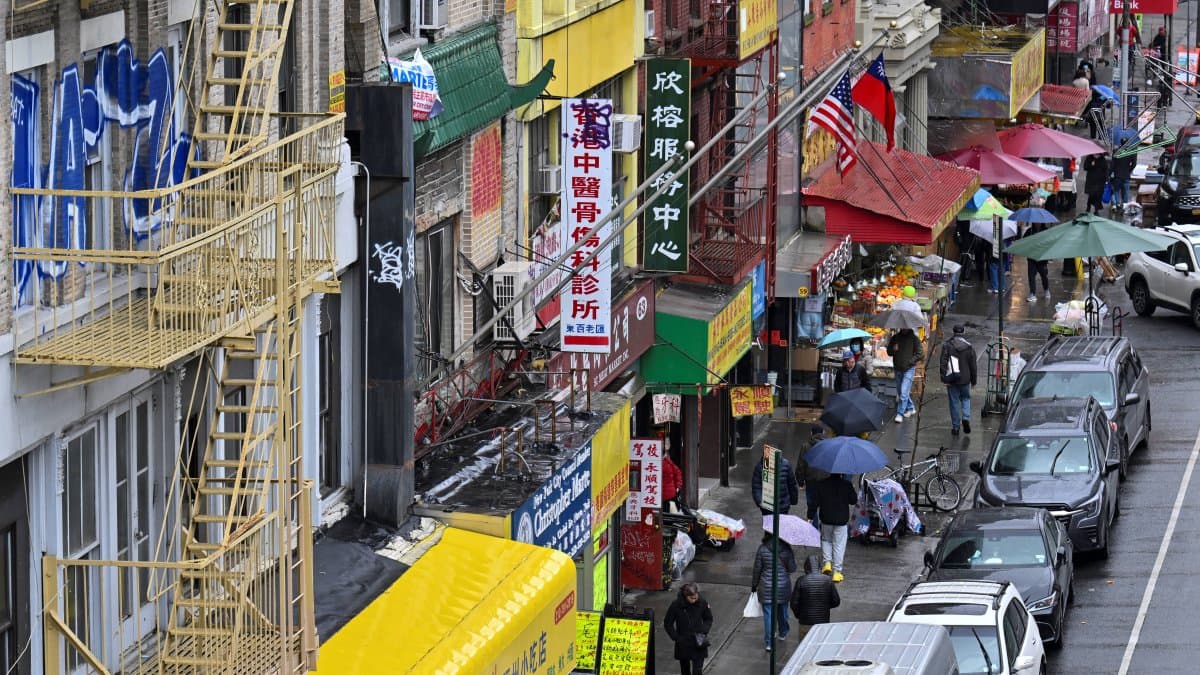

Candidates with weakened campaigns, impeached senators and a torrent of criticism on social networks: this is how politicians in New York face the consequences of questioning or disagreeing with the Chinese communist regime's plans.
A report by The New York Times revealed that social clubs, backed by China, contributed to affect the campaign of a congressional candidate who once challenged the regime on Chinese television.
Moreover, these centers - according to the New York media - also prompted the impeachment of a state senator for attending a banquet with Taiwan's president.
Meanwhile, the main beneficiaries are those who are close to the Chinese Communist Party. In that case, social clubs act at high speed to favor candidates who align themselves with the regime's interests.
"The groups, many of them tax-exempt nonprofits, have allowed America’s most formidable adversary to influence elections in the country’s largest city," detailed The New York Times.
In that sense, it was also learned that most of these social clubs are local associations made up of people originating from the same Chinese city or province. Some have existed for more than a century, while dozens have been created in the last ten years.
As usual, like other immigrant clubs in the city, these centers welcome newcomers, organize parades and promote social interaction among their members.
The difference with other social clubs in the world is that, according to several sources, they have become tools of the Chinese consulate in Midtown Manhattan. They do so, mainly, because many of the leaders of these groups have relatives or businesses in China and fear reprisals against them.
In that regard, highlighted The New York Times, "Consulate officials have enlisted them to intimidate politicians who support Taiwan or cross Beijing’s other red lines. In one case, a Chinese intelligence agent and several hometown leaders targeted the same candidate."
Although this is local politics and probably has no influence internationally, the Chinese regime is clear that its strategy goes beyond that. Audrye Wong, a researcher at the American Enterprise Institute who studies Chinese influence, explained that the Chinese government looks to the future.
"You never know which politician might eventually run for Congress at the national level, or become a presidential candidate," Wong said in a newspaper interview.
China is not the only country trying to influence international politics. In New York, federal prosecutors indicated that a Turkish government official offered Mayor Eric Adams luxury trips in order to expedite the opening of a new consulate, charges that Adams denied and which were eventually dropped during the Trump Administration.
However, explained The New York Times, China's influence network is among the largest and most effective in the world, with operations in countries such as France, Canada and the United Kingdom. It has even set up undercover police stations in different parts of the world to intimidate dissidents. Its efforts, however, have been particularly intense in New York, home to 600,000 people of Chinese origin.
One demonstration of this is that, in 2023, the FBI arrested the leaders of the American Changle Association for running a clandestine police station at its headquarters. Last year, a federal indictment singled out a former aide to New York Gov. Kathy Hochul for conspiring with the leaders of two Chinese associations, alleging that their political activities "were supervised, directed and controlled" by Chinese government officials.
The consulate's activities
Money was not left out in this strategy. More than 50 organizations linked to the Chinese regime have mobilized their members to raise funds or support political candidates in the past five years, according to Times records. Many were nonprofit charities that are prohibited by law from participating in election campaigns.
"This January, more than a dozen hometown associations, all with ties to the consulate and six of them tax-exempt nonprofits, put on a lively fund-raising dinner for Susan Zhuang, a Chinese immigrant running for re-election to City Council after biting a police officer at a homeless shelter protest," the Times reviewed.
The newspaper investigated Chinese social networks and media to determine whether Chinese-American groups were supporting or fundraising for candidates in New York, identifying at least 53 organizations with ties to China.
These ties included publicly promoting Beijing's political agenda, meeting in China with Communist Party members or maintaining frequent contact with the Chinese consulate. Of the organizations, at least 19 were found to have ignored the ban on electoral activities.
Meanwhile, the newspaper also revealed that the consulate has presided over local ceremonies promoting China's political interests.
"The Times found videos of 35 ceremonies overseen by consulate officials since 2016. Diplomats led group leaders through many types of oaths, such as affirming China’s Taiwan policy and promising 'to safeguard the development interests of the motherland'," noted the NYT.
In a city like New York, where elections can be determined by ethnic blocs, politicians maintain relationships with China-friendly groups and clubs. The NYT claimed that many politicians "often court these groups and, once in office, sometimes send government money back their way."
As the newspaper reported, Mayor Eric Adams - whose former aide resigned amid an investigation into alleged Chinese interference in the last election - has won the support of leaders of at least nine local associations in his intense re-election campaign.
Adams' former adviser was in the eye of the storm again last week when she was accused of offering money to journalists in exchange for support.
Eric Adams campaign spokesman Todd Shapiro reported that Winnie Greco was immediately suspended from the campaign:
"Winnie Grecco [sic] holds no position in this campaign and has been suspended from all VOLUNTEER campaign-related activities. Mayor Adams had no prior knowledge of this matter. He has always demanded the highest ethical and legal standards, and his sole focus remains on serving the people of New York City with integrity," Shapiro said.
Despite Adams' team's position with this case, the Times revealed that the Democrat has the backing for his re-election from organizations linked to China.
"Dixon Mai, a leader of the Chong Lou USA Association Headquarters — which formally endorsed a meeting with top consulate officials last year focused on opposing Taiwan’s president — said he was mobilizing the group’s 2,000 members to re-elect Mr. Adams," the NYT detailed."
Related to this issue, Todd Shapiro noted that the mayor engaged in cultural activities in order to address the concerns of neighbors. He added that the campaign sought to “safeguard against any improper influence.”
"If any group is prohibited from making endorsements or engaging in campaign activities, those rules apply to them, and we expect them to follow the law," Shapiro said.
But the Adams campaign is not the only one that has been caught up in this type of situation. In December 2021, the nonprofit Asian American Community Empowerment collaborated - according to the NYT - in organizing a fundraiser on behalf of Gov. Kathy Hochul.
"The event took place at a restaurant owned by the group’s leader, John Chan, a businessman aligned with the Chinese government who was once convicted of trafficking heroin and smuggling Chinese citizens into the United States," the Times highlighted.
In addition, according to reports, two months later, Hochul reported that $10 million in pandemic support went to Asian associations. John Chan's nonprofit got $45,000 of those funds.
For its part, Hochul's team said campaign endorsements and contributions do not influence the governor's policy decisions.
The Chinese regime has also used violence to impose its agenda. Chinese agents have violently attacked city politicians as a threat.
This is not the first allegation that China is pulling strings to spy on or persecute those it finds inconvenient. In 2024, a report by Nigel Inkster, former director of operations and intelligence at MI6, for The Spectator recalled that TikTok acknowledged that some of its employees had been spying on U.S. journalists.
"The harvested data serves a variety of purposes. Stolen medical data, for example, is used for biomedical research – which almost certainly includes not just pharma-ceutical but biowarfare programmes. Huge amounts of foreign data are used to train Chinese AI large-language models," the report detailed.
In addition, the report indicated that there are undercover Chinese police stations in at least 50 mostly democratic countries with the intent to pursue and suppress dissent.
"Officials insist these entities exist to assist Chinese nationals with a variety of bureaucratic procedures. But surely that is what the legitimate Chinese consulates are for? The reality is that these ‘police stations’ primarily exist to monitor and suppress anti-regime activity," Inskter detailed The Spectator piece.
🛠 Do you think there is an error in this article?
Recommendations


LATEST