The Necessary Alliance Between Catholic and Jewish Conservatives
The Christian West is undergoing an extraordinary process of secularization that threatens to dissolve the communities from which our civilization emerged. Symbols —the custodians of tradition— are disappearing into the machinery of modernity. Our spiritual crisis is profound.
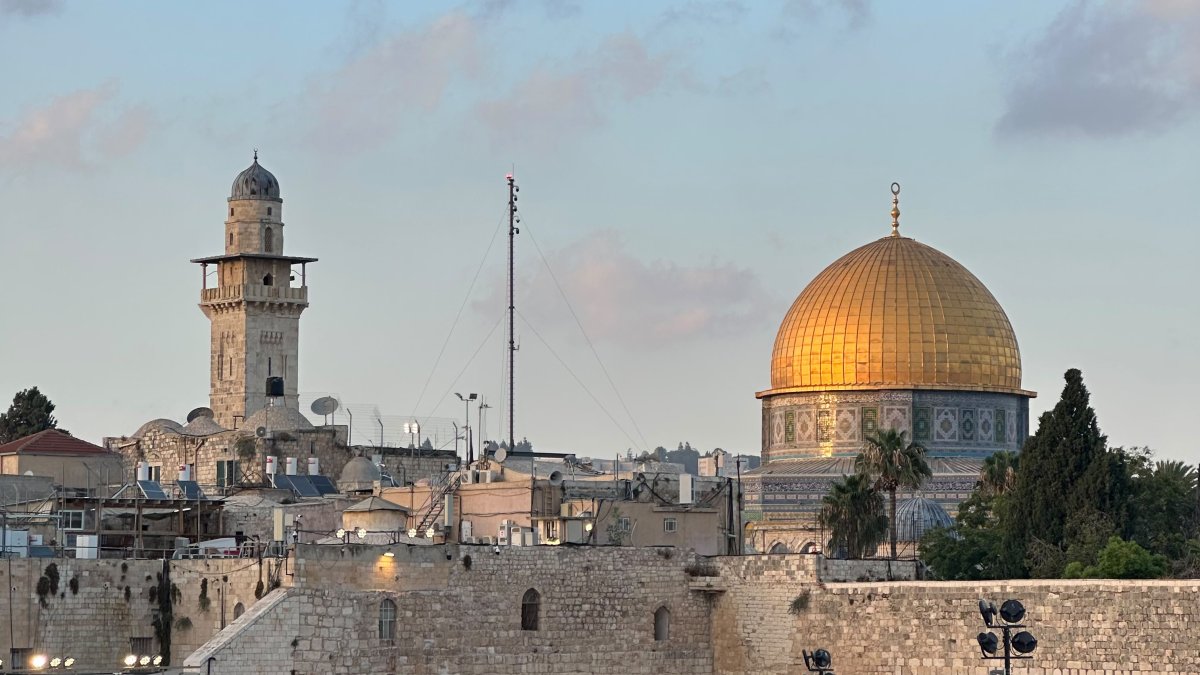
The Dome of the Rock and the Western Wall in Jerusalem.
War has opened divides that should never have existed in the first place—divides that are, in many ways, unnatural. But antisemites have always been adept at exploiting moments of crisis to manufacture hostility where there should instead be solidarity. One of the most troubling examples today is the growing tension between parts of the Catholic world and Judaism —and, more specifically, the State of Israel.
John Paul II and Benedict XVI understood this with remarkable clarity. John Paul II famously referred to the Jewish people as our “elder brothers” in faith. For him, Judaism was not something external to Christianity. It belonged to Christianity’s own spiritual inheritance. Christianity cannot fully understand itself without Israel.
Benedict XVI developed this relationship even further theologically, defending the historical and spiritual bond between the two faiths. Echoing Pius XI, he reminded Christians that, spiritually speaking, we too are Semites.
But those are religious arguments, and some will dismiss them as irrelevant to the political realities of our time. So consider a different case.
The prominent Catholic intellectual Rusty Reno once explained in The Washington Post why a Catholic could support the existence of the State of Israel on geopolitical, pragmatic, and civilizational grounds. In his essay, “I Am a Catholic. And a Zionist,” Reno, the editor of First Things, argued that a responsible American Catholic who takes history seriously, thinks theologically, and considers the demands of Catholic social teaching has powerful reasons to be a Zionist—even while criticizing Israeli policies, supporting a two-state solution, or grieving Palestinian suffering. Zionism, in his formulation, is not a religious obligation but a conclusion reached through clear thinking.
And yet antisemitism is increasingly visible today, including within some traditionalist Catholic circles. I find this deeply troubling.
As someone who increasingly identifies with Catholic traditionalism myself, I reject this growing divide. More than that, I find it incoherent. The affinities between conservative, traditionalist Catholics and their Jewish counterparts are far greater than the differences between us. Those affinities should be the foundation of an alliance that is becoming not merely convenient, but existential.
A recent trip to Israel only strengthened that conviction.
I spent ten days there as a guest of the Herzl Institute and the Edmund Burke Foundation, both led by Yoram Hazony, one of the most prominent intellectual figures in the national conservative movement. Our group consisted of fifteen conservative Catholics. We spoke with a range of voices from Israel’s conservative and traditionalist world while also making a pilgrimage to Christian holy sites that strengthened us spiritually.
I returned convinced that an alliance between Catholic and Jewish conservatives is urgently needed.
There is much that already binds us together. But amid the profound spiritual crisis consuming the West, there is also much that we Christians can learn from our “elder brothers,” to borrow John Paul II’s expression.
The Christian West is undergoing an extraordinary process of secularization that threatens to dissolve the communities from which our civilization emerged. Symbols —the custodians of tradition— are disappearing into the machinery of modernity. Our spiritual crisis is profound, and fewer and fewer people recognize that a healthy public life requires a spiritual horizon and a moral order.
At the same time, we have largely stopped defending the communities upon which nations and states are built. Sovereignty has become an embarrassment. Borders have become porous. Global markets are treated as ends in themselves. Nations fade, and identities fade with them.
Israel cannot afford such luxuries.
First, for existential reasons. Without a strong identity and a sovereign nation, Israelis know that their survival itself can be threatened by enemies who openly seek their destruction.
Second, because without the determined preservation of tradition, the Jewish people might have disappeared centuries ago. For thousands of years, parents have handed their children the inheritance of their ancestors, and those children have passed it on to their own. The flame has endured through persecution, exile, mass murder, and hatred.
What does that look like in practice?
On the final Friday night of our trip, we were invited to Shabbat dinner with Yoram Hazony and his family. For many of us, it was our first Shabbat dinner.
Before we ate, Hazony led a beautiful ritual of gratitude, honor, and spiritual reflection. There were songs that Jewish families have sung around their Friday-night tables for centuries. Here was a living tradition in which religion, family, history, and identity remained intertwined.
There, before us, were the people of Israel: alive, rooted, and unashamed of themselves.
And while we sat around that table, somewhere else in Israel a mother was probably saying goodbye to a son leaving peacefully for military service. Thousands of other Shabbat tables may have been welcoming home sons and daughters returning from their bases to spend the weekend with their families.
There is something powerful in that combination: spiritual life and love of country.
It is also part of the formula that allows nation-states to withstand enemies determined to destroy them —a lesson that much of Europe has forgotten precisely as hostile forces have found their way inside its borders.
Among our Jewish conservative friends, we encountered a devotion to ritual life, tradition, community, and nation that has become increasingly rare in the West, even among those who recognize what has gone wrong.
That is why a Catholic-Jewish conservative alliance makes sense on more than one level.
Strategically, Israel is the West’s most important ally in the Middle East. But the relationship can also be pedagogical. We have something to learn from a people who have spent millennia mastering the art of remaining themselves.
We can learn from their extraordinary sense of community. From the strength of their identity. From their attachment to ritual. From their determination to protect the symbols through which one generation speaks to the next.
Much of this has been stripped from the Christian West by our own complexes, by what Roger Scruton called oikophobia, and by the dogmas of secular modernity.
We should recover it.
And our conservative Jewish friends can help remind us how.
Because ultimately, the forces determined to dissolve our traditions, weaken our communities, erase our identities, and make us ashamed of our inheritance are often the same forces confronting them.
The Jewish people have endured for thousands of years because they refused to forget who they were. It is time for Christians to remember who we are—and to stand beside those who never forgot.
LATEST