The suicide of credibility: Somalia and ethical standards at the UN
The irony is tragic: the country that presides over action for international peace and security does not even control its own territory, much of which is under the yoke of Islamist militia Al-Shabaab.
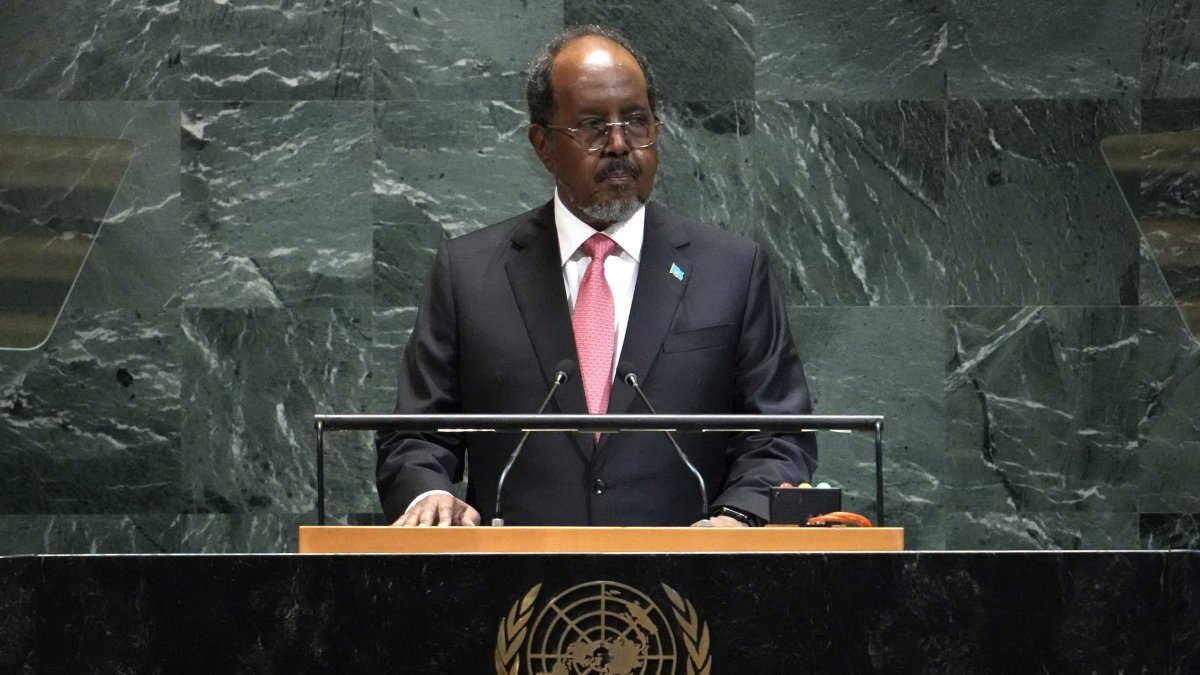
Somali President Hassan Shaykh Mohamud addresses the U.N. General Assembly.
Jan. 1, 2026 marked an ominous milestone in the history of the United Nations. Somalia, a nation that consistently tops the indices of failed states, assumed the rotating presidency of the Security Council. The irony is tragic: the country that presides over actions for international peace and security does not even control its own territory, much of which is under the yoke of Islamist militia Al-Shabaab.
The new rotating presidency of the United Nations Security Council raises an uncomfortable question: should there be minimum standards of governance, stability and transparency for leadership positions in the world's most important international bodies? The case of Somalia crystallizes this dilemma. The Security Council's presidential rotation system operates under a principle of formal equality: each of the 15 member states assumes office for 30 days, following alphabetical order. This mechanism, designed to ensure procedural fairness, does not contemplate assessments of institutional capacity, political stability or governmental integrity, evidently.
Somalia won its non-permanent position in June 2024 with 179 out of 193 votes in the General Assembly, an overwhelming endorsement that pointed to the country's progress since the collapse of the Siad Barre regime in 1991. However, the gap between diplomatic recognition and the reality on the ground is considerable.
The most vulnerable state on the planet to conflict or collapse
International indicators paint a worrying portrait of Somali institutional capacity. In the 2024 Fragile States Index, Somalia ranks high globally with a score of 111.3 out of 120, positioning it as the most vulnerable state on the planet to conflict or collapse. It is followed by Sudan (109.3) and South Sudan (109), in a region that concentrates the greatest global institutional fragilities.
In the 2024 Corruption Perceptions Index by Transparency International, Somalia scored 9 out of 100, ranking 179th out of 180 countries evaluated. Only South Sudan (8) registered a lower score. The Somali score also represents a drop of 2 points with respect to 2023, indicating deterioration rather than improvement.
In terms of violence and security, the 2024 Global Peace Index shows that Somalia remains among the least peaceful nations in the world. Large parts of the nation's territory are under the control of Al-Shabaab, an Al Qaeda-affiliated organization that has maintained a violent insurgency for nearly two decades.
The central government's ability to exercise effective sovereignty over its territory is a joke
Two federal regions, Puntland and Jubaland, have suspended their relations with Mogadishu, questioning the very authority of the central government. Somaliland, in the northwest, maintains its claim to independence, a claim Israel recognized on Dec. 26, 2025. The federal government's ability to exercise effective sovereignty over its territory is, at best, a joke.
However, recent revelations about high-level Somali officials add a troubling ethical dimension to the debate. In fact, Abukar Dahir Osman appears in corporate documents from the state of Ohio as legal agent for Progressive Health Care Services Inc., a home health care company, while simultaneously serving as permanent representative to the U.N. since 2017. Records show this connection through 2019. Progressive Health Care Services was included in November 2025 on the U.S. Department of Health and Human Services' exclusion list, as it operated in sectors funded by Medicaid, U.S. government programs that have been the subject of massive fraud investigations. The pattern is consistent with documented schemes in Minnesota, where one of the largest cases of public assistance fraud, with connections to the Somali diaspora, was unraveled.
Somali Foreign Minister Abdisalam Abdi Ali faces similar scrutiny. Public records indicate that he founded Ritechoice Healthcare Services LLC in Toledo, Ohio, in 2009, and served as CEO of MedExpress Transportation between 2015 and 2019. These individual cases point to a deeper structural issue: the relationship between diplomatic representation, institutional integrity and international oversight.
Mike Waltz: Somalia case represents one of the UN's major failures
U.S. Ambassador to the U.N. Mike Waltz expressed this concern directly: assigning senior international posts to countries facing profound internal security challenges represents one of the body's major failings. Hillel Neuer, executive director of U.N. Watch, described handing the Security Council presidency to the country ranked as the world's most fragile on multiple international indices as absurd.
Handing authority over global security to states that cannot guarantee basic security in their own territory creates a very serious institutional contradiction. When a country simultaneously ranks first in state fragility, second to last in corruption and faces ethical questions about its top diplomatic representatives, the tension between formal principle and practical implementation becomes untenable.
The Security Council is becoming a board where the foxes guard the henhouse
Somalia's presidency will end in 30 days. But the debate over what equal participation in the international order really means will remain much longer. Can a system based on formal equality maintain credibility when member states present radically asymmetric institutional capacities? Is a model of global governance where extreme fragility and systemic corruption are no impediments to leadership positions sustainable?
A system that allows a "state" that cannot protect human rights at home to participate in dictating the international human rights agenda is broken. Somalia's presidency of the Security Council is neither a triumph of multilateralism nor a sign of "progress"; it is validation of corruption and instability. The Security Council is proving to be a board where the foxes guard the henhouse.
LATEST