The U.S. Has Issued an Ultimatum to Maduro — but It May Not Work: Something More Will Be Needed
The United States will have to prove that, this time, it isn’t bluffing — that an ultimatum is exactly that, an ultimatum, not an empty threat. If it doesn’t work through the good way, as Trump himself said, then it will have to work the hard way.
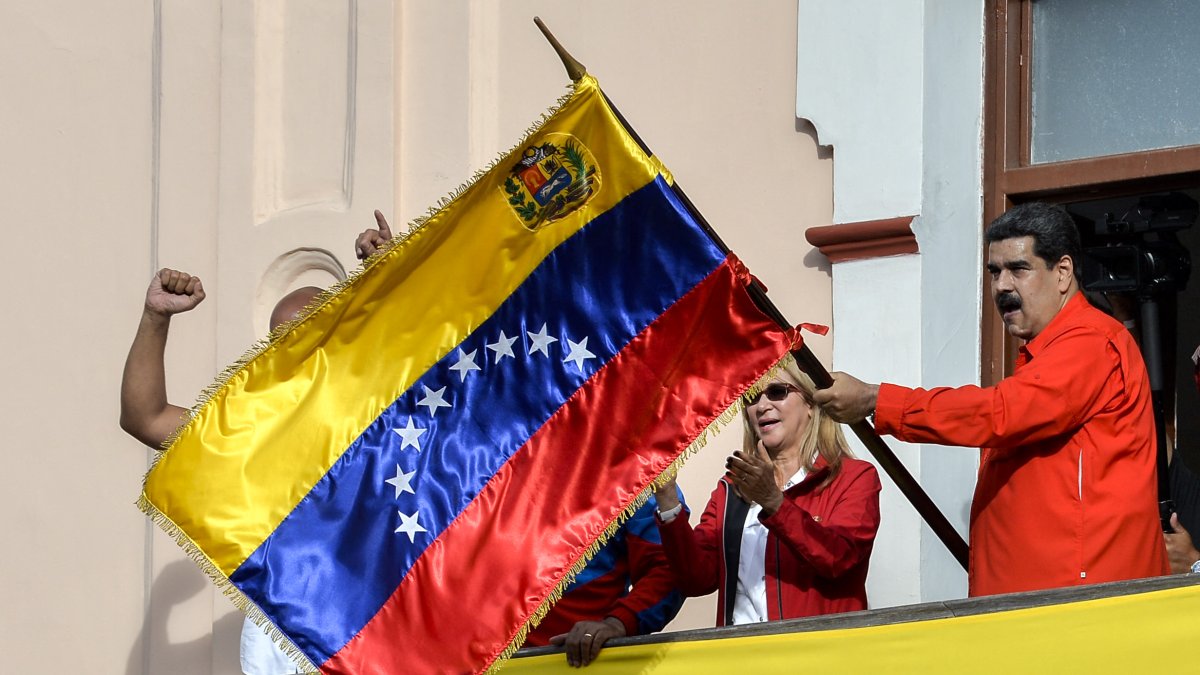
Nicolás Maduro in Miraflores, 2019.
According to reporting in The Wall Street Journal, the Miami Herald, and the New York Post, Donald Trump has issued a stark ultimatum to Nicolás Maduro: leave Venezuela “immediately,” or the United States will use military force against him and his family. This is not just any threat. An unprecedented U.S. naval force is currently deployed in the Caribbean —almost certainly positioned for a potential strike against the Venezuelan regime, now designated by Washington as a Foreign Terrorist Organization.
An ultimatum of that magnitude, especially coming from someone like Trump, would terrify almost any dictator on earth. And there is likely no tyrant alive who could withstand it. But Maduro’s circumstances are different — which means the ultimatum may not have its intended effect.
Trump’s United States understands exactly what Maduro’s regime is: it behaves less like a conventional dictatorship and more like a criminal organizaton, a cartel. Its internal logic mirrors that of organized crime. It operates no differently than the Medellín Cartel in the 1980s or the Sinaloa Cartel today.
Maduro is a hostage to his circumstances. The classic mix of threats and incentives — destroy you with military force or grant you and your family amnesty — is usually effective for pressuring tyrants. It’s the familiar carrot-and-stick strategy, the one that has worked, to varying degrees, on figures like Charles Taylor, Idi Amin, Stroessner, and even, in some respects, Pinochet. But it is unlikely to work on Maduro. The Venezuelan strongman, head of a narco-cartel, is not an autonomous leader, and the system he presides over is not vertical.
In a recent Axios report, a U.S. official made a point that is almost certainly correct: if Maduro tried to flee Venezuela, his own security detail — riddled with Cuban agents — could kill him. Cuban-American Congresswoman María Elvira Salazar believes the same. And they are not wrong. Maduro is a prisoner of the Cubans, and of the broader system around him.
There are factions within Chavismo. One of them — the fundamentalist faction tied most deeply to narcotrafficking — is controlled by Diosdado Cabello, who is effectively the most powerful man in Venezuela. Cabello controls the drug routes, but also the repression apparatus, counterintelligence operations, and torture units. It’s in those groups — especially the DGCIM, the General Directorate of Military Counterintelligence — where the regime’s true repressive power resides. The DGCIM spies on regime officials, neutralizes dissent, and keeps the military in check. Through the DGCIM, Cabello can watch and control even Maduro himself.
The incentives reportedly on the table for Maduro will never be available to Diosdado —not because the United States cannot offer them, but because he will never have guarantees. And Diosdado knows it. Some figures in the regime may hope for a silver bridge into exile —a semi-comfortable life with certain guarantees in a place like Iran or Turkey. But none of that applies to Cabello. He is far too implicated in the criminal structure, the narcotrafficking networks, and systematic human-rights abuses.
Because incentives don’t work for Diosdado —and because he controls the repression machine on which the regime now survives— he is the one who largely determines the dictatorship’s course (and Maduro’s). He is the central reason why the political game cannot be unlocked, despite the dynamics of ultimatums, incentives, and deterrence —all compounded, of course, by the Cuban factor.
Donald Trump, together with his Secretary of Defense, Pete Hegseth, and his Secretary of State, Marco Rubio, is shaping the toughest and most effective policy ever designed to confront the narco-terrorism devastating the United States and the hemisphere. But when it comes to facing —and ultimately dismantling— the Cartel of the Suns, ultimatums alone will not suffice.
None of this means Maduro’s regime could withstand a U.S. military offensive. That is utterly impossible. They would not even try. But the regime’s strategy is simple: stay as firm and unified as possible ahead of any strike, hoping that their show of strength will create the illusion that a U.S. incursion in Venezuela would be too costly —and that, in the end, Washington will settle for a deterrent bluff. The dictatorship is praying that, all along, the United States has merely been applying the old, exhausted formula of pressuring for an internal military fracture.
In that sense, I do not believe a large-scale, long-term military intervention would be necessary to end the Cartel of the Suns. Not at all. But the United States will need to demonstrate that this time it is not bluffing —that an ultimatum is truly an ultimatum, not an empty threat. If it doesn’t work the easy way, then, as Trump himself said, it will have to work the hard way.
LATEST