UN Watch: Strikes on Iran are self-defense, not illegal war
Hillel Neuer, executive director of the Geneva-based NGO, tells JNS that critics are misapplying international law as Israel and the United States target Tehran's military, nuclear and regime infrastructure.

An explosion close to Mehrabad International Airport in Tehran on March 7, 2026

The world is watching as Israel and the United States conduct massive, targeted strikes against Iranian military, nuclear and regime infrastructure. For many years, Israel fought proxy wars with Iran through groups like Hezbollah and Hamas. But Israel’s June 2025 operation—a direct confrontation with the Islamic Republic—changed the paradigm.
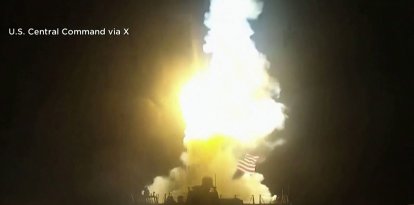
Israel damaged Iran’s uranium-enrichment facilities at Natanz and Isfahan, followed by a 12-day war that ended in a fragile ceasefire. Iran’s renewed efforts to develop its nuclear and ballistic capabilities prompted the Feb. 28 joint U.S.-Israeli strikes that killed Ayatollah Ali Khamenei and other senior officials, including IRGC commanders, in the opening salvo.
Iranian retaliatory missile barrages have struck Israeli cities and even U.S. bases in the region, prompting global condemnation and emergency U.N. Security Council sessions—but not necessarily for the reasons one might expect.
Amid the escalating conflict with the world’s leading sponsor of terrorism, JNS spoke with Hillel Neuer, executive director of UN Watch, a Geneva-based NGO known for monitoring and critiquing anti-Israel bias at the United Nations, about the legal ramifications of the war against Iran.
“The first thing to understand is that a lot of the public debate is using the wrong legal framework,” Neuer told JNS.
“Critics are treating this as if the United States and Israel suddenly launched a brand new war,” he said, “but in reality, there has been an ongoing armed conflict between Iran and Israel—and to a significant extent between Iran and the United States—for decades.”
Neuer noted that for years Iran has attacked Israel through proxies such as Hezbollah, Hamas and the Houthis, directing militias across the region. Last year, he added, Iran even launched hundreds of missiles and drones directly at Israel.
“Under international law, that matters,” he said. “This is an ongoing armed conflict.”
Neuer also pointed to Article 51 of the U.N. Charter, which “explicitly recognizes the inherent right of states to defend themselves.”
“So when the U.S. and Israel target IRGC bases, missile launchers or nuclear infrastructure that poses a grave threat to all humanity, they are acting within a well-established legal framework of self-defense,” Neuer said.
The historical context of the Iran-Israel proxy war helps explain this perspective. The conflict intensified following Iran’s direct missile attacks on Israel last year. Those attacks came after Israeli strikes on Iranian targets in Syria and Lebanon that crippled Hezbollah leadership and helped pave the way for political changes in Syria.
Washington has justified its involvement in the 2026 strikes as self-defense against Iran’s nuclear program and proxy threats, citing Article 51 in notifications to the United Nations. Critics, however, argue the actions violate Article 2(4) of the U.N. Charter, which prohibits the use of force against a state’s territorial integrity without an imminent armed attack or Security Council approval.
If Article 51 allows states to defend themselves, Neuer argued, it is difficult to understand why so many critics claim the Trump administration’s decision to go to war is unlawful.
“A lot of it comes down to politics,” he said.
“The phrase ‘international law’ is weaponized for partisan debates,” Neuer added. “Some people assume that any use of force across borders is automatically illegal unless the U.N. Security Council approves it. But that’s not what the law says.”
“The U.N. Charter recognizes the right of self-defense precisely because states sometimes have to act to protect their citizens without waiting for permission from a Security Council—where regimes like Russia and China hold veto power,” he said. “If that right didn’t exist, international law would effectively become a suicide pact.”
The Trump administration’s return to power in 2025 set the stage for the strikes, following failed nuclear negotiations in June that were followed by Israeli assassinations of senior Iranian officials and attacks on key facilities. Subsequent U.S. strikes targeted nuclear sites such as Fordow, degrading Iran’s nuclear-development and ballistic-missile capabilities.
Dissenting voices, particularly among Democrats in the United States and leaders in Europe, have called the actions “ill-advised and illegal,” warning of regional chaos that could affect shipping lanes and oil facilities.
Russia and China, both veto-wielding members of the Security Council, have blocked resolutions condemning Iran, fueling accusations that international law is being politicized.
Neuer acknowledged that opposition to the strikes can be legitimate if framed as a policy debate.
“Instead of arguing it on strategic or political grounds, they frame their objections in legal language that doesn’t accurately reflect how the law of self-defense actually works,” he said.
He noted that international law is often misunderstood. “With international law, there’s no single global court or legislature that resolves every dispute,” Neuer told JNS. “States interpret and apply legal principles based on evolving circumstances.”
As an example, he cited the concept of proportionality in the law of armed conflict.
“Many people think it means both sides must suffer roughly the same number of casualties,” Neuer said. “But that’s not at all what the law says. Proportionality actually means weighing the expected military advantage of a strike against the anticipated civilian harm.”
“So two people can invoke the same legal term but mean completely different things,” he added.
Neuer also addressed the issue of civilian casualties.
“Many people assume that if civilians are killed, that automatically means a war crime,” he said. “That’s what U.N. officials have been saying about the reported tragedy of an Iranian school that was apparently hit by a U.S. strike.”
“But that’s not the law,” Neuer continued. “The legal question is whether civilians were deliberately targeted, or whether the military was aiming at legitimate targets while trying to minimize civilian harm.”
“There is simply no serious evidence that the United States is intentionally targeting schools or civilians,” he said. “International law judges the intent and the targeting decisions, not simply the result. That distinction often gets lost in public debates.”
UN Watch has also criticized U.N. experts for what it calls selective focus—for example, amplifying civilian casualties in Iran while largely ignoring the regime’s mass killings of protesters.
Neuer cited criticism of U.N. special rapporteur Francesca Albanese, whom UN Watch accused of spreading propaganda in defense of Iran.
U.N. Secretary-General António Guterres has also taken a critical stance toward the strikes. Addressing an emergency meeting of the Security Council on Feb. 28, Guterres invoked Article 2 of the U.N. Charter, which states that member states “shall refrain in their international relations from the threat or use of force against the territorial integrity or political independence of any State.”
He warned that the war is “squandering an opportunity for diplomacy.”
Neuer said the secretary-general’s remarks “reflect a troubling, one-sided reading of international law.”
“He repeatedly invokes the prohibition on the use of force, yet says far less about the equally fundamental principle in the U.N. Charter: the inherent right of states to defend themselves,” Neuer said.
“For decades, the Iranian regime has funded terrorist organizations, launched missiles at civilian populations, threatened the destruction of Israel and pursued nuclear-weapons capability,” he added. “Yet when democracies act to neutralize those threats, the U.N. leadership suddenly finds its voice about restraint and diplomacy.”
According to Neuer, international law “was never meant to function as a shield for aggressive regimes while tying the hands of those defending themselves.”
“By focusing almost exclusively on the actions of the U.S. and Israel while downplaying Iran’s long record of aggression, the secretary-general risks turning the law into a political talking point rather than applying it as a serious and consistent legal principle,” he said.
Neuer criticized what he described as selective outrage by U.N. agencies. “They had UNICEF highlight child victims of strikes, but staying silent on the regime’s own mass killing of children,” he said.
“UNESCO decried the ‘grave violation’ of student deaths—without any evidence of intent,” he added. “Yet it said nothing about the regime housing military forces in schools and universities to hide behind civilian infrastructure.”
He also noted that UNESCO had issued a statement about damage to an Iranian heritage site, “but refused to say a word on Iranian missiles striking Tel Aviv’s UNESCO-listed Bauhaus buildings.”
“What we’re seeing from the U.N. now isn’t impartiality,” Neuer said. “Shockingly, we are seeing complicity in shielding tyrants while undermining efforts to liberate the Iranian people.”
© JNS.
LATEST