AIPAC, other pro-Israel groups enter midterms with $100 million to spend
A spokeswoman for AIPAC, which has $96 million on hand, said that “our six million grassroots members are as determined and eager as ever to participate this election cycle.”
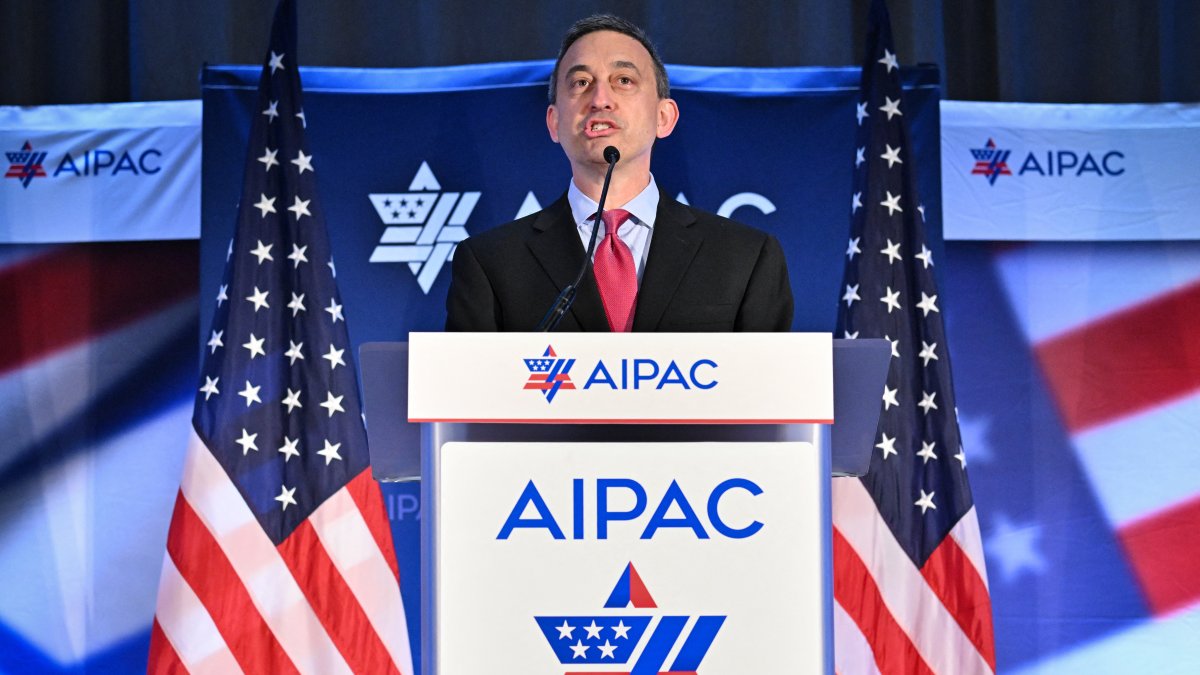
American Israel Public Affairs Committee (AIPAC) President Michael Tuchin. File archive

Pro-Israel political action committees entered 2026 with more than $100 million to spend on the midterm elections at a time when more and more candidates are pulling away from unquestioningly supporting the Jewish state, according to a JNS analysis of year-end reports filed with the Federal Election Commission.
Most of the money, $96 million, was banked by the American Israel Political Action Committee’s super PAC, the United Democracy Project.
“Our six million grassroots members are as determined and eager as ever to participate this election cycle, supporting Democrats and Republicans who strengthen the U.S.-Israel partnership and opposing those who may seek to undermine it,” Deryn Sousa, AIPAC spokeswoman, told JNS.
The Republican Jewish Coalition’s political director, Sam Markstein, quoted Mark Hanna, a U.S. senator from Ohio and Republican National Committee chair in the late 1890s and early 1900s, who was instrumental in electing William McKinley to the presidency twice.
“There are two things that are important in politics. The first is money, and I can’t remember what the second one is,” he said.
The numbers make the pro-Israel community one of the financial heavyweights in this year’s midterms, with few other interest groups having the bank accounts needed to wade into primary and general elections across the country on behalf of favored candidates, according to Jacob Rubashkin, deputy editor of Inside Elections.
“It absolutely puts them in pretty rare company right off the bat,” he told JNS.
Crypto and artificial intelligence industries and the political party committees and their affiliated super PACs are the others in a similar position, according to Rubashkin.
The only other pro-Israel PAC entering 2026 with a seven-figure bank account was Democratic Majority for Israel, which reported $2 million cash-on-hand to the Federal Election Commission.
DMFI PAC announced in February that it had endorsed 11 House candidates, five of whom were running for open seats and six challenging Republican incumbents.
“These endorsements reflect our belief that supporting Israel and winning elections go hand in hand,” stated Kathy Manning, a former Democratic congresswoman from North Carolina and a member of the PAC’s board of directors.
“The U.S.-Israel relationship has long been a bipartisan pillar of American foreign policy because it’s critical to our security and intelligence capabilities and it remains a view shared by the majority of Democratic voters,” she said.
J Street, which describes itself as “pro-Israel, pro-peace, pro-democracy,” reported $717,957 in its political action committee and super PAC combined at the end of last year. The group announced last month that it had raised $3 million for its super PAC to be spent on competitive races this fall, including against candidates that it said blindly support Israeli Prime Minister Benjamin Netanyahu’s policies.
“Through this super PAC, we will be targeting a select number of extremist members in general elections, many of whom tout their unconditional support for Israel while promoting antisemitic rhetoric and advancing agendas that undermine American democracy,” Jeremy Ben-Ami, its president, stated.
The Republican Jewish Coalition had a PAC balance of $299,877 but has plans to spend more than $3 million on independent expenditures in the midterms, Markstein told JNS.
Markstein said that the money will go into competitive races where the group can make a difference. Already, the RJC’s super PAC spent $2.9 million to try to defeat Rep. Thomas Massie (R-Ky.) in the Republican primary, FEC reports show. Massie has been a critic of Israeli government policies and of the Jewish state, which he has accused of “indiscriminate bombing” in Gaza.
“We don’t get into races that are either landslides or windmills,” Markstein told JNS. “We want to train our resources at the center of the political battlefield, and that’s exactly what we’re going to be doing again.”
“Obviously having a big war chest is critical in these key races,” he added.
The fourth-biggest PAC classified as pro-Israel by the research group OpenSecrets, Norpac, had $529,540 to spend.
As a mostly volunteer group, the PAC gets a lot of bang for its buck, its president Ben Chouake told JNS. Most of the money it raises is earmarked for specific candidates.
“Our staff costs are very low, since it is predominantly volunteer,” he said. “We hold 50-plus fundraisers annually plus a substantial mission to D.C., either the largest or second-largest on U.S.-Israel relations.”
AIPAC, though, remains the dominant force.
“This is the big leagues of the big leagues,” Democratic consultant Joel Rubin told JNS. “It will be a major factor in both primaries and the general election in this cycle. They cannot ignore the Goliath—the massive spigot of funds that this represents.”
“It’s not just the amount of money. It’s the flexibility for political engagement that that money buys,” he said. “They can just roam and look for targets.”
But AIPAC’s first efforts of the year backfired when it spent $2.3 million against former congressman Tom Malinowski in a New Jersey Democratic primary for the U.S. House, only to see the nomination go to a more progressive Democrat, Analilia Mejia, who has accused Israel of committing genocide in Gaza.
“They made a big strategic error and a major strategic error in New Jersey recently,” Guy Ziv, a professor at American University and associate director of its Center for Israel Studies, told JNS.
“They’re tone deaf and not in touch with the sentiment of the Jewish community as they once were, and so spending more money does not necessarily equate to greater influence, especially when attitudes in this country are changing quickly,” Ziv said. “They have not been as quick to adapt to these changing attitudes.”
Malinowski was a reliable pro-Israel vote in Congress and even ran for re-election with AIPAC support. But he said that because he would not give Netanyahu a blank check, he incurred the wrath of the powerful pro-Israel lobbying group.
Ziv said that AIPAC should reassess how it defines what it means to support the Jewish state.
“What a lot of the donors may not even realize is that their kids and grandkids are moving away from Israel altogether,” Ziv told JNS. “There’s real antisemitism in this country and around the world, a real genuine and disturbing spike in antisemitism across the country and so we need to be extremely cautious about who we label antisemitic, who we label as pro-Israel or anti-Israel.”
“The very definition of what it means to be pro-Israel needs an update,” he said. “AIPAC is behind the times.”
Rubashkin said that AIPAC’s loss in New Jersey was a caution sign that money doesn’t always equal victory.
“I think the special election in New Jersey 11 is instructive on how there are limits to what a fundraising advantage can get you,” he told JNS. “If you don’t play your political cards right, then you can end up with an outcome that you wouldn’t have preferred.”
That didn’t stop AIPAC’s super PAC from pivoting to the 7th Congressional District in Illinois, spending $2.3 million so far on behalf of Chicago city treasurer Melissa Conyears-Ervin in the party primary in the heavily Democratic district.
AIPAC’s backing could prove a political liability in some races, as pro-Israel supporters face off against Democrats who have been critical of Israeli policies, including claiming that the Jewish state is committing genocide against the Palestinians even as they support Israel’s right to exist.
“Because they’ve made themselves a money player, they’re now a legitimate target,” Rubin told JNS.
Some Democrats have made accepting AIPAC contributions a campaign issue against their opponents.
“Frankly, at this point, there’s just a straightforward risk of blowback by virtue of getting involved in the race,” Rubashkin told JNS. “We’ve seen candidates now try to get ahead of AIPAC involvement in their races, using it as a fundraising message, drawing attention to their own campaigns.”
“If one of their opponents is getting that support, then I think that it wouldn’t surprise me if being the beneficiary of that kind of spending becomes a bit of a double-edged sword,” he said.
Others welcomed AIPAC’s bank account. “Glad to see AIPAC doing well,” Chouake told JNS.
And Markstein told JNS that “having the resources at the disposal of the pro-Israel community is a really important factor in 2026.”
© JNS.
LATEST