







ANALYSIS
On the anniversary of the jihadist attacks in Paris: Houellebecq’s prediction that continues to polarize France and has landed him in court
More than ten years later, the Bataclan massacre continues to symbolize the West's vulnerability to jihadist terrorism. It also serves as a reminder that the warnings of writers such as Michel Houellebecq—which were dismissed as Islamophobia or alarmism—are once again being taken seriously following his indictment for having spoken in 2022 about a possible "reverse Bataclan."
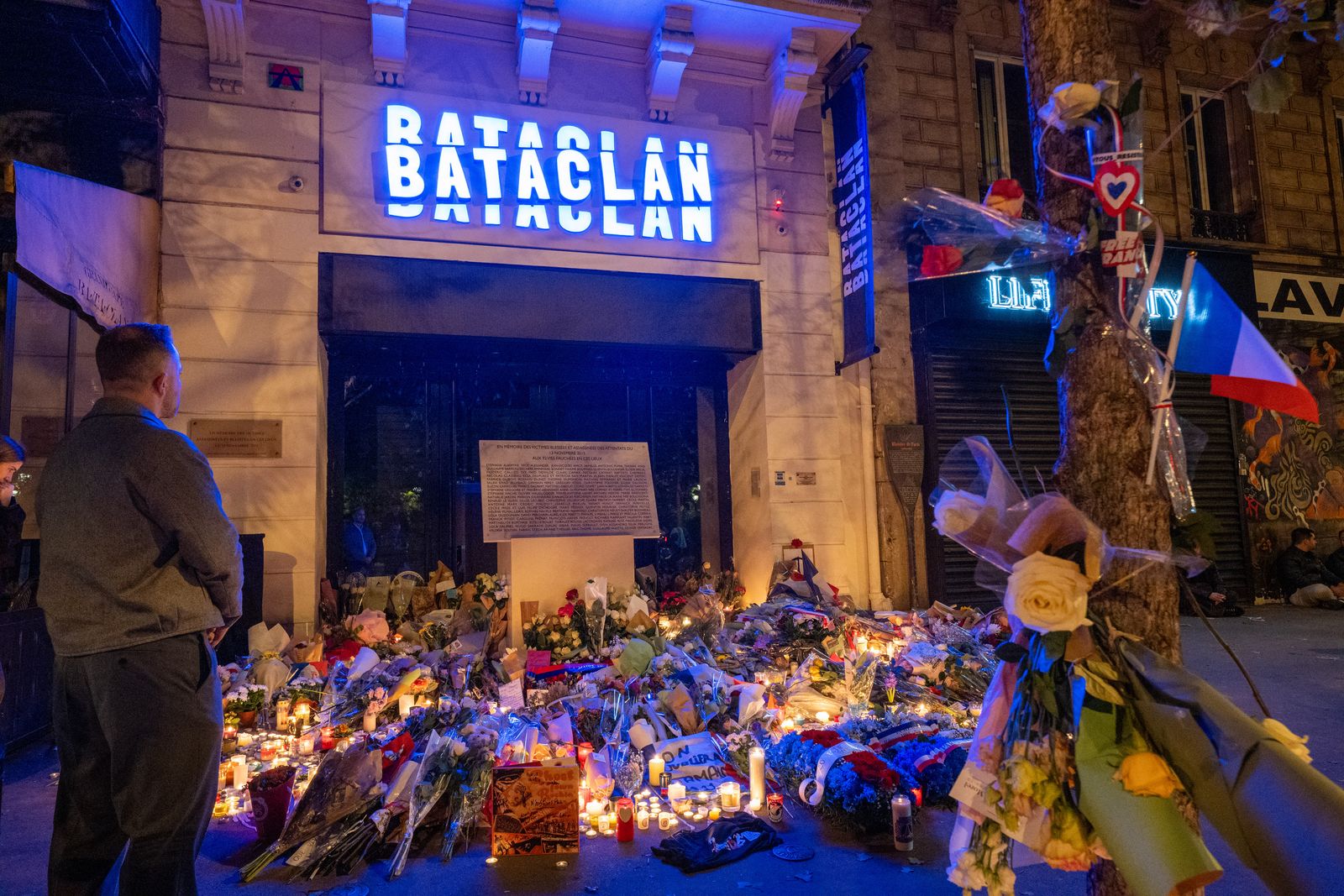
A vigil held in front of the Bataclan concert hall in memory of the victims of the 2015 attacks

On November 13, 2015, France suffered the worst terrorist massacre in its contemporary history. Ten Islamic State (IS) jihadists carried out a series of coordinated attacks in Paris and in the town of Saint-Denis, a northern suburb of the capital, leaving 130 dead and more than 400 wounded, many seriously. The deadliest site was the Bataclan, where three terrorists killed 90 people during a concert by the American rock band Eagles of Death Metal.
More than ten years later, the memory of the Bataclan remains a symbol of Western civilization's vulnerability to jihadist terrorism. But it is also an uncomfortable reminder that warnings about the Islamist threat issued by French writers such as Michel Houellebecq were dismissed at the time as Islamophobia or alarmism, and are now back on the table following the novelist's indictment for remarks he made in 2022 in which he spoke of a possible "Bataclan in reverse."
November 13: A night of horror
The night of November 13, 2015, began with three explosions near the Stade de France in Saint-Denis during the France-Germany soccer match. A suicide bomber blew himself up at one of the stadium gates, and two others did the same in the immediate vicinity, killing one person and injuring several others. The goal was to carry out a massacre inside the stadium, but security measures prevented it.
Minutes later, two gunmen armed with assault rifles attacked several venues in eastern Paris. They fired indiscriminately at patrons at the restaurants and bars Le Carillon, Le Petit Cambodge, La Bonne Bière, La Belle Équipe, and Café Comptoir Voltaire, leaving 39 dead and dozens seriously injured.
The deadliest attack took place at the Bataclan concert hall, where the band Eagles of Death Metal was performing. Three terrorists armed with AK-47 rifles, grenades, and explosive belts stormed the venue while the concert was underway. Shouting "Allahu akbar!" ("God is greatest!") and "This is for Syria!" they opened fire on the audience, causing a bloodbath. They held hostages for nearly three hours. The assault by the police special forces, the Investigation and Intervention Brigade (BRI) and the Investigation, Assistance, Intervention, and Deterrence Unit (RAID), brought the hostage situation to an end: two terrorists were shot dead, and the third blew himself up with his explosive vest.
Salah Abdeslam, one of the members of the jihadist group who had participated in the attacks on bars and restaurants in eastern Paris, did manage to escape that night. He was arrested months later, in March 2016, in the Molenbeek neighborhood of Brussels.
"Soumission": The novel that anticipated the debate
Months before the November 13 attacks, on January 7 of that same year—the very day that jihadist terrorists attacked the offices of the French satirical magazine Charlie Hebdo and murdered 12 people, Soumission ("Submission"), Michel Houellebecq's sixth novel was published. In it, the author imagined a France in 2022 in which a moderate Islamist party came to power with the tacit support of left-wing and centrist groups. The book became an instant success and sparked an intense political and cultural debate fueled by the attack on Charlie Hebdo.
Houellebecq did not invent political Islamism. What he did was describe, with literary detachment, a process of cultural submission that was already underway—the reluctance of broad sectors of the political, academic, and media classes to clearly name the nature of the problem. After the 2015 attacks, that reluctance did not diminish; in many circles, it intensified.
In the novel, the character of Rediger—an intellectual who has converted to Islam, holds a high-ranking position in the new Islamized France, and tries to convince the protagonist to convert—summarizes the book's central idea with these words: "It is submission. The astonishing and simple idea, never before expressed with such force, that the pinnacle of human happiness lies in the most absolute submission." And he adds, "For the Muslim, the true enemy—what he fears and hates—is not Catholicism. It is secularism. It is laicism. It is atheistic materialism."
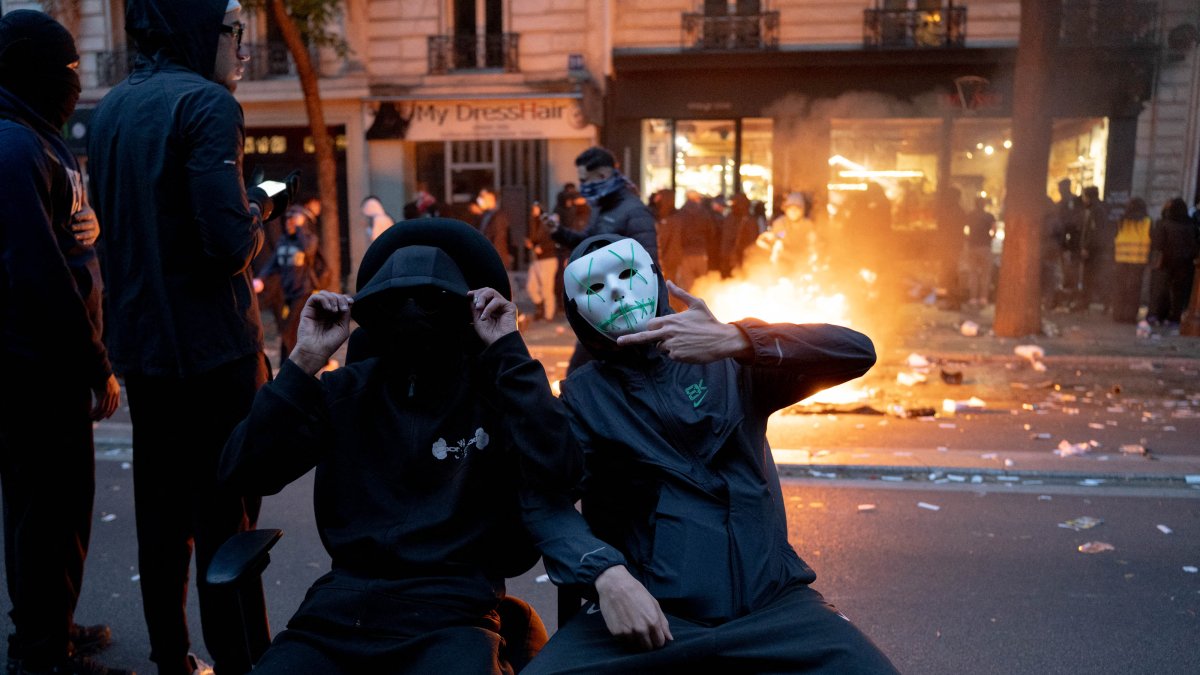
Just the News
Same red-green network that boosted anti-Israel protests in US at center of French unrest, riots
Just The News
The charges against Houellebecq
In 2022, in an interview with the philosopher Michel Onfray published in the magazine Front Populaire, Houellebecq stated: "The French people's desire for 'native', as they say, is not for Muslims to assimilate, but rather that they stop robbing and assaulting them. Or, alternatively, that they leave." He also stated: "When entire territories are under Islamist control, I believe acts of resistance will occur. There will be attacks and shootings in mosques, in cafes frequented by Muslims—in short, a reverse Bataclan."
The Grand Mosque of Paris announced in December 2022 its intention to file a complaint for incitement to hatred, but months later it withdrew the legal action. However, the Union of Mosques of France did file a formal complaint in January 2023 with the Nanterre court. On Tuesday, an investigating judge in Nanterre charged Houellebecq with complicity in incitement to discrimination, hatred, or violence. His attorneys, Thibault de Montbrial and Louis Cailliez, have asserted that the comments in question "contain no element of incitement, not even implicitly, and therefore fall within the scope of freedom of opinion and expression."
This is not the first time the writer has faced legal action for his statements about Islam. In September 2001, in an interview with the magazine Lire, Houellebecq said: "The most idiotic religion is Islam. When you read the Quran, you're left shattered… shattered." He also stated that Islam is "a dangerous religion, and has been since its inception."
After being denounced by the Grand Mosques of Paris and Lyon, the World Islamic League, and the League of Human Rights, the writer was acquitted on October 22, 2002, by the Paris Criminal Court. The judges ruled that, although his statements were derogatory, they were directed at the religion and did not constitute incitement to hatred against Muslims.
An assessment that is difficult to refute
Houellebecq is no oracle, but his work and subsequent statements serve as an uncomfortable mirror: they show the extent to which a segment of the Western elite has preferred to manage the problem through silence or by criminalizing the diagnosis rather than confronting it.
Eleven years after the Bataclan massacre, the culture war has not stopped. In certain circles, efforts to turn any critical analysis into a crime of opinion have intensified. The writer who dared to say what many politicians and media outlets avoided saying continues to pay the price for that candor. The victims of November 13 deserve more than just ritual commemorations. They deserve an examination—free of taboos—of why Houellebecq's analysis remains so controversial and so difficult to refute.
🛠 Do you think there is an error in this article?
Recommendations


LATEST


