From Lula to Bolsonaro's heir: The men leading the battle for power in Brazil
Luiz Inácio Lula da Silva is seeking a fourth term with the Workers' Party, while Flávio Bolsonaro is trying to bring the right back to the Planalto Palace and preserve the political movement built by his father.
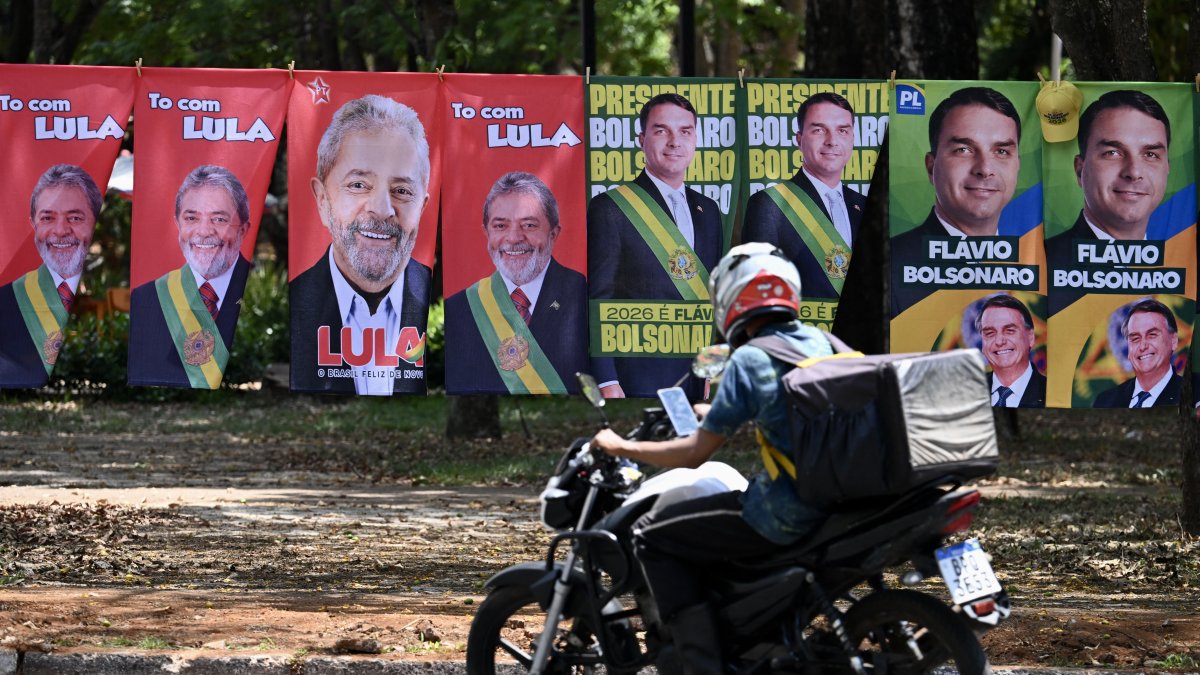
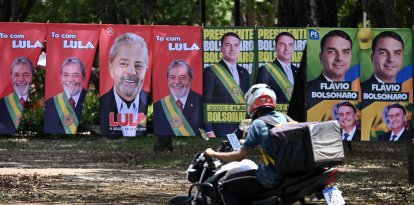
Images of Brazil's presidential candidates, Luiz Inácio Lula da Silva and Flávio Bolsonaro

This Sunday, Oct. 4, Brazil heads to the polls for a presidential election once again dominated by two virtually opposing political agendas.
On one side is Luiz Inácio Lula da Silva, the historic leader of the Brazilian left who returned to power in 2023 and is now seeking a fourth non-consecutive term. Opposing him is Flávio Bolsonaro, a senator, the eldest son of former President Jair Bolsonaro, and the political heir to a conservative movement that wants to return to the halls of the Planalto Palace.
Although 11 other candidates appear on the ballot, polls in the final stretch show a race that is essentially a two-way contest between them. The media describe a tight race in which Lula and Bolsonaro are separated by narrow margins, with a runoff scheduled for Oct. 25 if neither candidate secures more than 50% of the valid votes.
Beyond deciding who will govern for the next four years, the election pits two different visions against each other on the economy, security, social values and foreign policy—including the relationship Brazil should maintain with the United States, China and the regimes that remain in Latin America.
Lula: Four decades on the left, a corruption conviction and 80 years old
At 80 years old, Luiz Inácio Lula da Silva is once again attempting to extend a political career that has shaped much of Brazil's recent history.
A former steelworker and union leader, he was one of the founders of the Workers' Party (P.T., for its acronym in Portuguese) and served as president from 2003 to 2010. He returned to the Planalto Palace in January 2023 after narrowly defeating Jair Bolsonaro.
His career includes one of Brazil's most controversial political and legal episodes: he was convicted of corruption and money laundering during Operation Car Wash and spent 580 days in prison. The convictions were later overturned, allowing him to regain his political rights and run for office again.
He is now seeking to become president for the fourth time.
On domestic policy, Lula adheres to the traditional P.T. model: a strong state presence, expansion of social programs and a more gradual fiscal policy. His team proposes achieving a primary surplus of around 1.3% of GDP by 2030, while seeking to preserve social spending. Flávio Bolsonaro, in contrast, proposes a faster adjustment based on spending controls, privatization and reducing bureaucracy.
But one of Lula's most defining characteristics once again lies outside Brazil.
Lula: The return of Cuba and Venezuela to the Brazilian agenda
But these relations are not new. During his first terms, Lula maintained a close relationship with Fidel Castro and the Cuban regime. His administration made Cuba a priority for Brazilian South-South cooperation and expanded political, commercial, scientific and academic dialogue with Havana.
More recently, he met with dictator Miguel Díaz-Canel and traveled to Havana, where he defended his historic relationship with the Castro regime. As for Venezuela, he welcomed former dictator Nicolás Maduro to Brasília and supported his reintegration into the South American dialogue.
This rapprochement has been criticized by sectors that question the authoritarian nature of both governments.
Flávio Bolsonaro: The family name seeking a return to the Planalto
A familiar last name has emerged as a rival to Lula.
Flávio Bolsonaro, 45, is a senator from Rio de Janeiro and the eldest son of former President Jair Bolsonaro. Before joining the Senate, he served four terms as a state representative.
His candidacy emerged after his father was eliminated from the presidential race. Since then, Flávio has sought to transform the political capital built by Jair Bolsonaro into a movement capable of surviving electorally without the former president on the ballot.
Analysts describe these elections precisely as a test of Bolsonarism's ability to remain one of the country's major political forces after its founder's exit from the electoral race.
Flávio was nominated as the candidate by the Liberal Party and chose Representative and former prosecutor Alfredo Gaspar as his running mate.
His campaign has maintained several of the central tenets of his father's movement: public safety, the defense of Christian and conservative values, tax cuts, greater openness to the private sector, and opposition to the economic policies of the left.
In July, he officially launched his candidacy, symbolically accompanied by international political figures. The event included messages of support from Argentine President Javier Milei and Israeli Prime Minister Benjamin Netanyahu, as well as a speech by Jair Bolsonaro. Flávio promised tax cuts and a tougher stance on crime.
On economic policy, he is also trying to draw a clear distinction from Lula.
While the government proposes a gradual reduction of the deficit accompanied by protection for social programs, Bolsonaro's advisors advocate for privatization, reduced bureaucracy, tax relief and a fiscal adjustment of about 1.5% of GDP over approximately 18 months.
In foreign policy, Flávio Bolsonaro is much closer to the international conservative axis and particularly to sectors aligned with the United States and Israel, in contrast to Lula's commitment to a more autonomous foreign policy, BRICS and a close relationship with China.
His main political asset is also his greatest challenge: the Bolsonaro name.
Flávio is trying to retain the millions of Brazilians who still identify with his father's administration and positions, while projecting his own image and seeking to broaden his support beyond the traditional Bolsonaro electorate.
The other candidates
The election features eleven other candidates, including conservatives Ronaldo Caiado and Romeu Zema, liberal leader Renan Santos, and writer Augusto Cury, as well as various candidates from the radical left and minority parties.
But so far, none has managed to break the electoral momentum centered on Lula and Flávio Bolsonaro.
Therefore, although Brazil will find 13 names on the ballot this Sunday, the election once again hinges on a much simpler question: whether the country will extend the Workers' Party's political cycle or return to power the movement built around the Bolsonaro family.
LATEST