ANALYSIS
France: Hundreds of schools closed due to protests, with at least 65 teachers injured, while government accuses far-left LFI of inciting violence
Justice Minister Gérald Darmanin stated that, since the movement began, around 2,000 people have been taken into police custody, "90% of whom are minors."
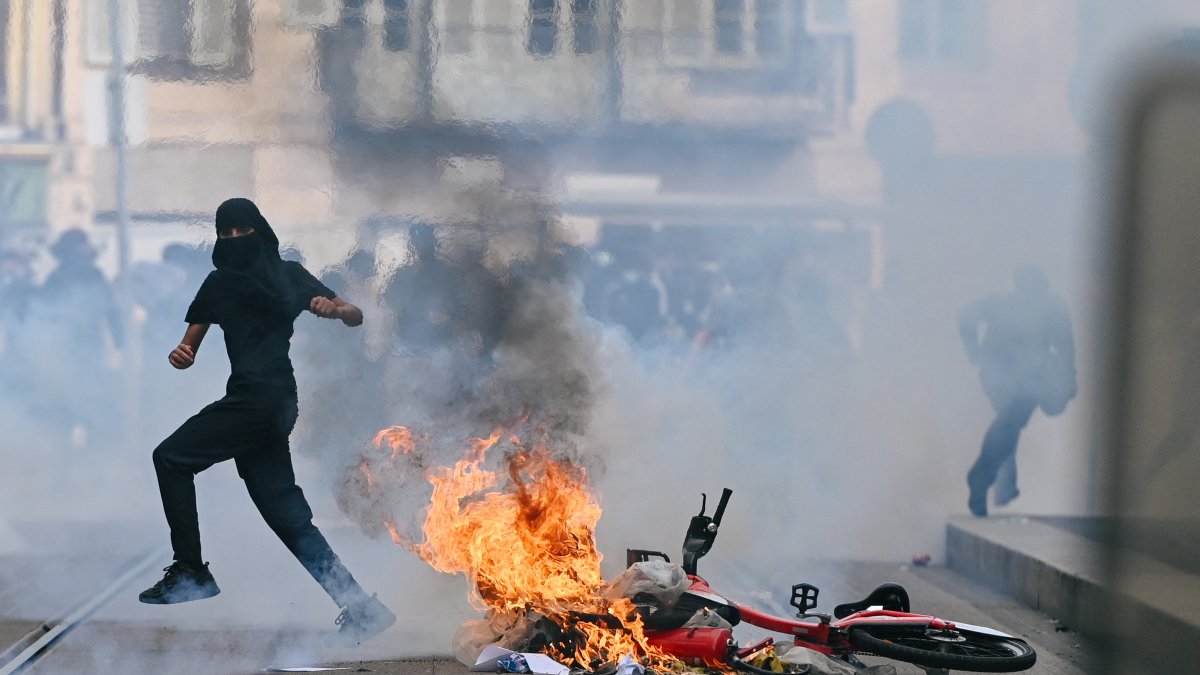
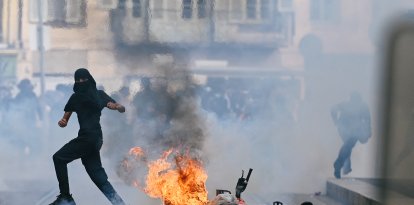
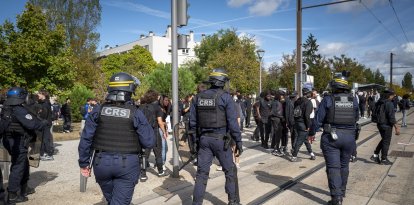
A protester in Clermont-Ferrand, France

More than 560 French high schools woke up this Friday to suspended or severely disrupted classes. Seniors set fires in front of the entrances to some schools and clashed with police in a wave of protests that, far from subsiding, has spread from the Paris region to the entire country.
The movement began last week in Île-de-France and quickly gained national momentum. It has led to roadblocks, property damage and an escalation of tension that the government is now describing as "urban violence."
On Thursday, Marine Le Pen, the National Rally (R.N.) candidate and frontrunner in the 2027 presidential election, wrote on X that Jean-Luc Mélenchon, leader of La France Insoumise (LFI), bears "significant responsibility" for the violence. She accused him of going in person to high schools to rouse students, calling on his supporters to rise up and sending his lawmakers to the schools. The government also accuses Mélenchon's party of being behind the blockades at high schools.
World
Macron Government's Fiscal Adjustment Triggers a Wave of Mass Protests in France
VozMedia Staff
Student complaints
According to AFP, students are complaining that their school days are "excessively long." They are also protesting inadequate physical conditions—including overheated classrooms and a lack of resources—as well as frequent teacher absences.
"For an entire year, we didn't have a science teacher. We don't have textbooks," 15-year-old Simon told AFP outside Turgot High School in central Paris. "And yet we're the lucky ones. In the suburbs, it's even worse."

Injuries and damaged schools
The government acknowledges that the complaints are legitimate but insists that the movement has been hijacked by "ultra-violent groups." Education Minister Edouard Geffray stated on BFMTV that at least 65 members of the educational staff have been injured, including 40 high school principals. Some 170 students have been injured since the protests began.
According to his ministry, more than 100 schools have suffered "severe damage." Many schools, especially in Marseille, have opted to conduct classes remotely to ensure some continuity in education.
World
Pope Leo XIV warns against excesses of science, AI, surrogacy and euthanasia in France
Carlos Dominguez
Arrests and political tension
The police response has been forceful, involving tear gas, charges and mass arrests. In Paris, firefighters extinguished fires at the entrances of two high schools—Leonard de Vinci, in the south, and Gaston-Bachelard, in the southeast—as observed by an AFP photographer.
According to Franceinfo, Justice Minister Gérald Darmanin explained that, since the start of the movement, around 2,000 people have been taken to police stations, "90% of whom are minors." On RTL he announced that he has asked prosecutors to hold parents accountable for the damage caused by their children during the protests and to "pay for the damages."
Geffray urged families to "clearly tell their children not to go" to the demonstrations because "they are in danger."
LFI's shadow over the protests
LFI spokesperson Manuel Bompard rejected these accusations and condemned the government for "resorting to conspiracy theories." Meanwhile, tensions remain high in cities such as Rennes, Brest and Marseille, where hooded students and police cordons are mapping out a conflict that places the state of public education and the limits of youth protest at the center of the French debate.
The pattern is familiar. Genuine discontent among young people is being exploited to push a narrative of confrontation against the state. Le Monde, in an analysis on Monday, had already warned that "the government accuses LFI of exploiting the protests, while Jean-Luc Mélenchon denounces 'irresponsible repression.'" The strategy is classic. Chaos is created, the police are blamed, and the party presents itself as the defender of young people—all with an eye toward the presidential election, in which Mélenchon is once again seeking the Élysée.
LATEST