Toasts, a Meatless Menu and A-List Guests: Inside Trump's State Dinner for Xi Jinping
Among the attendees was a heavy contingent from the tech sector, including Jeff Bezos, Elon Musk, Sam Altman, Tim Cook, Sundar Pichai, Satya Nadella, Mark Zuckerberg, and Jensen Huang, alongside bank and investment fund executives such as Jamie Dimon, Larry Fink, and Stephen Schwarzman. Supreme Court Justices John Roberts, Amy Coney Barrett, and Brett Kavanaugh were there too, along with several cabinet members and the Trump family.
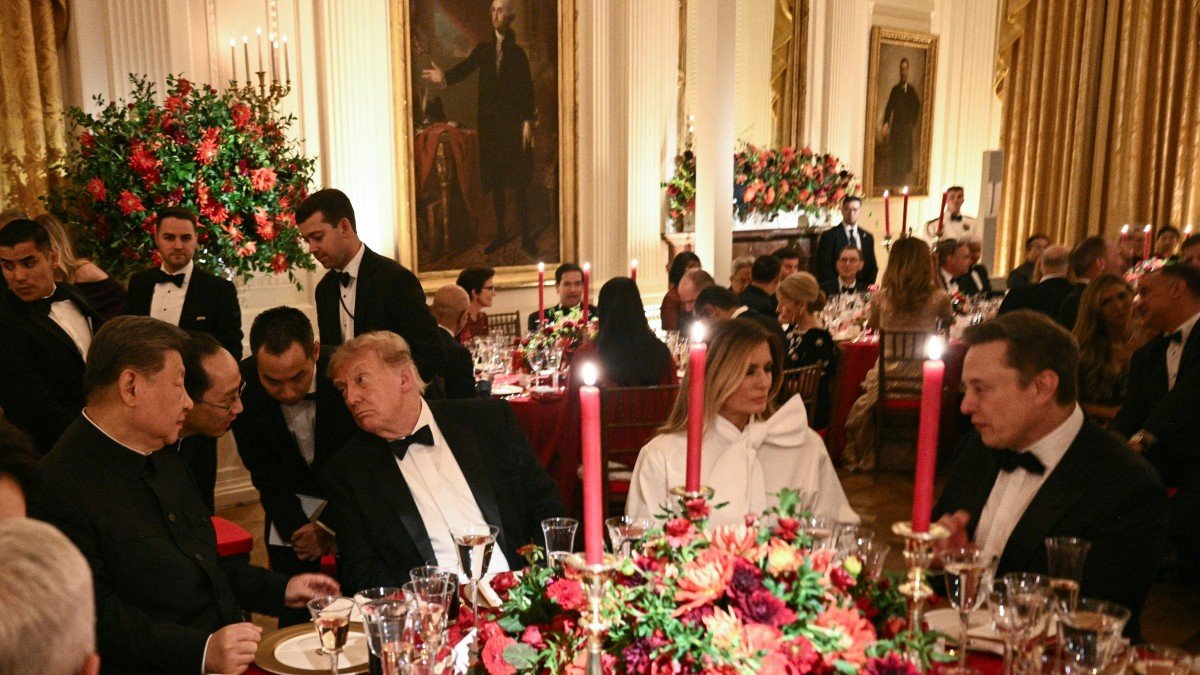
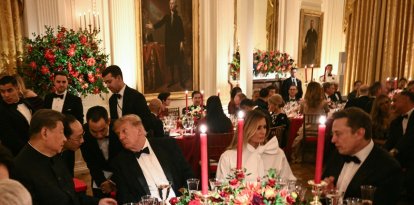
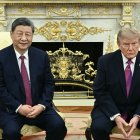
Xi Jinping (L) and Donald Trump speak during the State Dinner

The White House hosted a state dinner on Thursday in honor of the Chinese leader, Xi Jinping,—a format that President Donald Trump reserves for very few occasions and leaders of great stature. As a result, the East Room was filled with red tablecloths and flowers to welcome more than 130 distinguished guests at an event that took place amid the trade, technology, and global influence dispute between the world's two greatest superpowers.
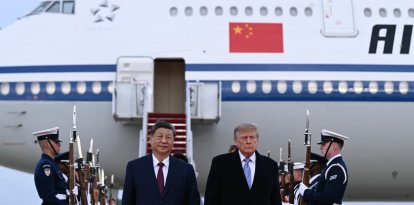
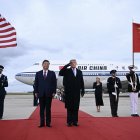
Xi and his wife, Peng Liyuan, arrived at the White House main entrance, where Trump and First Lady Melania Trump personally came out to greet them. Journalists in attendance shouted questions at both of them, but neither responded. Media coverage of the event, incidentally, was limited because the major television networks did not broadcast video footage, as the White House press pool remains suspended sincethe Trump administration revoked CNN's customary spot in presidential coverage. Journalists from MS NOW and CNN reported earlier that they were prevented from covering the arrival of dinner guests.
Among the attendees was a strong presence from the tech sector, including Jeff Bezos, Elon Musk, Sam Altman, Tim Cook, Sundar Pichai, Satya Nadella, Mark Zuckerberg, and Jensen Huang, along with executives from banks and investment funds such as Jamie Dimon, Larry Fink, and Stephen Schwarzman. Also in attendance were justices from the Supreme Court —Chief Justice John Roberts, Amy Coney Barrett, and Brett Kavanaugh—as well as several members of the Trump administration and the Trump family.
Furthermore, according to the New York Times, at least four of the top campaign donors of the current election cycle were on the guest list, including Jeff Yass, the couple Greg and Anna Brockman, and Miriam Adelson. Musk, considered the fourth-largest donor of the entire cycle, sat next to Melania Trump at the head table, while Tim Cook was seated next to Xi's wife.
It was also notable how the White House described Yass, one of the Republican Party's biggest financial backers, on the official list: simply as "Jeff Yass, TikTok," even though he holds no formal position at that company. His investment firm, Susquehanna International Group, holds a significant stake in TikTok and played a key role in the campaign that convinced Trump not to ban the app in the United States.
A red-meat-free menu, an American classic
Contrary to Trump's reputation for fast-food preferences—his most famous order at McDonald's includes Big Macs, Filet-O-Fish, and a large chocolate milkshake—the dinner menu was exclusively pescatarian, as revealed by Fox News citing a menu shared by Melania Trump's office. The first course was a yellow squash velouté with a fricassee of wild mushrooms, crispy pancetta, and chive oil. For the main course, sesame-crusted sea bass was served, accompanied by braised bok choy, roasted eggplant, and a French herb sauce. Dessert featured a vanilla crémeux, sour cherry jam, walnut frangipane, and ice cream made with honey from the beehives Melania Trump installed this year in the White House South Garden.
Speeches with Historical References and an Absence of Contentious Issues
Trump opened his remarks by telling the Chinese delegation, "You are truly outstanding, amazing people," and recalled the arrival of the first Chinese delegation to the United States 158 years ago. He then invited Xi and his entourage to tour the construction site of his new ballroom, which he said would have room for more than 1,000 people standing—far exceeding the roughly 145 who fit in the East Room that evening. He joked that the space was still "nice and clean and sparkly," adding that he wished it had been finished in time for the dinner. Before taking his seat, he presented Xi with a gift: a large statue of a bald eagle.
Xi, for his part, evoked the "ping-pong diplomacy" of the Nixon era and recalled that George Washington collected Chinese porcelain, drawing on the historic 1972 rapprochement between the two countries. He also invoked the alliance China and the United States maintained against Japan during World War II, describing it as a friendship "forged in blood and fire." He likened his own project of "great national rejuvenation" to Trump's push to "make America great again," saying "these two goals are both ambitious and can surely be mutually reinforcing." Xi said the two leaders had held "sincere and in-depth exchanges, and reached common understanding on many issues," and closed with a toast "to the health of President and Mrs. Trump, to the prosperity and progress of China and the United States, and to the friendship between our two peoples." Neither speech addressed the most contentious issues between the two powers, such as the development of China's nuclear arsenal, the dispute over Taiwan, the South China Sea, or competition in artificial intelligence.
LATEST