ANALYSIS
More euthanasia deaths in Canada than gun homicides in US: What the data says and why the debate matters
This figure makes Canada the country with the highest absolute number of euthanasia cases in the world and the second-highest per capita rate, trailing only the Netherlands, while controversy over cases of questionable or non-existent consent fuels opposition from pro-life, conservative and disability rights groups.
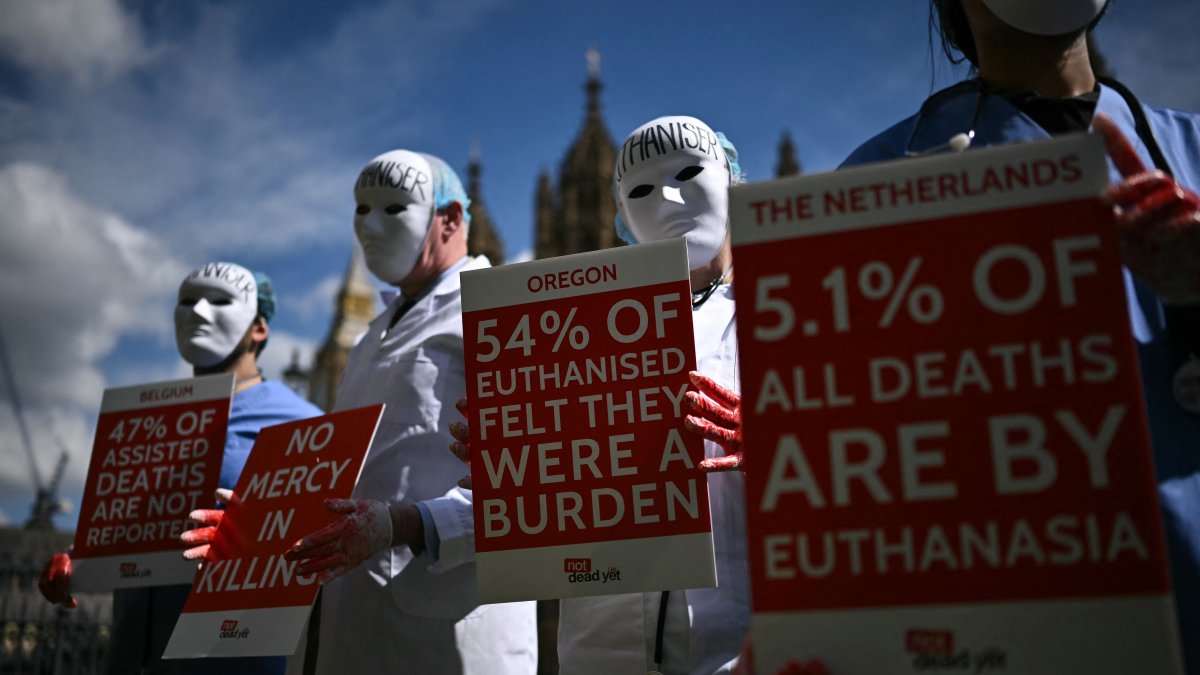
Disability rights activists in London

In 2024, Canada's healthcare system carried out 16,499 euthanasia deaths under its Medical Assistance in Dying (MAiD) program, 1,135 more than the 15,364 homicides committed with firearms in the United States during the same year, according to official data from Health Canada and the Centers for Disease Control and Prevention (CDC).
This figure makes Canada the country with the highest absolute number of euthanasia cases in the world and the second highest per capita rate, trailing only the Netherlands, while controversy over cases of questionable or non-existent consent fuels opposition from pro-life, conservative and disability rights groups.

World
Euthanasia: An elderly Canadian woman receives a lethal injection against her will
Carlos Dominguez
What the numbers say
- Canada: 16,499 people died via MAiD in 2024, a 6.9% increase from 2023, representing 5.1% of all deaths in the country (more than one in every 20 deaths).
- U.S.: 15,364 people died from firearm homicides in 2024, according to the CDC, amid a 16% year-over-year decline in that category.
A painful comparison: Medical death vs. Criminal death
The equation is statistically correct and morally uncomfortable. In Canada, the state administers more deaths by lethal injection than criminals cause with handguns and rifles in the U.S. For pro-life advocates and critics of euthanasia, this is not a public health achievement, but proof that "state-sanctioned death" has become so normalized that it now exceeds criminal violence in volume in the world's leading superpower.
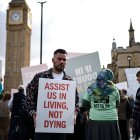
While Canadian politicians downplay problematic cases as "exceptions," the recurring accounts of elderly, disabled or vulnerable people who claim to have been pressured or to have not given explicit consent suggest a structural pattern.
Systemic errors and lack of accountability
Beyond individual cases, official data and government leaks reveal a system with high error rates and little oversight. In British Columbia, 51.9% of MAiD cases in 2024 required follow-up due to incidents, including 2,807 errors and 353 cases so problematic that staff had to receive additional training. In 2023, the same province recorded 2,833 errors out of 3,808 cases, but in seven years there is no record of public disciplinary actions or referrals to law enforcement, except for two cases that did not result in charges.
Health Canada acknowledged in its sixth annual report that consent must be "voluntary and not made as a result of external pressure," but evaluators are only required to explain how they formed that opinion, without systematic independent audits. Critics argue that this turns consent into a bureaucratic formality rather than a genuine safeguard.

Society
Cardinal Cupich and two orders of nuns sue Illinois days before a law on assisted death takes effect
Carlos Dominguez
Track 2: Euthanasia without a foreseeable death
MAiD Track 2, which allows euthanasia when death is not reasonably foreseeable, remains in effect. In 2024, according to Health Canada, 732 people died through this route (4.4% of the total), all of whom had serious illnesses or non-terminal disabilities.
Reports from the Ontario coroner have described cases in which isolation, homelessness, poverty or mental health issues coincided with the request, sometimes without equivalent social supports being offered. Mental illness as the sole condition remains excluded until March 2027.

A model nobody wants to import
The comparison with firearm homicides in the U.S. has been used by Republican senators such as Ted Cruz and Mike Lee to block any expansion of assisted suicide in the United States, describing the Canadian model as "evil" and "state-led horrors." In Europe, countries with advanced euthanasia laws are watching Canada's trajectory with caution, while in Latin America, pro-life lawmakers cite these cases to demand moratoriums or referendums before passing similar laws.
The most recent and high-profile case is that of Brigitte Stegemann, an 83-year-old Christian grandmother who died in July at a care home in Ontario under MAiD, according to her family, without having given explicit verbal consent. Days before the procedure, Stegemann appeared distressed and said she had "made a mistake" in agreeing to an eligibility assessment for MAiD, following a private conversation with Dr. Kate Koester that the family describes as biased and lacking guarantees of genuine voluntariness.
Society
Canada: Bereaved parents demand change after their son was euthanized under controversial law
Carlos Dominguez
LATEST