Donald Trump orders a reduction in military exercises with South Korea and reveals that Seoul refused to support Iran's denuclearization
Faced with the logistical impossibility of canceling the deployment at the last minute, he instructed Defense Secretary Pete Hegseth to scale it back substantially.
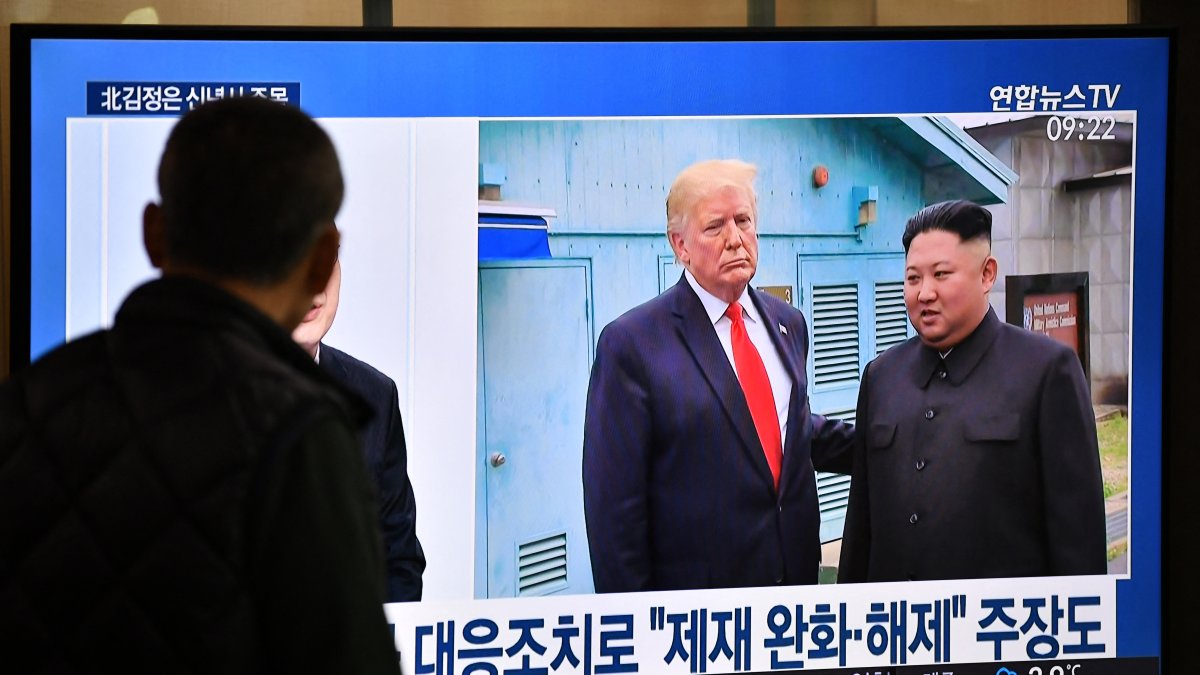
A man watches the meeting between Donald Trump and Kim Jong Un on television on January 1, 2020.

President Donald Trump ordered the Department of Defense on Sunday to substantially scale back the upcoming joint military exercises with South Korea.
The president justified the measure by citing the need to curb excessive public spending borne by U.S. taxpayers, adding that such deployments send unnecessarily hostile signals to Pyongyang.
In a Truth Social post, the U.S. leader questioned the defense agreements inherited from previous administrations and called for more responsible fiscal management of troop deployments abroad.
"Based on my very good relationship with Kim Jong Un of North Korea, I am not happy with the fact that the United States agreed, a long time ago, to participate in joint military exercises with South Korea," the president stated.
"These exercises are not only costly, and most of these costs are paid for by the United States of America (as usual!), but they send a signal that is totally inappropriate and hostile toward a country that, while Donald J. Trump has been president, has not threatened and has been respectful," the president added.
Faced with the logistical impossibility of canceling the deployment at the last minute, he instructed Defense Secretary Pete Hegseth to scale it back substantially.
Seoul's distancing from the global geopolitical agenda
In addition to the economic impact of naval and ground operations in the Pacific, the U.S. president revealed underlying diplomatic tensions with the South Korean government regarding the containment of other global threats, such as Tehran's nuclear program.
Trump made public that he had formally requested the South Korean president's support to join forces with Washington in neutralizing the Iranian regime's nuclear ambitions, receiving an evasive response from Seoul authorities.
"I recently asked the South Korean president if they would like to join us in the denuclearization of the Islamic Republic of Iran, and they said: 'No, thank you!'" the president revealed in the same post.
The presidential decision reaffirms the doctrine of prioritizing fiscal sovereignty, demands that historical allies share a real burden of defense costs, and maintains pragmatic bilateral communication channels to ensure regional stability without compromising the nation's resources.
Updates
CENTCOM commander inspects crew of USS Abraham Lincoln amid offensive against Iran
Andrés Ignacio Henríquez

Just The News
Trump Bump: Tax refunds jumped 17% after president’s signature law, GAO reports
Just The News
Politics
Donald Trump endorses conservative District Attorney Saritha Komatireddy to defeat Letitia James
Andrés Ignacio Henríquez
LATEST