Search for the last signs of life in the Venezuela earthquake zone
This Friday, the ninth day after the devastating earthquakes that killed nearly 2,600 people and left tens of thousands injured across the country, will be the last day of the search for survivors, according to some rescue workers.
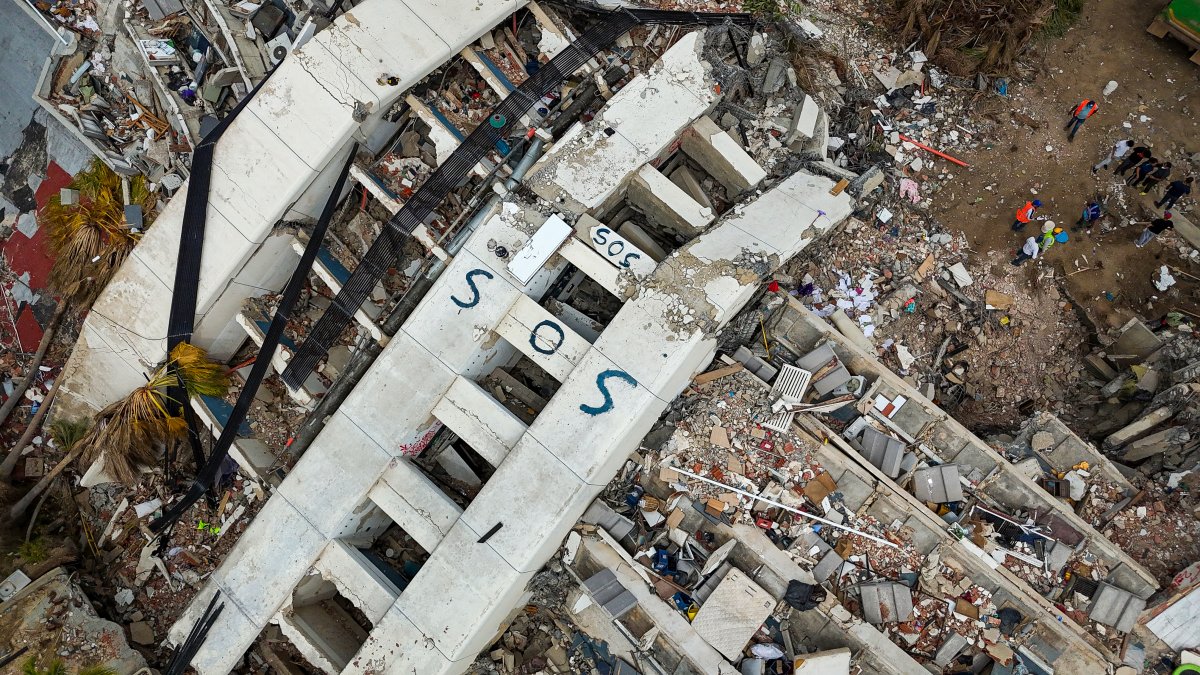
Image of a building collapsed by the earthquakes

In the Venezuelan resort town of La Guaira, a group of rescue workers watched as the sensors that had previously detected signs of life beneath the rubble now showed nothing, while silence gave way to resignation.
This Friday, the ninth day after the devastating earthquakes that killed nearly 2,600 people and left tens of thousands injured across the country, will be the last day of the search for survivors, according to some rescue workers.
After 30 hours of grueling, unsuccessful work, the operation was called off. There was nothing more that could be done.
The chances of finding life among the rubble are highest in the first 72 hours and decrease as time passes, with temperature being a crucial factor.
The human body can survive up to seven days without water, according to a rescuer.
Just a few hours earlier, another rescue team rescued a 43-year-old man in the coastal area of Catia La Mar, who had survived eight days under the rubble; his rescue, in which he was dug out from beneath a collapsed seven-story building, was considered a miracle.
World
Delcy Rodríguez's intelligence officers threaten US reporter with arrest, demand he stop filming
Emmanuel Alejandro Rondón
Rescuers provided him with more than ten liters of water to keep him hydrated via a hose and fitted him with a tube to supply him with oxygen.
But in the sweltering heat of La Guaira, the team’s final assessment found no signs of life.
Venezuela has received a large amount of international aid, with teams from 27 countries.
A Mexican rescuer working in La Guaira said his team could detect signs of life in another building, but they had not been able to establish contact, since after digging through the rubble they found nothing.
They asked for silence. Police ordered drivers traveling on the destroyed highway to turn off their engines.
"We're rescuers—make some noise!" shouted one of them, hoping to hear survivors.
Nearby, a U.S. rescue team deployed search dogs and activated a highly sensitive sensor to detect sounds. Still, nothing.
"There’s no support"
Marina Castillo waited for help to recover the body of her grandson, Alexandro de Guidice, a 24-year-old law student.
“It’s been horrible—there’s no support at all,” said Castillo, 67, echoing a common complaint among Venezuelans who denounce the government’s inaction.
“We went to his apartment and saw all his law books, his files. It’s terrible,” said Castillo.
"What I want right now is for them to bring him back."
According to official figures, nearly 200 buildings were completely destroyed in the earthquakes that struck La Guaira and the nearby Venezuelan capital, Caracas.
A preliminary analysis of satellite data indicated that the number could be much higher.
Neighbors, family members, and volunteers quickly rushed to help with picks and shovels, but their efforts were often not enough.
“Help, my dead mother is here,” wrote Mirosnel Gordon in black paint on the green facade of a house.
The family placed lime on the body to slow the decomposition process while they waited for help.
"We’ll get them out of here, dead or alive"
When people begged him for help, he urged them to stay calm and said: “You can’t just go in there and jump in.”
But desperation was widespread.
On the outskirts of the complex where Joan Manuel Lucena’s mother-in-law disappeared, rescuers found no signs of life.
“We’re not going anywhere,” said Lucena. “We’ll get them out of here, dead or alive,” he added.
LATEST