Venezuelan opposition leader Juan Pablo Guanipa was reportedly abducted again by an armed group shortly after his release from prison
"We denounce that a group of armed individuals intercepted and kidnapped Juan Pablo Guanipa just minutes ago. It was a group of approximately 10 unidentified individuals," stated a post on the politician's X account.
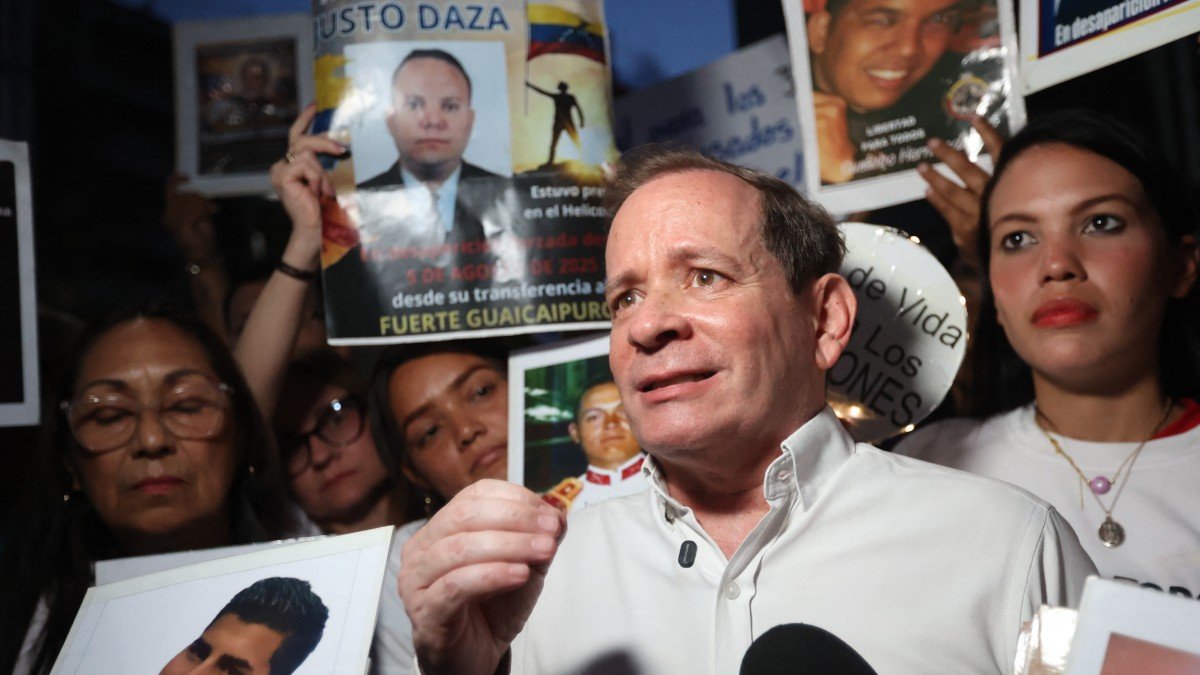
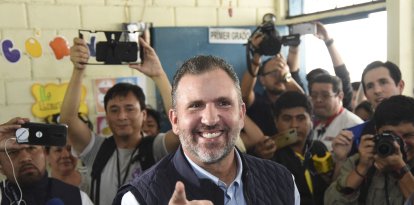
Juan Pablo Guanipa speaks to the media after his release from Helicoide prison

On Sunday, Venezuela witnessed another round of political prisoner releases. The civil organization Foro Penal confirmed at least 30 individuals were freed, including opposition leader Juan Pablo Guanipa. However, just hours after regaining his freedom, Guanipa was reportedly abducted again by "a group of armed individuals," according to a statement on his X account.
"We denounce that a group of armed individuals intercepted and kidnapped Juan Pablo Guanipa minutes ago. It was a group of approximately 10 unidentified people. We managed to identify a silver Corolla, a white Range Rover, and a Renault Symbol. We demand immediate proof of life and his release," his family confirmed.
Denunciamos que un grupo de personas armadas interceptaron y secuestraron a Juan Pablo Guanipa hace minutos.
— Juan Pablo Guanipa (@JuanPGuanipa) February 9, 2026
Era un grupo de aproximadamente 10 personas no identificadas.
Logramos identificar un Corolla plateado, un Range Rover blanca y un Renault Simbol.
Exigimos FE DE VIDA…
Guanipa, a close collaborator of opposition leader and Nobel Peace Prize laureate María Corina Machado, and a staunch critic of the chavista regime, was released as part of a broader process of political prisoner releases initiated by Delcy Rodríguez's regime in early January, amid growing domestic and international pressure to free those considered detained for political reasons.
However, his re-abduction raises serious doubts about the effectiveness and credibility of this release agenda, which has been supported by Washington as part of the transition process, and once again brings into question the real security guarantees for opposition figures released from the regime's prisons.
Confirmation of Guanipa’s release and subsequent abduction
In the same statement, he called for the immediate, full, and unconditional release of all political prisoners, noting that “there are still hundreds of Venezuelans imprisoned for political reasons.”
Later, it was Ramón himself who confirmed the new abduction of his father.
Opposition leader María Corina Machado alerted the international community about Guanipa’s kidnapping: "A few minutes ago, Juan Pablo Guanipa was kidnapped in the Los Chorros neighborhood of Caracas. Heavily armed men, dressed in civilian clothing, arrived in four vehicles and violently took him away. We demand his immediate release."

World
Chavista National Assembly approves in first discussion the amnesty law for political prisoners in Venezuela
Luis Francisco Orozco
An ongoing process of releases
Guanipa's release is part of series that began in early January, when Venezuelan regime authorities announced the release of political detainees. Civil organizations that are monitoring the situation, such as Foro Penal and Plataforma Unitaria Democrática (PUD), have been verifying these cases and updating figures.
Foro Penal reported that as of Sunday, Feb. 8, at least 30 additional releases had been verified, which are added to the general count of releases initiated in January. Among those released are opposition members Perkins Rocha, Jesus Armas and Luis Tarbay, among others.
The PUD has noted that since Jan. 8 at least 391 political prisoners have been released, although it has warned that the pace of releases has been uneven and that hundreds of people still remain detained for political reasons.
However, Foro Penal has warned that in Venezuela, more than 600 people remain in prison for political reasons.
Amnesty law and official rhetoric
The parliament, controlled by the ruling party, has defended the measure as a step to close a chapter of political arrests, although critics have pointed out that the law has not yet produced mass releases nor has it been implemented in a transparent manner.
President-elect's statement
Venezuelan president-elect Edmundo González welcomed the releases, but stated that they do not represent full freedom. He pointed out that personal freedom is not a concession or an exceptional measure, but a fundamental right.
He warned that as long as the cases remain open and restrictive measures, threats and surveillance persist, the persecution will continue. For this reason, he reiterated his demand for full and immediate freedom for all people imprisoned for political reasons and the definitive closure of the arbitrary processes.
LATEST