This is the Democrats' plan to regulate AI through Congress: more power to the states and controls on data centers
With a majority in both chambers since January, the Democrats are focusing on the security of the models and the chips being shipped to China, but Trump's veto forces them to seek Republican votes.
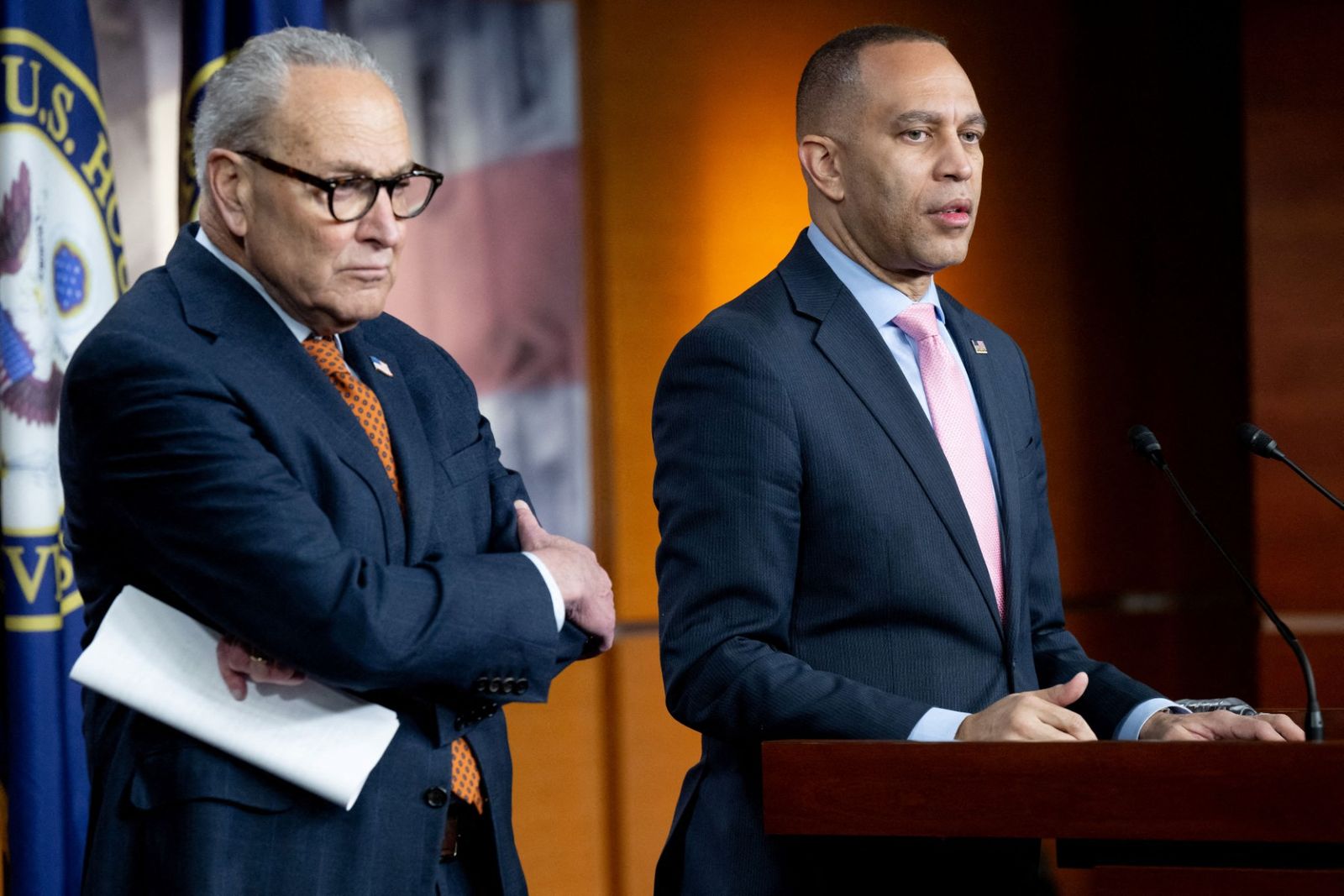
Chuck Schumer and Hakeem Jeffries in a file photo

Democrats are preparing to make artificial intelligence into one of the priorities of their new majority in Congress, after sweeping the midterm elections. The agenda that is beginning to take shape aims to preserve states' ability to legislate, tighten oversight of data centers, require safety tests for new models and curb the sale of advanced chips to China. All of this faces an obstacle in the White House, where President Donald Trump has promised to veto any bills passing through Congress that run counter to the priorities of his own agenda, including the development of superintelligence.
The outlines of this approach emerge from recent media reports, including articles published in the Wall Street Journal, POLITICO and The New York Times, as well as a letter that Democrats on the House Foreign Affairs Committee sent to Commerce Secretary Howard Lutnick, demanding answers regarding the Trump administration's policy on advanced artificial intelligence chips.

Tech & Science
Hispanics are driving the adoption of artificial intelligence in the country
Williams Perdomo
Timing is critical in this whole matter. The majorities secured in the midterms will not take office until Jan. 3, 2027, with the start of the new Congress. Even then, any AI legislation that Trump decides to veto will require a two-thirds majority in both chambers to survive — a threshold that forces Democrats to secure support from dissenting Republicans, a task that looks, to say the least, complex.
The first front is at the state level. Throughout the year, Trump pressured Congress to establish a single federal standard that would override state laws on AI and signed an executive order to combat local regulations he considers excessive. Democrats resisted those attempts, and with a divided government, the private sector expects regulation to continue moving forward state by state rather than from Washington.
Doug Gilbert, chief information officer at the technology services firm Sutherland, told the WSJ that, by ensuring the integrity of elections, Democrats have ruled out any possibility of a federal cap on regulation in the short term. "State laws — California, Colorado, New York, Texas — are the operating standard, not a placeholder," he said.
This approach has its critics within the industry itself. Matt Calkins, CEO of Appian, warned that a patchwork of state regulations could lead to inconsistencies across the country and that issues such as model alignment or intellectual property should be resolved at the federal level.
The other front: data centers
Voters' unease over the expansion of these facilities — which consume enormous amounts of energy and water — played a role in last week's Democratic victory, according to POLITICO, and, according to the WSJ, lawmakers from the party are beginning to focus their regulatory proposals precisely on this issue.
Among the options under discussion is the requirement to subject new systems to testing before their public release — an idea that is gaining traction among Democratic presidential hopefuls for 2028.
Four of them — Illinois Governor JB Pritzker; former Chicago Mayor Rahm Emanuel; Senator Cory Booker of New Jersey; and Representative Ro Khanna of California — took part over the weekend in San Francisco in a meeting with AI safety researchers and activists, organized by Who Decides, the group led by New York State Assemblyman Alex Bores, author of one of the most ambitious state laws on the subject.
"I think the AI safety risk is an existential risk," Khanna said during the meeting, in which he also criticized the technical jargon the industry uses to keep the debate out of the public eye.
Booker even called on Congress to act sooner: "For Congress to do nothing is inviting exponentially more harm than the last wave of technology did," said the senator, who called for a special session to address the issue. Emanuel, for his part, told attendees that he couldn't ask people not to panic and that citizens expect the government and industry to be held accountable.

Democrats against Lutnick
The fourth pillar focuses on national security. Democrats Gabe Amo, Gregory W. Meeks and Sydney Kamlager-Dove demanded explanations from Lutnick regarding the Department of Commerce's decision to authorize exports of advanced AI chips, including licenses for Chinese companies with ties to the Beijing government, military contractors and sanctioned firms, according to the NYT.
"National security must come before corporate sales targets," they wrote in the letter.
The complaint comes amid the scandal rocking Nvidia, whose board of directors has launched an investigation into the relationship between its CEO, Jensen Huang, with Alice Huang, a former executive at Megaspeed. According to sources familiar with the intelligence cited by the NYT, the woman worked for China's Ministry of State Security. Huang acknowledged the romance to his employees and will remain at the helm of the company for the duration of the investigation.
On the business side, the prospect of new regulations is not causing alarm. Several executives interviewed by the WSJ stated that they already have their own internal controls in place and that the models' current capabilities are sufficient for their needs, so a potential slowdown would not alter their plans. Tony Bates, CEO of Genesys, summed up the underlying discussion by asking whether the new regulations will succeed in building trust without stifling innovation.
The Democrats' strategy, however, depends on something the party does not control. At the San Francisco meeting, one of the researchers present warned that the window of opportunity to prevent serious harm could be as short as one or two years, and that this timeframe is not long enough to wait for a unified government. Her conclusion was that any real progress will require cooperation between both parties.
🛠 Do you think there is an error in this article?
Recommendations






LATEST