






Afghan watchdog concludes billions in weapons U.S. left behind form ‘core’ of Taliban military
The U.S. invaded Afghanistan on October 7, 2001, in response to the 9/11 attacks a month earlier. The U.S. presence in Afghanistan then continued under four presidents.
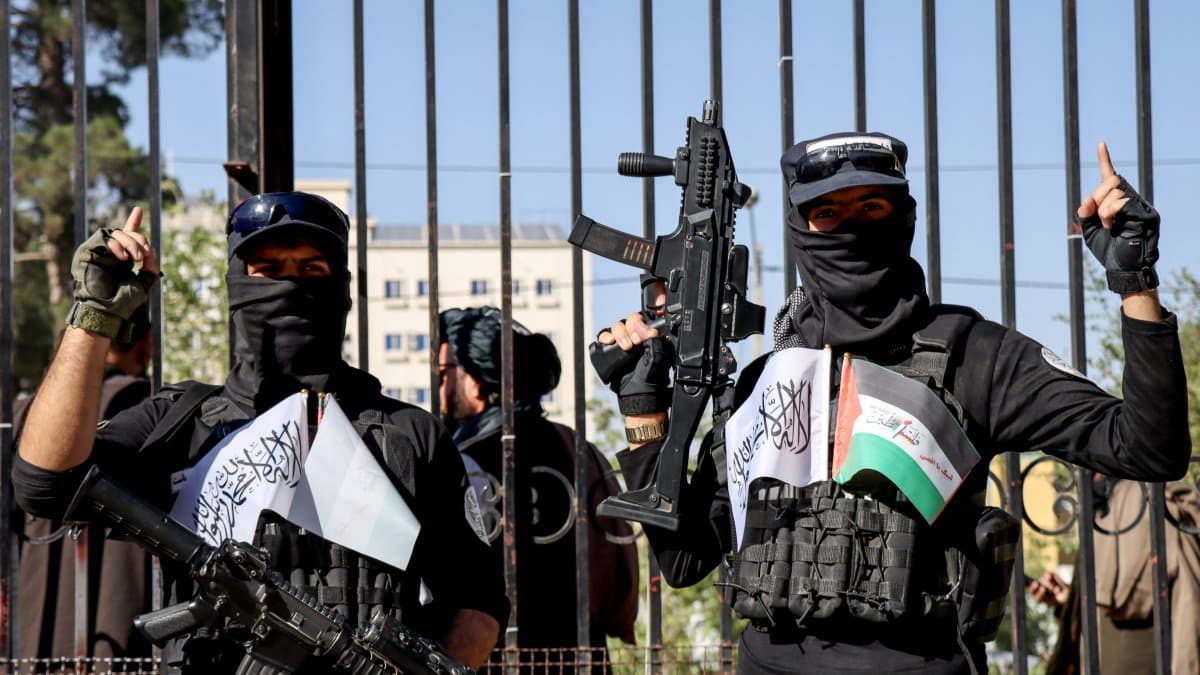

The inspector general responsible for scrutinizing U.S. reconstruction efforts in Afghanistan has detailed the billions of dollars wasted by the U.S. government during the 20-year war in the country and concluded that the arsenal of U.S.-provided military weaponry that was left behind now forms the “core” of the Taliban’s own military machine.
A massive number of U.S.-made and U.S.-supplied weapons and military facilities were left behind in Afghanistan as a result of President Joe Biden’s troop withdrawal announcement in April 2021, which resulted in the dissolution of the Afghan military, a chaotic U.S. evacuation, and a Taliban takeover in August 2021.
The Special Inspector General for Afghan Reconstruction (SIGAR) issued its “final forensic audit report” this week more than four years after the U.S. withdrawal and evacuation from the country, concluding that “these U.S. taxpayer-funded equipment, weapons, and facilities have formed the core of the Taliban security apparatus.” SIGAR said in its final report that it will close its doors at the end of January 2026 as a result of the National Defense Authorization Act for 2025.
The report said that the Pentagon has concluded that the U.S. left behind weaponry worth at least $7.1 billion — weapons now in the hands of the Taliban — and that the U.S. government also continued to send $3.47 billion in humanitarian and development assistance to Afghanistan after the Taliban takeover.
The U.S. invaded Afghanistan on October 7, 2001, in response to the September 11 terror attacks a month earlier. The U.S. presence in Afghanistan continued under four presidents. Though many inspector general reports include a response from those connected to the findings, this one did not.
Acting SIGAR Gene Aloise said in a letter attached to the new report that “despite nearly $90 billion in U.S. appropriations for security-sector assistance, Afghan security forces ultimately collapsed quickly without a sustained U.S. military presence” and that the watchdog office’s work “highlights serious systemic issues with reconstruction and paints a picture of a two-decade long effort fraught with waste.”
“Over two decades, the United States invested billions of dollars and incurred thousands of casualties in a mission that promised to bring stability and democracy to Afghanistan, yet ultimately delivered neither,” the report said. “The rapid collapse of the Afghan government in August 2021 laid bare the fragility that had been concealed by years of confident assertions of progress. The gap between ambition and reality was vast, with deteriorating conditions continually stymying objectives that proved to be unrealistic.”
SIGAR said that it found that “despite 20 years and $90 billion of U.S. support, the U.S. and Afghan governments failed to create an independent and self-sustainable Afghan National Defense and Security Forces." The report found that “the ANDSF remained reliant on the U.S. military in part because the United States designed the ANDSF as a mirror image of U.S. forces, which required a high degree of professional military sophistication and leadership” – creating “long-term ANDSF dependencies” – and “the decision to withdraw all U.S. military personnel and dramatically reduce U.S. support to the ANDSF destroyed the morale of Afghan soldiers and police.”
The collapse of the Afghan forces and the Taliban takeover meant billions of dollars worth of U.S.-provided weapons were now in the hands of the Talibs.
U.S. left behind billions of dollars of military equipment and facilities now used by Taliban security forces
The report also laid out how the majority of the money the U.S. government spent on Afghan reconstruction went to Afghan security services. This meant $88.8 billion for security, $35.9 billion for development and governance, $16.3 billion for agency operations, and $7.1 billion for humanitarian assistance.
The report said that “Congress appropriated nearly $80.7 billion” to the Afghan Security Forces Fund (ASFF) “which comprised nearly 91 percent of all security-related reconstruction appropriations.” The ASFF was designed to provide the ANDSF with “equipment, supplies, services, training, and funding for salaries, as well as facility and infrastructure repair, renovation, and construction.”
The SIGAR report said that, from 2002 onward, the U.S. “obligated $31.2 billion on infrastructure, equipment, and transportation for the ANDSF” and that “of the $31.2 billion, the U.S. spent $19.7 billion to equip and transport the ANDSF.”
The report said this included the purchase of 96,000 ground vehicles, more than 51,000 general purpose or light tactical vehicles, nearly 24,000 High Mobility Multipurpose Wheeled Vehicles, close to 900 armored combat vehicles, more than 427,000 weapons, over 17,000 helmet-worn night vision devices, and a minimum of 162 aircraft.
SIGAR said that Pentagon records from late July 2021 – roughly two weeks before the Taliban seized Kabul – “indicated that the Afghan Air Force had 162 U.S.-provided aircraft in its inventory, of which 131 were usable.”
The report added that “the remaining $11.5 billion of the $31.2 billion spent by the U.S. was devoted to the construction of infrastructure for the ANDSF, including the construction of headquarters, training facilities, and bases or outposts around the country.”
“DoD determined that the United States left behind approximately $7.1 billion in material and equipment it had given to the ANDSF,” SIGAR stated. “Similarly, any remaining ANDSF facilities that were not destroyed, can be assumed to be under Taliban control.”
SIGAR also found that “approximately $57.6 million likely remained in Afghan government-controlled accounts when the Taliban took over in August 2021” and that “it is likely that the Taliban were able to access at least a portion of this money when they took over Afghanistan’s Ministry of Finance.”
U.S. inadvertently armed and equipped its former Taliban adversaries
A Pentagon spokesman said in October 2021 – just a couple of months after the Taliban takeover – that “since 2005, the U.S. military has provided the Afghan national defense and security forces with many thousands of small arms, ranging from pistols to medium machine guns” and that “we recognize that large numbers of these weapons are probably now in Taliban hands.”
The Defense Department inspector general also conducted an investigation into the U.S.-provided weapons that were left behind in Afghanistan and that are now mostly in the hands of the Taliban. The watchdog argued that “the U.S.-funded equipment now under the control of the Taliban had previously been property of the Afghan National Defense and Security Forces.”
The Pentagon inspector general revealed in 2022 that the U.S. military left $7.12 billion worth of U.S.-funded aircraft, vehicles, weapons, munitions, and other equipment in Afghan government inventories at the time of the Taliban takeover. This included Afghan military aircraft “valued at $923.3 million” – although the U.S. military stressed that “some” of these aircraft were “demilitarized and rendered inoperable” during the NEO – as well as aircraft weapons “valued at $294.6 million.” This also included Afghan ground vehicles “valued at $4.12 billion” – including tactical vehicles such as Humvees and Mine-Resistant Ambush Protected vehicles (MRAPs). The U.S. military had transferred 35 MRAPs to the Afghan Ministry of Defense in early 2021.
The Pentagon watchdog found that “Afghan forces had 316,260 weapons, worth $511.8 million, as well as ammunition and other equipment in their stocks when the former government fell.” This included rifles, sniper rifles, pistols, machine guns, rocket-propelled grenade launchers, and howitzers. The Taliban also got its hands on “specialty ground munitions (such as mortar rounds), communications equipment, explosive ordnance detection and disposal equipment, night vision devices, and other surveillance equipment.”
The Pentagon argued at the time that the U.S. military had removed or destroyed nearly all major equipment used by U.S. troops in Afghanistan throughout the drawdown period in 2021.
Former CENTCOM Commander Gen. Frank McKenzie wrote in his memoir that “the thousands of weapons ranging from M4 and M16 rifles to D-30 artillery pieces that were in the hands of the Afghan military … were all lost.” The general said the Taliban also likely gained control of “12,000 high-mobility multi-wheeled vehicles and 21,000 Ford Ranger trucks.” And the general wrote that “37 aircraft that weren’t at HKIA fell into Taliban hands at airbases like Kandahar.” All told, the general said that “our best estimate was that the equipment lost totaled about $18 billion.”
The Taliban claimed to have recovered 40 operational aircraft from the former Afghan government, including two Mi-17 helicopters, two UH-60 Black Hawk helicopters, two MD-530 light helicopters, two Mi-24 helicopter gunships, and one fixed-wing transport aircraft – all of which the Pentagon said have since been observed flying.
SIGAR later revealed that an unclassified Defense Intelligence Agency assessment from March 2022 stated that the Taliban claimed to have repaired seven former Afghan Air Force aircraft, with the DIA indicating that “the Taliban may have obtained a degree of operation and maintenance capability.”
The United Nations sanctions monitoring team said in July 2024 that the Taliban claimed it had 60 aircraft in service, an increase from 40 aircraft in 2023. The UN team said that “there have been at least three operations in which Taliban forces successfully used existing Mi-17 transport helicopters, Mi-24 attack helicopters, and MD-500 light attack helicopters.”
The Pentagon had also provided the Afghan forces with specialty ground munitions such as mortar rounds, communications equipment, explosive ordnance detection and disposal equipment, night vision devices, and other surveillance equipment – equipment in the hands of the Afghan military when it collapsed and the Taliban took over.
The Biden White House had previously downplayed the value of the equipment left behind.
Then-White House press secretary Jen Psaki said at the end of August 2021 that “our objective was not to leave them with any equipment, but that is not always an option when you are looking to retrograde and move out of a war zone.”
Then-Pentagon press secretary John Kirby insisted in November 2021: “We were nothing but clear from the very beginning that we fully expected that property and equipment that we had turned over to the Afghans – it was Afghan national security force equipment, and vehicles, their equipment and vehicles – we were completely transparent about the idea that some of those would probably find their way into Taliban hands, and they have,”
Kirby said the only thing left operable at Kabul airport when the U.S. left at the end of August 2021 was “some airport vehicles like a fire truck, I think a forklift, one of those stair trucks, and some firefighting equipment.”
Latifullah Hakimi, head of the Taliban’s Ranks Clearance Commission, claimed in 2022 that during their takeover of Afghanistan the Taliban had seized over 300,000 small arms, 26,000 heavy weapons, and roughly 61,000 military vehicles.
The Taliban claimed in 2022 that it was working to professionalize its security forces, and the Taliban Ministry of Defense announced that recruitment for 130,000 troops for its new national army had been completed.
Taliban defense spokesman Enayatullah Kharazami said in August 2022 that the Taliban had the ability to increase its military size to 200,000 soldiers if it wanted to, and further recruitment was underway.
The Taliban claimed in March 2024 that it was now in charge of a combined military and police force of over 384,000 forces in Afghanistan. SIGAR said at the time that the State Department couldn’t verify those numbers and that the Pentagon doesn’t track that data.
U.S. wasted more than one hundred billion on Afghan reconstruction efforts
The new SIGAR report stated that, from 2002 through mid-2021, the U.S. government “appropriated approximately $144.7 billion for Afghanistan reconstruction” and that, since its creation in 2009, SIGAR “identified 1,327 instances of waste, fraud, and abuse totaling between $26.0 billion and $29.2 billion.”
The watchdog report said the U.S. government provided more than $144.7 billion for the reconstruction of Afghanistan during the twenty-year war, and that “an additional $763 billion was spent on warfighting.”
“Billions of dollars spent to develop and equip the Afghanistan National Defense and Security Forces, as well as billions of dollars spent to construct civilian infrastructure were lost when the United States withdrew from Afghanistan in August 2021,” SIGAR concluded. “Together, the U.S. obligated at least $38.6 billion equipping and building infrastructure for the ANDSF and constructing civil infrastructure for the benefit of the Afghan people.”
U.S. continued sending billions to Taliban-controlled Afghanistan
The SIGAR report also made it clear that the U.S. continued sending billions of dollars to Afghanistan after August 2021, even though it was now controlled by the Taliban.
“Despite Afghanistan falling to the Taliban in 2021, the United States continued to be the nation’s largest donor, having disbursed more than $3.83 billion in humanitarian and development assistance there since,” the report said. The money continued to flow even through the first quarter of 2025, with disbursements of $120 million.
The watchdog said that “following a review of U.S.-funded foreign assistance programs in the first quarter of fiscal year 2025, the United States terminated all foreign assistance awards in Afghanistan.”
The report said that, during the Biden administration, the UN also continued sending “shipments of U.S. currency to Afghanistan” which had “stabilized the Afghan economy” but also “benefited the Taliban.”
“SIGAR reported on U.S. funds used to pay taxes to the Taliban-controlled government of Afghanistan,” the new report concluded. “SIGAR found that since the fall of the Afghan government in August 2021, at least $10.9 million in U.S. funds were used to pay taxes to the Taliban-controlled government on the $2.8 billion in humanitarian and development assistance delivered to help the people of Afghanistan. While the United States government made exceptions for such types of payments, U.S. agencies inconsistently required its implementing partners to report on taxes paid to the Taliban.”
The “No Tax Dollars For Terrorists Act” — which requires the State Department to “develop and implement a strategy to discourage foreign countries and nongovernmental organizations from providing financial or material support to the Taliban” — passed the House in June and is awaiting action in the Senate.
🛠 Do you think there is an error in this article?
Recommendations

LATEST